Clear Sky Science · en
Determination of the contact patch length in tractor tire–soil interaction
Why tractor tires matter for healthy soil
Every time a tractor crosses a field, its heavy wheels press on the ground. If that pressure is too high, the soil becomes compacted, making it harder for roots to grow, water to soak in, and crops to thrive. This study explores a deceptively simple question with big consequences for food production: how long is the strip of contact where a tractor tire actually touches the soil, and how do tire and soil properties control that contact and the resulting compaction?
The hidden footprint beneath a tractor wheel
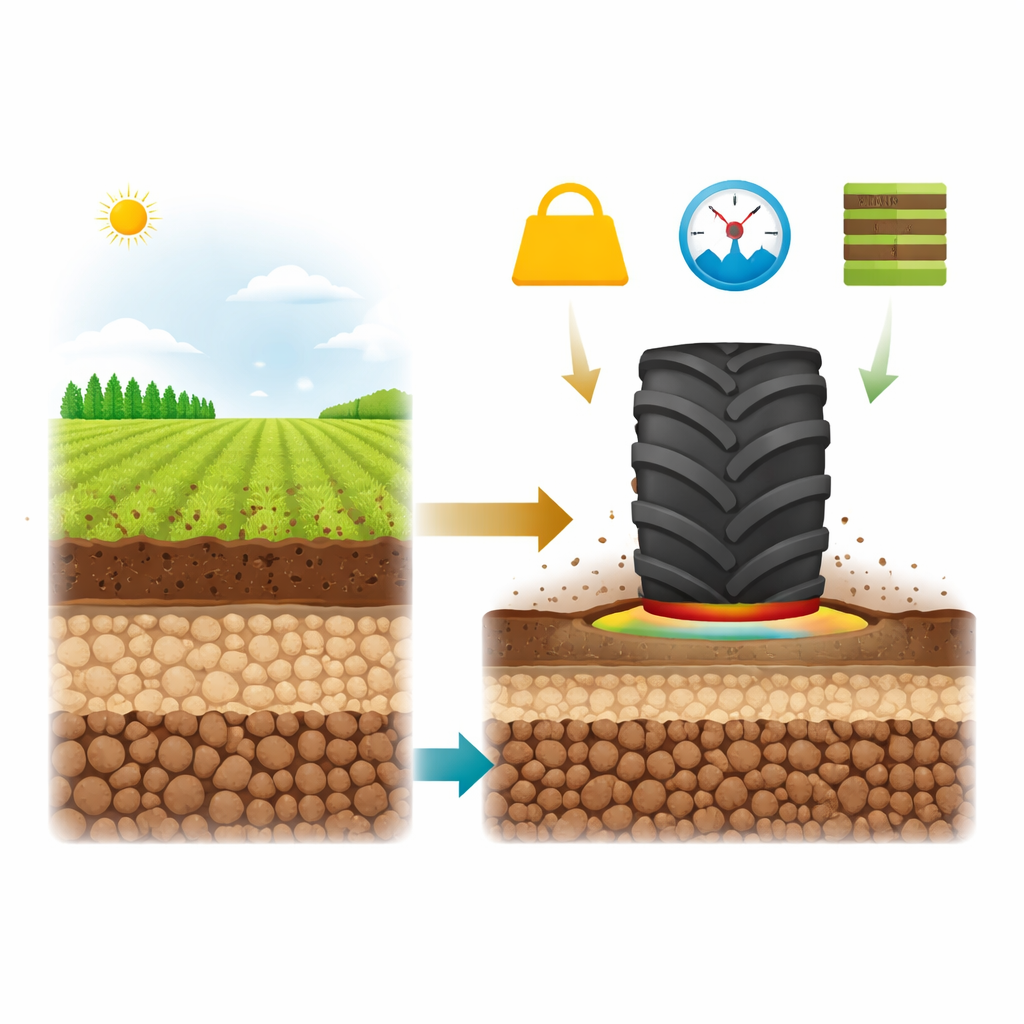
At first glance, a tractor tire leaves a clear track on the surface, but the key factor for soil health is the area of contact between tire and soil below the tread. The authors focus on the length of this contact patch along the direction of travel. For a single wheel, the average pressure on the soil is the wheel load divided by this contact area. The longer and wider the contact patch, the more that load is spread out, and the less the soil is squeezed. Earlier formulas for contact length were either based on idealized shapes, like ellipses, or worked only on hard, non-deforming surfaces, and they often ignored important factors such as tire pressure and soil properties. This paper sets out to build a more realistic model that brings the tire, its inflation, the wheel load, and the soil’s resistance to compression into one unified description.
A new way to calculate the tire–soil handshake
The researchers begin by describing the geometry of a tire pressed into soft ground. They express the total contact length as the sum of a curved section of the tire and two short straight segments where the tire sidewall approaches the soil. Using trigonometry and mechanics, they connect this length to two key deformations: how much the soil is pushed down and how much the tire itself flattens under load. Those deformations, in turn, depend on measurable quantities: the vertical load on the wheel, the tire’s rolling radius and width, the air pressure inside the tire, and a soil parameter that represents how easily its volume can be squeezed (the volumetric compression coefficient). The result is an analytical formula that predicts contact length while explicitly including both machine and soil characteristics.
What happens when you change tire size, pressure, and soil
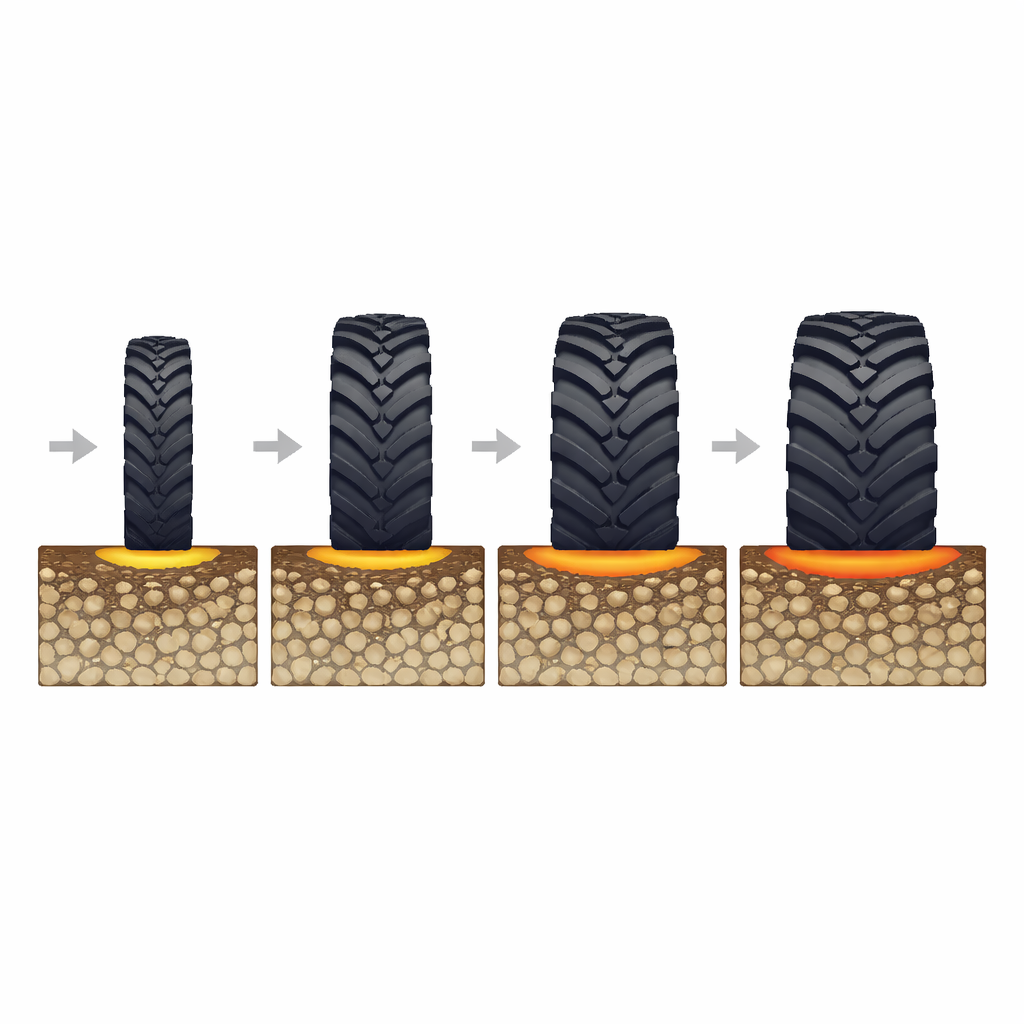
With this model, the team ran numerical experiments for two common Ukrainian tractors and realistic field conditions. They found that increasing the vertical load on a wheel lengthens the contact patch, but not fast enough to offset the extra weight: overall pressure on the soil still rises. A larger wheel radius, by contrast, both lengthens the contact patch and reduces the pressure, making it kinder to the soil. Increasing tire width produces a subtle effect: the contact length shrinks slightly because a wider tire spreads the load across a broader strip, so the soil deforms less deeply. Yet the contact area still grows overall, and average pressure drops. Tire inflation pressure adds another twist. Higher pressure stiffens the tire, reduces its deflection, and ultimately shortens the contact patch even if the rolling radius grows slightly. The net result is a smaller contact area and higher soil pressure. Harder soils, represented by a larger compression coefficient, also shorten the contact length and increase pressure.
Testing tire choices in real fields
To check how these relationships play out in practice, the researchers measured soil density in the wheel tracks of the two tractors working on a loamy field in Ukraine. They compared relatively narrow standard tires with wider ones and with dual-wheel setups, where two tires are mounted side by side. In both tractors, the narrow tires produced the highest soil density in the top 10 centimeters. Switching to wider single tires led to measurable and statistically significant reductions in compaction. Using dual tires, which more than doubled the effective width, cut soil density even further, by around 9–12 percent relative to the narrow tires. The tractor with the higher front-axle load consistently compacted the soil more than the lighter one, reinforcing the model’s prediction that wheel load is a major driver of damage.
Designing tractors that are gentler on the ground
Taken together, the model and field data offer a clear message for farmers, equipment designers, and agronomists. To curb harmful soil compaction, the wheel–soil contact strip should be made as long and as wide as practical, while keeping tire inflation and wheel load as low as operating conditions allow. That means favoring larger-radius and wider tires, dual wheels or tracks where feasible, careful management of ballast and mounted implements, and softer soil structures that are less prone to extreme densification. By understanding and managing the quiet handshake between tire and soil, it becomes possible to protect the living structure of the ground while still getting heavy work done in the field.
Citation: Nadykto, V., Horetska, I., Glowacki, S. et al. Determination of the contact patch length in tractor tire–soil interaction. Sci Rep 16, 8520 (2026). https://doi.org/10.1038/s41598-026-37868-2
Keywords: soil compaction, tractor tires, tire pressure, contact patch, agricultural machinery