Clear Sky Science · en
Research on factors affecting sustainable development in ecologically fragile areas based on a social-ecological system framework
Why fragile countryside matters to us all
Across the world, many rural villages are losing people, jobs, and vitality just as cities surge ahead. This paper looks closely at rural communities in one of China’s poorest and most environmentally delicate provinces, Guizhou, to ask a simple but urgent question: why do some villages manage to survive and adapt, while others fall further behind? The answers matter not only for local farmers but for food security, landscape protection, and social stability far beyond these remote hills.
The village caught between people and nature
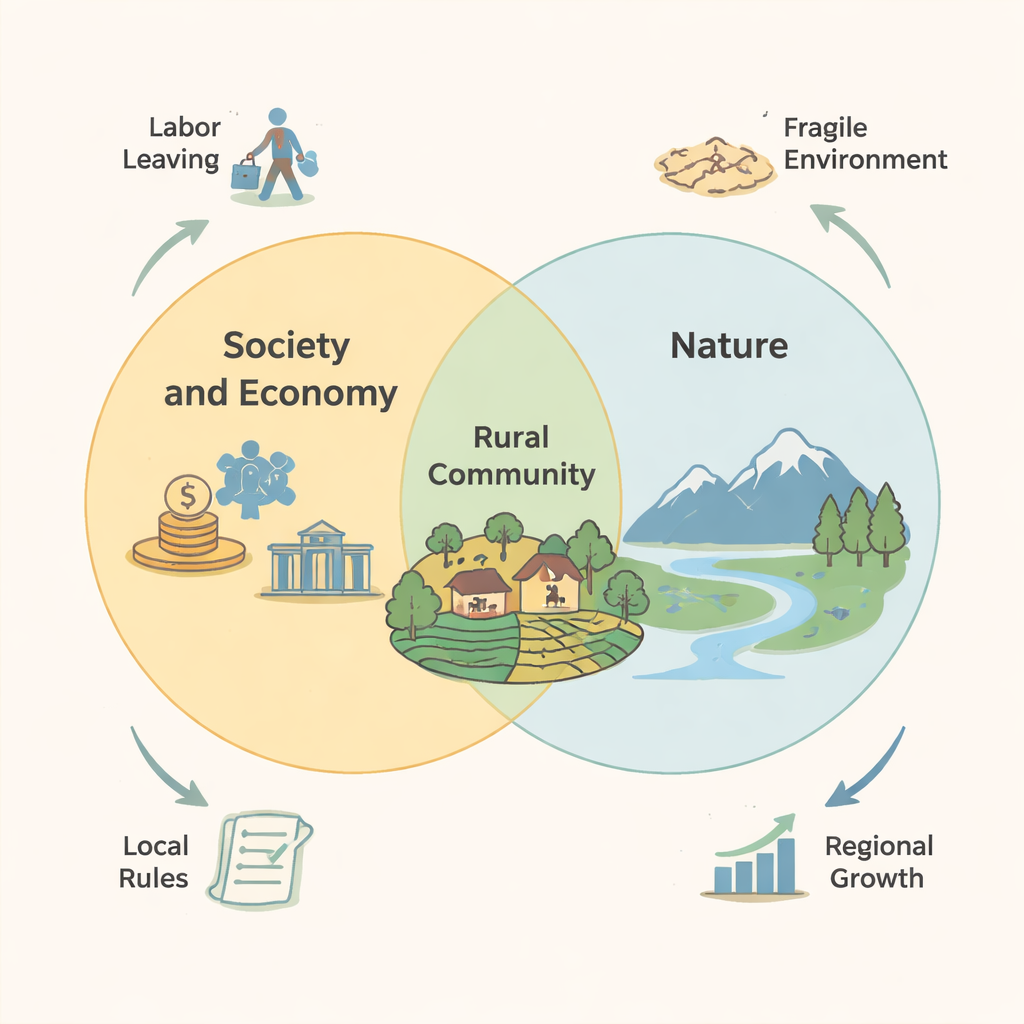
Guizhou’s rural communities sit in steep karst mountains where thin soils, rocky slopes, and a fragile ecology make farming difficult. The authors treat each village as a “social–ecological system,” meaning that land, water, people, institutions, and markets are tightly intertwined. Instead of blaming decline on a single cause, they examine how labor migration, local customs, government rules, ecological stress, and regional economic growth interact to shape whether a village can develop in a lasting way. To do this, they surveyed 227 rural communities across the province and combined these field data with official statistics.
Measuring how strong a village really is
To judge how sustainably a community is developing, the researchers did not look only at income. They built an index that combines four aspects of village life: how well land, money, and other resources are put to use; how active and capable local leaders and organizations are; how well public affairs and services are managed; and how quickly the village economy is growing. Scores across villages varied dramatically, showing a deep divide between relatively resilient communities and those struggling with weak economies and limited public services. Many villages in Guizhou still sit at an early, uncertain stage of development, with high risks to livelihoods and few buffers against shocks.
People leaving, land under pressure, and rules that stall change
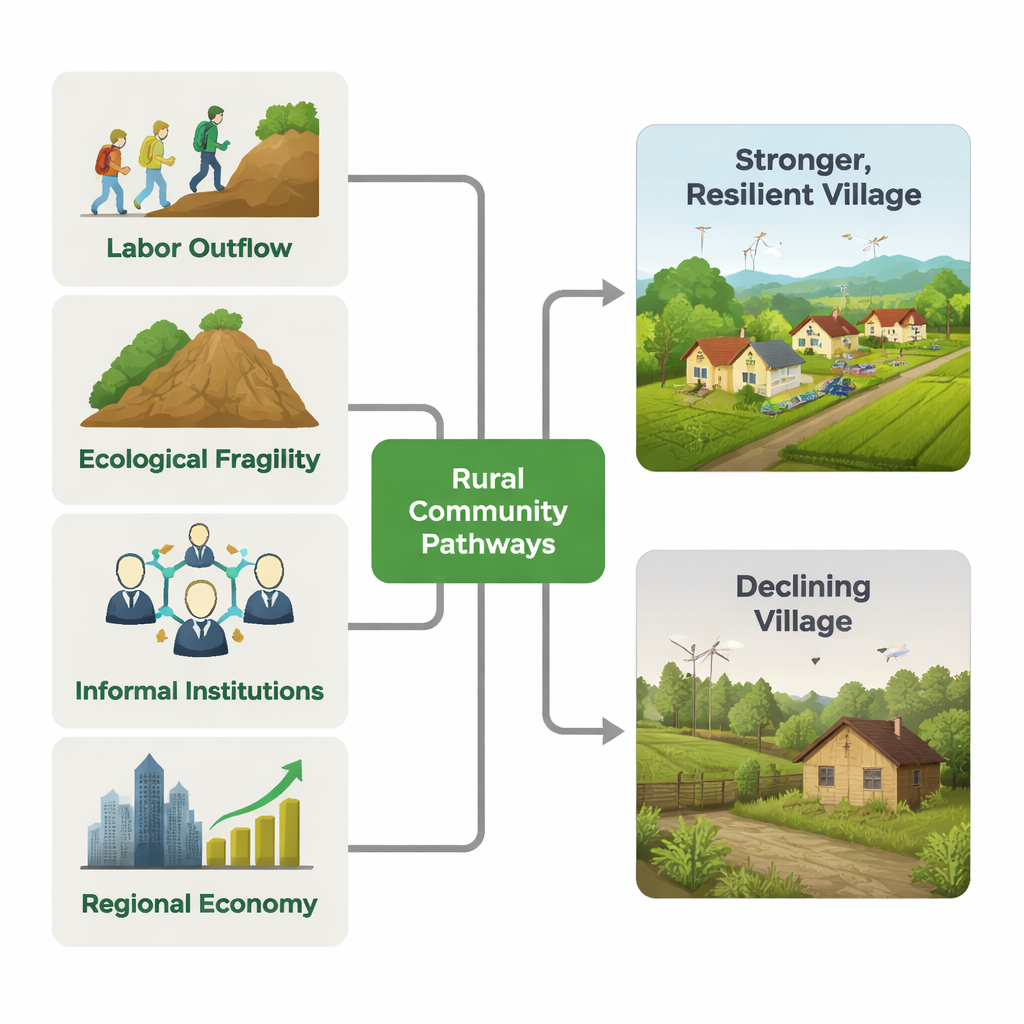
Statistical analyses reveal three powerful forces that hold villages back. First, when a larger share of working-age residents leave to seek jobs elsewhere, the village’s development score drops. Younger, better-educated men are often the first to go, leaving behind older people, women, and children. On steep mountain farms, machines cannot easily replace missing workers, so fields are abandoned, livestock numbers fall, and the social glue that supports cooperation weakens. Second, ecological fragility—in this study reflected by high population pressure on limited land—also drags down village prospects. In places prone to rocky desertification, environmental damage is hard to repair, and small subsidies for conservation rarely make up for the loss of farm income, tempting some households back into ecologically harmful practices.
When the wider economy helps—and when village customs hurt
On the positive side, villages located in counties with stronger economies tend to do better. Growing regional income brings improved roads, water systems, and markets that spill over into surrounding rural areas. Yet location is crucial: these benefits mostly reach communities that are closer to county seats and township centers, which act as bridges between city and countryside. Less accessible villages are largely left out. The study also uncovers a surprising villain: certain informal village institutions, such as powerful clan networks built around a dominant surname. In some communities, these networks slow down reforms that would clarify who owns which plots of land, a change that is needed to attract investment and manage resources fairly. Where such informal forces are strong, land-rights reform advances more slowly, and overall village development suffers.
Different villages, different struggles
The picture becomes even more complex when looking at village size and poverty levels. In smaller communities, both ecological fragility and the boost from regional economic growth have especially strong effects—good or bad. Larger communities, by contrast, are more vulnerable to the downsides of labor outflow and obstructive informal institutions, partly because coordinating many households is harder and free-riding is more common. In communities with relatively low poverty, losing workers to migration is especially damaging, perhaps because they had more potential to grow. In very poor communities, regional economic growth matters more, but ecological stress and unhelpful local customs push back strongly against progress.
What it all means for the future of fragile villages
For a layperson, the core message is straightforward: a village’s fate in fragile environments is not fixed by nature alone. It depends on whether local people can keep enough working hands at home, protect and wisely use their land, benefit from nearby economic growth, and update rules and customs—especially around land rights—so that cooperation beats conflict. The study suggests that policies should be tailored: improving access and public investment for remote communities, creating better local jobs to reduce the need to migrate, aligning ecological protection with real livelihood gains, and reforming village institutions so that traditions support, rather than block, fair and sustainable development. In short, saving fragile villages means strengthening both their people and their landscapes at the same time.
Citation: Yang, D., Zhang, W., Li, C. et al. Research on factors affecting sustainable development in ecologically fragile areas based on a social-ecological system framework. Sci Rep 16, 7294 (2026). https://doi.org/10.1038/s41598-026-37865-5
Keywords: rural sustainability, ecologically fragile areas, social-ecological systems, labor migration, rural China