Clear Sky Science · en
Seismic reflection characteristics and genesis of goafs and underlying coal seams
Why Hidden Cavities Under Coal Mines Matter
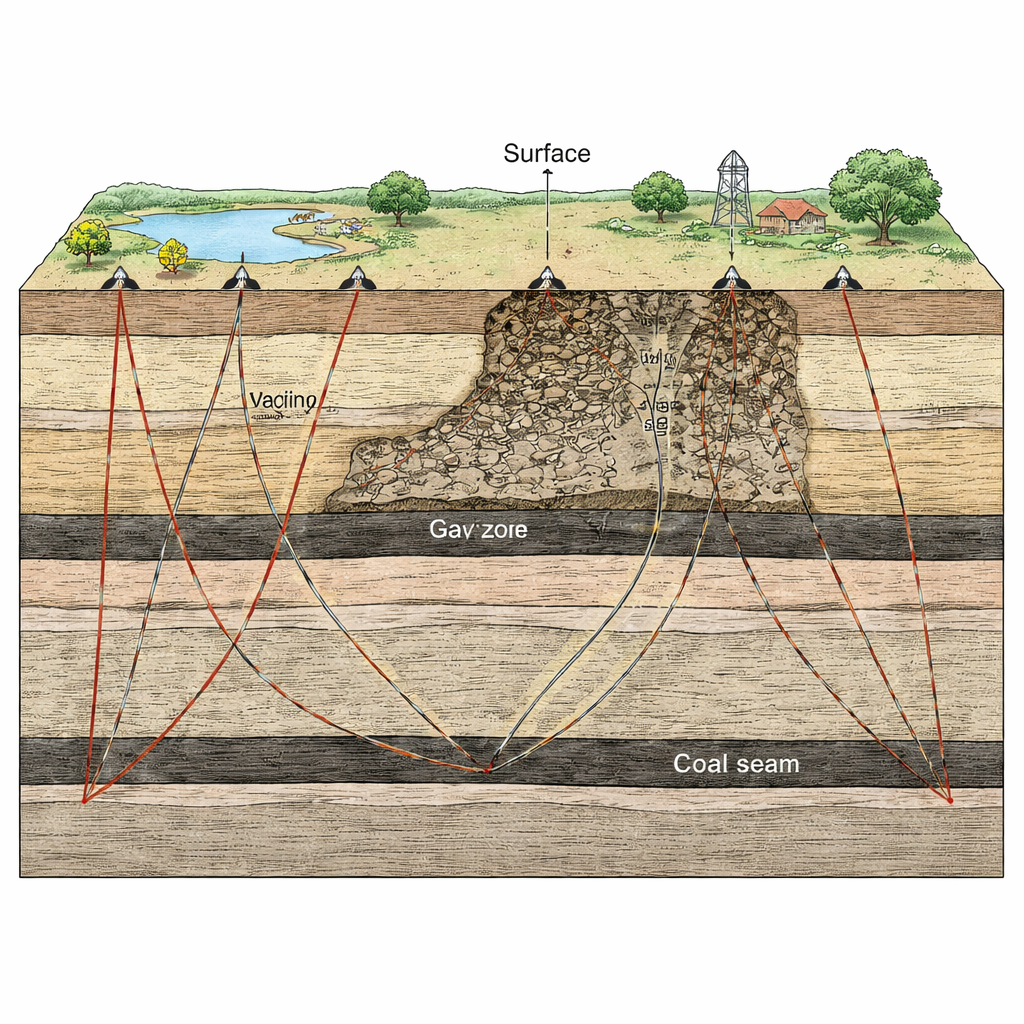
Deep beneath many coalfields lie man‑made voids called goafs—spaces left behind after coal is removed. Over time, the rock above these empty rooms can break and cave in, creating unstable zones that stretch upward toward the surface. These hidden cavities and collapsed zones can trigger ground subsidence, threaten miners’ safety, and make it harder for geologists to see deeper coal seams using seismic surveys (the same basic technology as medical ultrasound, but for the Earth). This study explains how these underground scars distort seismic signals and shows how we can still "see" valuable deep coal seams through the chaos.
A Landscape Shaped by Mining
The research focuses on a mining area in eastern China’s Huaibei Plain, a flat region dotted with rivers, ponds, and villages. After two decades of mining an upper coal seam, large goafs and caving zones formed beneath the surface, along with noticeable ground subsidence. Below the upper seam lie deeper coal seams that are increasingly important as shallower reserves are exhausted. Before more extensive seismic surveys were rolled out, geophysicists collected two test lines of seismic data that crossed both mined and unmined ground. They quickly noticed a problem: reflections from the deeper coal seams beneath the goaf‑related areas were faint, broken, and difficult to trace, hinting that the disturbed rock above was scrambling the seismic signals.
Reading the Underground Echoes
On each of the two seismic lines, the team divided the profiles into zones based on how clean or disturbed the reflections looked. In undisturbed areas, the upper coal seam and the deeper target seam showed strong, continuous echoes with regular shapes. Inside the mined‑out regions, however, the picture changed. Where goafs and caving zones were present, reflections from the upper coal seam showed patches of weakened energy and breaks, and the deeper coal seam often appeared with much lower energy, scrambled wave shapes, and poor continuity. The strongest disturbances occurred near the centers of large goafs, where overlying rock had broken badly and numerous voids and fractures were present; the effects gradually faded toward the edges of these zones, where the rock was less disrupted.
Building a Laboratory Earth Underground
Because real rocks are messy, the researchers built a simplified but realistic computer model of the layered strata, including two coal seams and three goafs of different sizes and states—one still largely intact, one modestly collapsed, and one heavily caved with a wide influence zone. They adjusted the wave speed and density in the caving zones to mimic broken rock and water‑filled voids, then simulated seismic waves traveling through this virtual Earth. Using advanced imaging algorithms on the synthetic data, they produced a clean seismic section free from field‑related noise such as near‑surface variations or recording errors. This allowed them to isolate exactly how the goafs and caving zones alone altered the seismic reflections from the layers below.
What Happens to Seismic Waves in Broken Rock
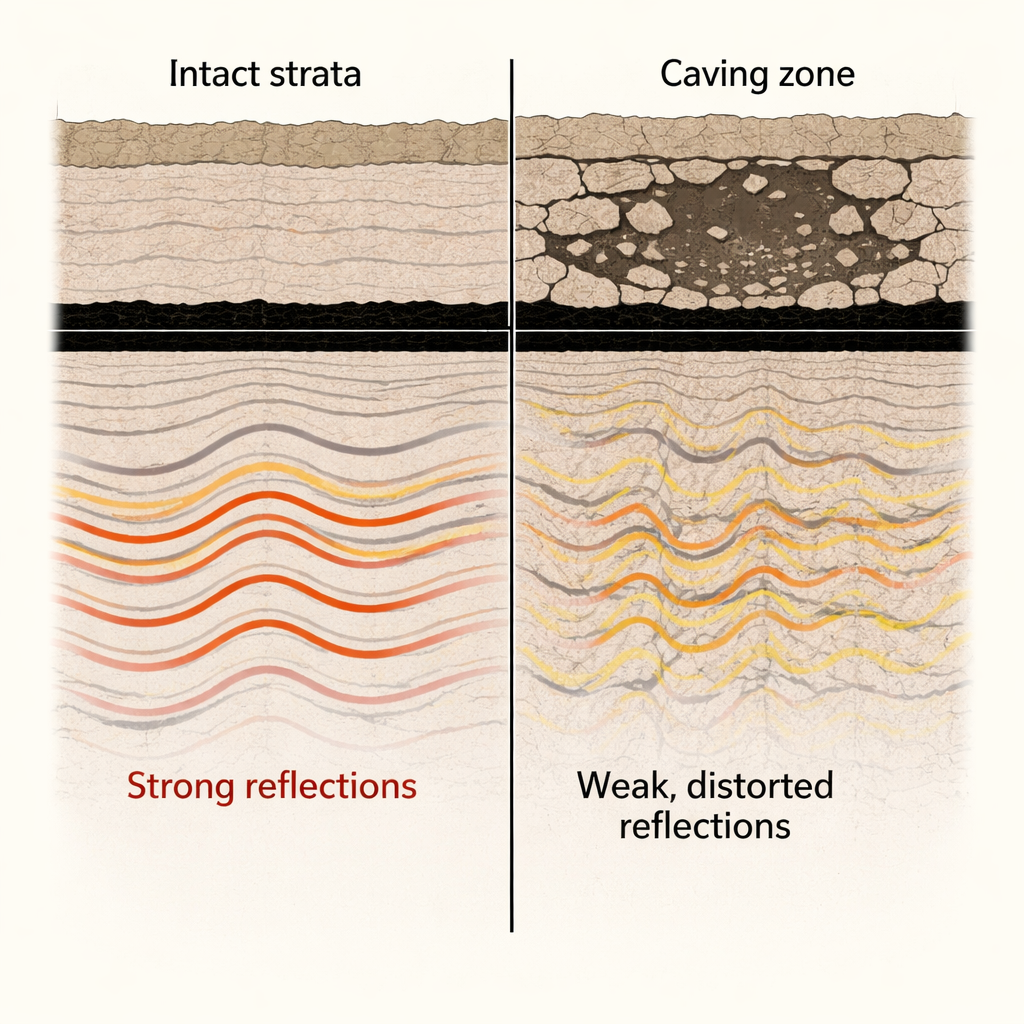
The simulations confirmed three key ways that goafs and caving zones deform the seismic picture: energy, wave shape, and continuity. First, the base of a goaf acts like a strong mirror, reflecting a large share of the incoming energy and leaving less to continue downward, while the broken rock in the caving zone scatters energy in many directions. Together, these effects greatly weaken reflections from deeper coal seams. Second, because seismic waves travel more slowly through broken, low‑velocity rock and water‑filled gaps, their arrival times are delayed and their phases—essentially the wave shapes—become distorted. Third, scattering within the caving zone breaks up what would otherwise be smooth, continuous reflection lines from deeper layers, turning them into patchy, irregular events. In contrast, goafs that have not collapsed still slow the waves but largely preserve their shapes, so the reflections remain more coherent.
Seeing Through the Damage
For non‑specialists, the takeaway is that old mine workings can act like both a cracked mirror and a foggy window for seismic imaging: they reflect and scramble the waves used to map what lies below. This study links specific seismic symptoms—weak signals, jumbled wave shapes, and broken reflection lines—to physical features such as caving, fragmentation, and strong reflecting boundaries at the bottom of goafs. Armed with this understanding, geoscientists can better recognize where prior mining is distorting their images and still piece together a reliable picture of deeper coal seams. That, in turn, supports safer, more efficient development of deep coal resources while helping to manage the risks posed by decades of underground excavation.
Citation: Shan, R., Nie, A., Cao, X. et al. Seismic reflection characteristics and genesis of goafs and underlying coal seams. Sci Rep 16, 6711 (2026). https://doi.org/10.1038/s41598-026-37861-9
Keywords: coal mining, seismic imaging, ground subsidence, goaf and caving zones, deep coal seams