Clear Sky Science · en
Multi-scale entropy analysis of acoustic emission for gearbox fault severity classification
Why listening to machines can prevent breakdowns
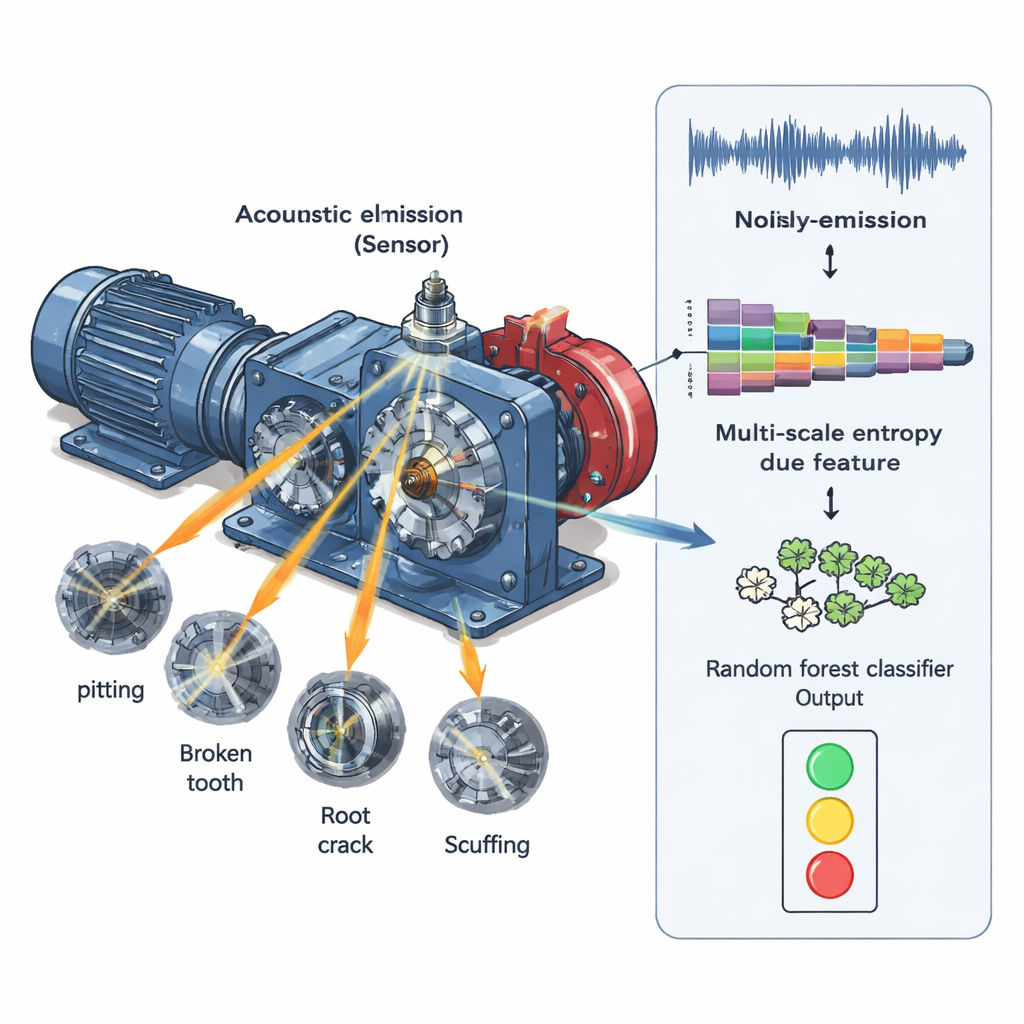
From wind turbines to factory conveyors, gearboxes quietly keep industry moving—until a hidden crack or worn tooth suddenly brings everything to a halt. This study shows how “listening” to the tiny, high‑frequency sounds inside a gearbox, and analyzing them in a clever way, can reveal not just whether something is wrong, but how bad the damage is. That level of detail is crucial for planning repairs before failures become costly or dangerous.
From simple vibrations to subtle acoustic clues
Most condition monitoring systems rely on vibration sensors, which work well once a fault is fairly advanced. But the earliest signs of trouble often appear as very brief, high‑frequency acoustic emission bursts—tiny sound waves produced when surfaces rub, crack, or chip. These signals carry rich information, yet they are extremely fast, complex, and noisy, which makes them hard to interpret directly. Traditional deep‑learning approaches can learn from such data, but they tend to act like black boxes and demand lots of computing power and labeled examples, making them less practical for everyday industrial use.
Measuring signal “irregularity” across many time scales
The authors instead focus on a family of measures known as entropy, which in this context describes how unpredictable or irregular a signal is. Rather than looking only at raw amplitudes, they compute 16 different entropy‑based features that capture how energy and frequency content are spread out in time. Crucially, they do this at multiple time scales, from fine to coarse, using three related techniques: Composite Multi‑Scale Entropy (CMSE), Hierarchical Multi‑Scale Entropy (HMSE), and a combined method called Composite Hierarchical Multi‑Scale Entropy (CHMSE). By viewing the same acoustic emission data through this multi‑scale lens, they can tease out patterns that are invisible in a single snapshot but change systematically as gear damage progresses.
A highly controlled test of gear damage and severity
To put these ideas to the test, the team built a spur‑gear test rig with a 2‑horsepower motor and installed a specialized acoustic emission sensor on the gearbox case. They then created four realistic types of gear damage—pitting, broken teeth, root cracks, and scuffing—each at nine distinct severity levels, alongside a healthy condition. For three different speeds and three load settings, they recorded three‑second bursts of sound at one million samples per second, ending up with 1,215 signal records. From each record they extracted their entropy features and fed them into classic machine‑learning models such as random forests, support vector machines, and neural networks, repeating the training and testing many times to ensure the results were statistically sound.
Seeing inside the “black box” of fault classification
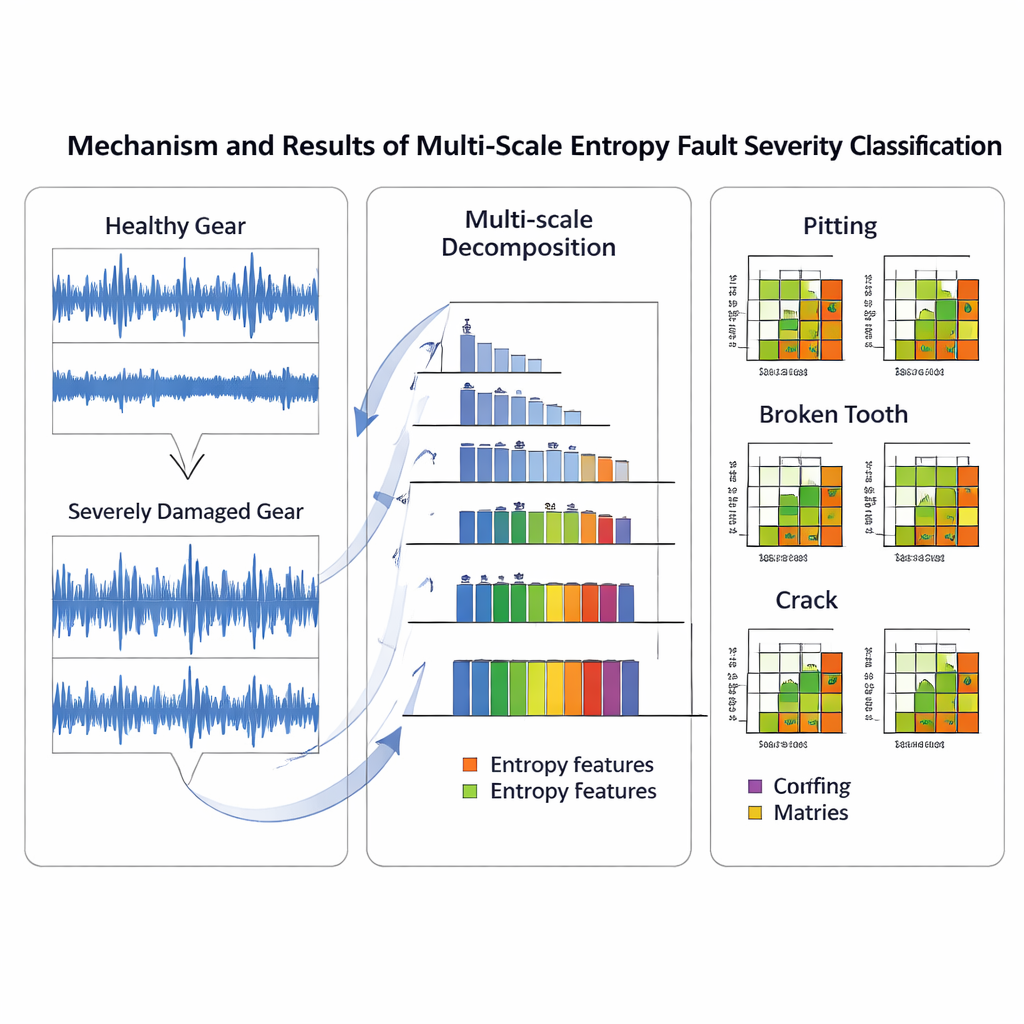
Among all combinations tested, the pairing of CHMSE features with random forest models performed best. For several fault types, this setup correctly identified the exact severity level more than 99% of the time; even in the hardest cases, accuracy stayed above about 97%. The study also compared these entropy features with more familiar statistical descriptors—like mean, variance, and peak value—and found that entropy delivered a steady 1–4% gain in accuracy. To make the decisions understandable to engineers, the authors applied SHAP, a modern explainability technique, which ranks which features matter most to each prediction. It revealed that certain generalized entropy measures (Rényi and Tsallis), along with log‑energy and threshold‑based entropy, are especially powerful in distinguishing small, early defects from advanced damage across all four fault types.
What this means for real‑world maintenance
In everyday terms, the work shows that a single, well‑placed acoustic sensor, combined with thoughtful multi‑scale entropy analysis, can act like a stethoscope and blood test in one for industrial gearboxes. Instead of simply flagging that “something is wrong,” the system can estimate how far along each type of damage has progressed, giving maintenance teams time to plan repairs and avoid catastrophic failures. Because the chosen entropy features are much cheaper to compute than many deep‑learning alternatives, the approach is practical for routine monitoring on standard hardware. With further validation on real factory gearboxes, such methods could become a cornerstone of predictive maintenance, extending equipment life and reducing unplanned downtime.
Citation: Sánchez, RV., Liu, Y., Qin, H. et al. Multi-scale entropy analysis of acoustic emission for gearbox fault severity classification. Sci Rep 16, 7279 (2026). https://doi.org/10.1038/s41598-026-37858-4
Keywords: gearbox health monitoring, acoustic emission, fault severity classification, multi-scale entropy, predictive maintenance