Clear Sky Science · en
Identification and analysis of the MYB transcription factors against seawater tolerance in daylily (Hemerocallis fulva L.)
Why salty soil matters for everyday plants
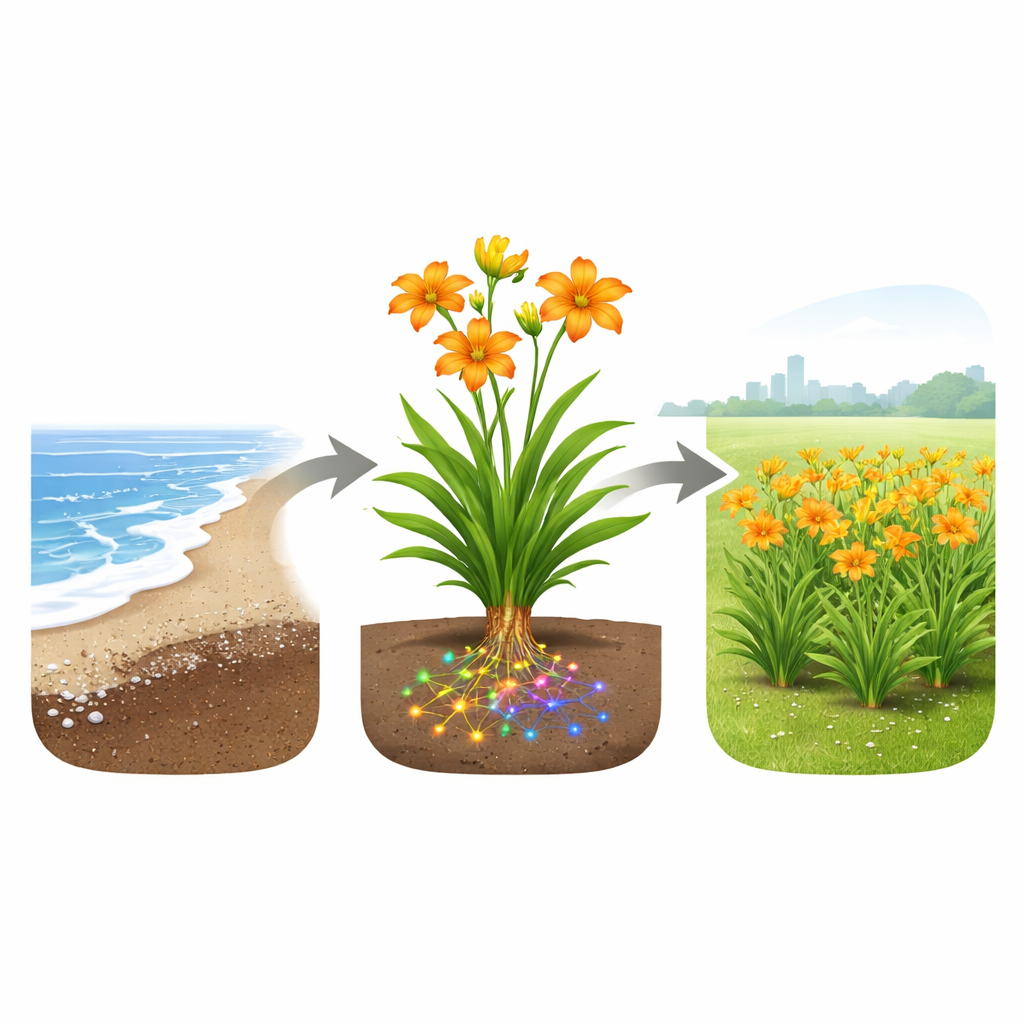
Rising soil salinity is quietly shrinking the world’s usable farmland, especially along coasts where seawater seeps into fields. Most garden and crop plants struggle in salty ground, wilting, yellowing, and yielding less food or fewer flowers. Daylilies, however, are famously tough ornamentals that can stay lush even near the ocean. This study asks a simple question with big implications: what is happening inside daylilies that lets them shrug off seawater, and can that knowledge help us design greener cities and more resilient crops?
How plants talk to their genes under stress
Plants cannot walk away from trouble, so they rely on internal control switches—special proteins that turn thousands of genes on or off in response to drought, heat, or salt. One of the largest families of these switches is called MYB. These proteins help plants adjust growth, chemistry, and defenses when conditions change. Scientists already knew that MYB switches help model plants such as Arabidopsis and rice cope with salt. Yet no one had systematically explored them in daylily, a champion of salt tolerance that is widely used in coastal landscaping.
Finding the key switches inside daylily roots
The researchers focused on a popular, hardy daylily variety called ‘Autumn Red’. They grew young plants, soaked their roots in real seawater for periods ranging from a few hours to three days, and then extracted all the active genetic messages from the roots. By comparing these messages with known MYB switches from Arabidopsis and rice, they identified 33 MYB genes that were clearly engaged during seawater treatment. These genes were scattered unevenly across nine of the daylily’s chromosomes, often appearing in duplicated clusters—an evolutionary hint that extra gene copies may have helped the plant refine its salt defenses over time.
Patterns in the plant’s response to seawater
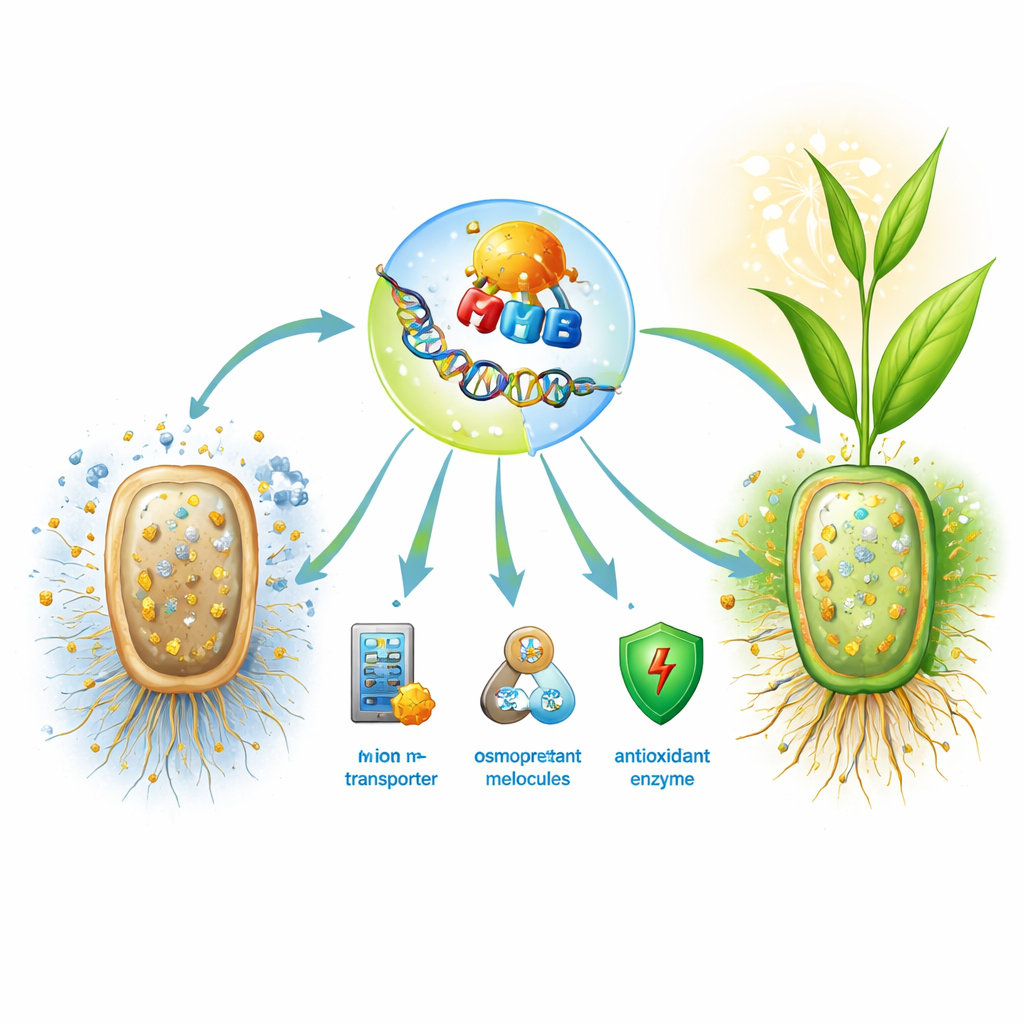
Not all MYB switches behaved the same way under stress. By tracking gene activity over time, the team sorted the 33 genes into three groups: those that stayed strongly active, those that remained mostly quiet, and those that rose and fell in a more complex rhythm. Many of the most active daylily genes sat next to known salt-tolerance genes from rice and Arabidopsis on an evolutionary family tree, suggesting that they share similar jobs in helping plants sense salt, adjust hormone signals, and detoxify harmful by-products. Structural analysis showed that most of these daylily switches still carry the classic “grip” for binding DNA, hinting that their core function has been preserved while subtle sequence changes may fine-tune their roles.
Zooming in on one standout helper gene
One switch in particular, named HfMYB10, caught the scientists’ attention. Its activity followed a “low–high–low” pattern: dialed down soon after seawater exposure, strongly boosted in the middle of the treatment, and reduced again after prolonged stress. On the family tree, HfMYB10 clustered with a well-studied Arabidopsis gene known to improve plant performance under salt and drought. To test whether HfMYB10 truly helps plants, the team inserted it into Arabidopsis and created transgenic lines that constantly produced this daylily switch. When both normal and modified Arabidopsis plants were watered with seawater, the difference was striking: ordinary plants yellowed and declined, while the HfMYB10 plants stayed greener, grew better, and maintained about double the leaf photosynthesis rate.
What this means for gardens and future crops
This work shows that daylilies rely on a specialized set of MYB switches to survive seawater, and identifies HfMYB10 as a powerful player that can boost salt tolerance even in a different species. For non-specialists, the key takeaway is that a hardy garden flower holds genetic tools that could eventually help stabilize crops and green spaces on salty, otherwise marginal land. While many genes and pathways still need to be mapped and tested directly in daylily itself, this study lays the molecular groundwork for breeding or engineering plants that can thrive where seawater intrusion once made cultivation nearly impossible.
Citation: Wu, W., Zhang, X., Zhang, L. et al. Identification and analysis of the MYB transcription factors against seawater tolerance in daylily (Hemerocallis fulva L.). Sci Rep 16, 9812 (2026). https://doi.org/10.1038/s41598-026-37856-6
Keywords: salt tolerance, daylily, transcription factors, seawater stress, plant breeding