Clear Sky Science · en
Leveraging universal and transfer learning models for influenza prediction in Thailand
Why flu forecasts matter for everyone
Influenza may feel like a routine winter illness, but it still sends millions to clinics and hospitals every year and can be deadly, especially when health systems are caught off guard. Being able to forecast when and where flu will surge allows doctors and public health officials to stock vaccines and medicines, prepare hospital beds, and warn communities in advance. This study focuses on Thailand, but the ideas behind it—using modern artificial intelligence to make better predictions even where data are scarce—could help many countries brace for the next bad flu season.
Flu, weather, and patchy data
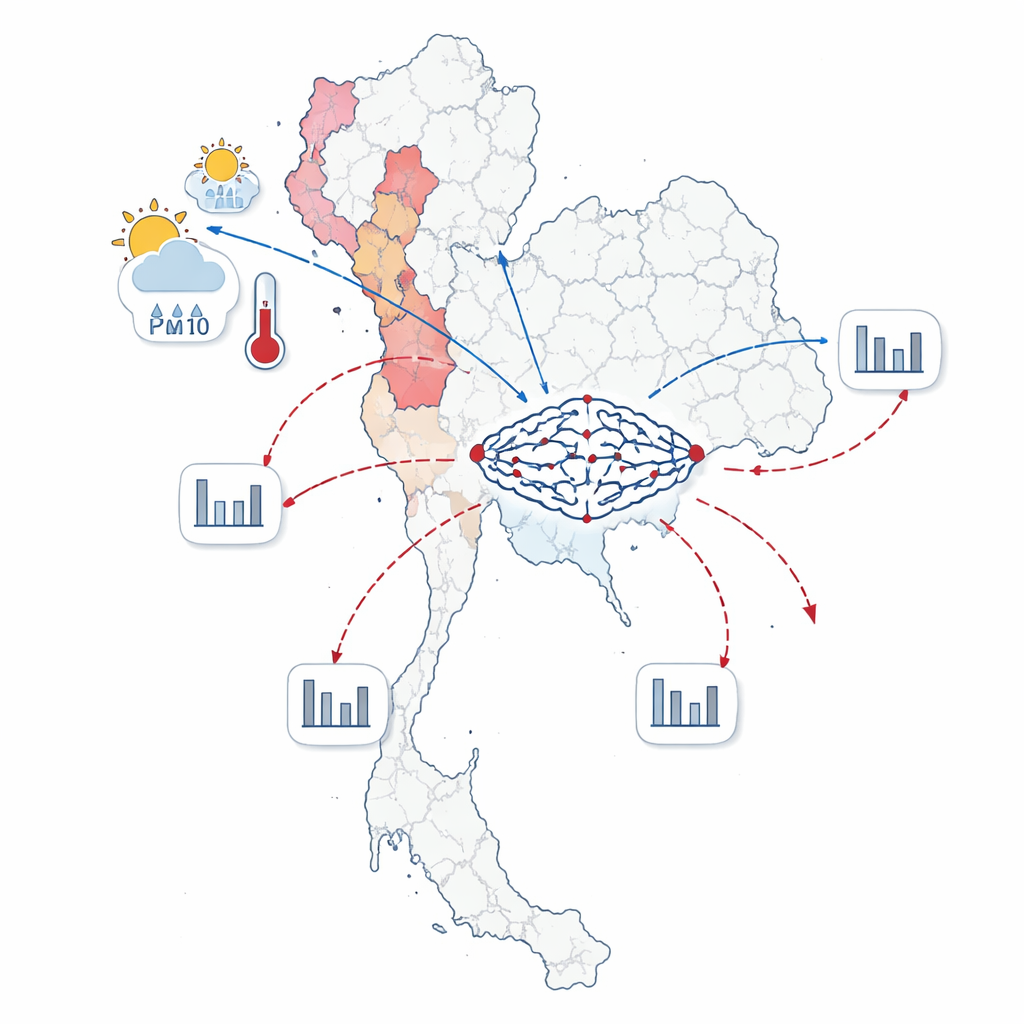
Thailand’s flu burden varies widely across its provinces, and past research has shown that local climate—such as temperature, humidity, rain, and air pollution—can shape when outbreaks occur. Unfortunately, detailed weather and air-quality measurements are not available everywhere. Of Thailand’s 76 provinces, only 22 have both flu case counts and supporting environmental data; the rest have case numbers alone. Traditional statistical tools, which are often tuned separately for each location, struggle to cope with this patchwork. They can miss unusual patterns and are slow to update when conditions change, limiting their usefulness for nationwide early warning.
Building one model for many places
The researchers set out to build a single “universal” computer model that could learn from all 22 data-rich provinces at once. They used an artificial neural network—a type of deep learning that loosely mimics how brain cells process information—to predict monthly flu incidence from 2010 to 2019. Before training the network, they used a machine-learning method called Random Forest to sift through 27 candidate inputs, including current and delayed values of temperature, humidity, rainfall, wind, visibility, air pollution, and recent flu levels. This step highlighted which ingredients actually helped prediction and let the authors trim away less useful variables, making the final model faster and less prone to noise.
What the universal model learned
After extensive testing of different network sizes, a relatively simple design—one hidden layer with 128 internal units—performed best. Interestingly, adding environmental factors such as weather and air pollution only slightly improved forecasts in most provinces, and in some cases made little difference. One clear signal did stand out: temperature was consistently selected as important, echoing earlier work that linked cooler or changing temperatures to higher flu activity. Across the 22 provinces, the universal model captured the overall ebb and flow of influenza but tended to underestimate the very highest peaks, especially in large urban centers like Bangkok and high-incidence northern provinces.
Teaching the model to help data-poor regions
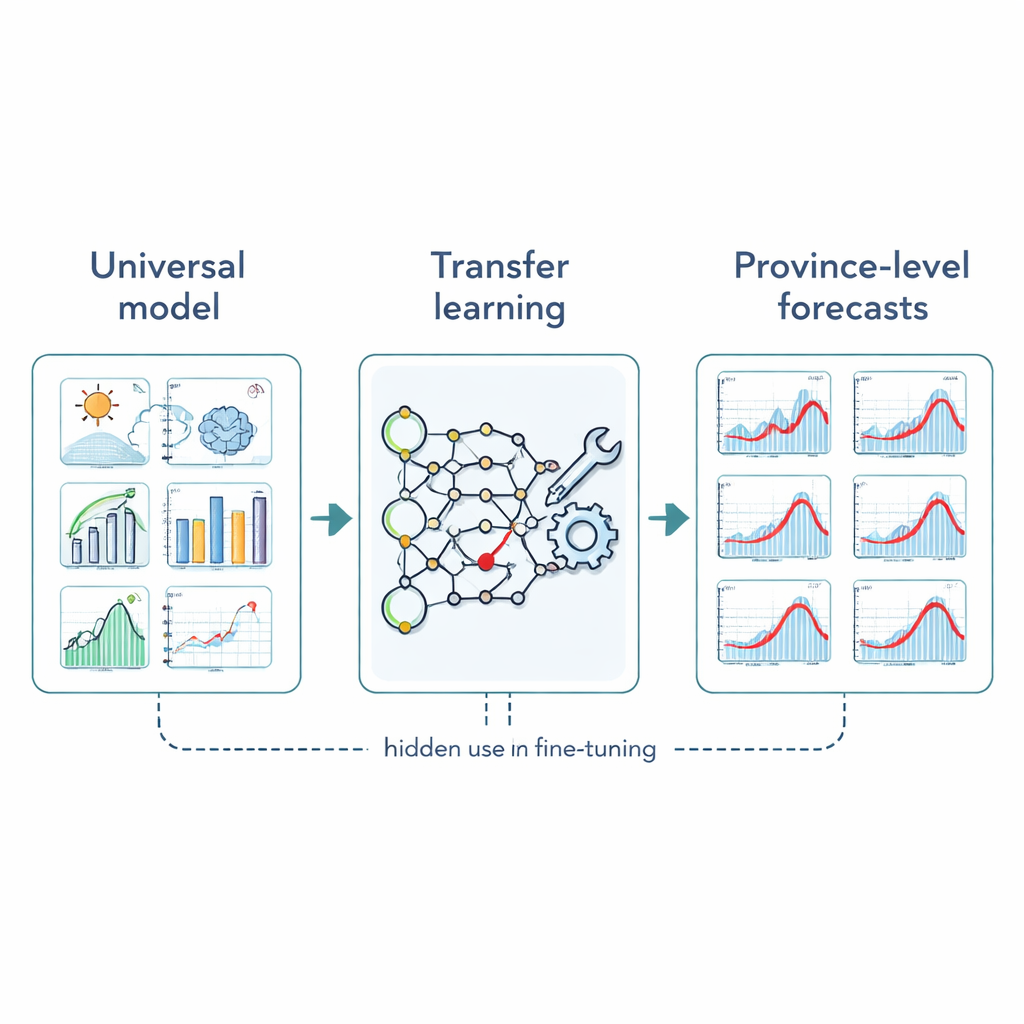
The real challenge was forecasting flu in the remaining 54 provinces that lacked detailed environmental data. Here the team turned to transfer learning, a technique in which a model trained on one task is adapted to a related one. First, they trained their universal neural network on the 22 well-measured provinces. Next, they reconfigured the model so that it could operate using only past flu counts as input. Finally, they fine-tuned this adapted model in two ways: once using case data pooled across all 54 provinces, and once separately for each province. The province-by-province fine-tuning clearly worked best, reducing prediction errors and giving a closer match to observed trends than either the pooled approach or a simple baseline model that relied only on past local flu levels.
What this means for future flu planning
For a lay reader, the takeaway is that a single, carefully designed AI model can learn broad patterns of how flu behaves in one part of a country and then be reused to improve forecasts elsewhere, even where supporting data are sparse. In Thailand, the best version of this approach—a modestly sized neural network that was fine-tuned for each province—predicted local flu trends more accurately than standard methods. While the model still underestimates the size of extreme outbreaks and does not yet include social or economic factors, it offers a practical blueprint for low- and middle-income countries: start where data are rich, transfer that knowledge to data-poor areas, and use these forecasts to guide vaccines, staffing, and other defenses before the next wave hits.
Citation: Lueangwitchajaroen, P., Anupong, S., Winalai, C. et al. Leveraging universal and transfer learning models for influenza prediction in Thailand. Sci Rep 16, 6668 (2026). https://doi.org/10.1038/s41598-026-37855-7
Keywords: influenza forecasting, transfer learning, deep learning, epidemic prediction, Thailand public health