Clear Sky Science · en
A microscopic traffic characterization considering the impact of density on carbon emissions from CAVs
Why traffic jams matter for the climate
Anyone who has ever sat in stop‑and‑go traffic has wondered how much fuel is being burned for no good reason. This paper asks a closely related question: how does the spacing between cars on the road—the traffic “density”—shape the carbon dioxide (CO₂) emissions from modern connected and autonomous vehicles (CAVs)? By tying detailed driving behavior to real emission measurements, the authors show that smarter spacing and smoother flow can significantly cut pollution.
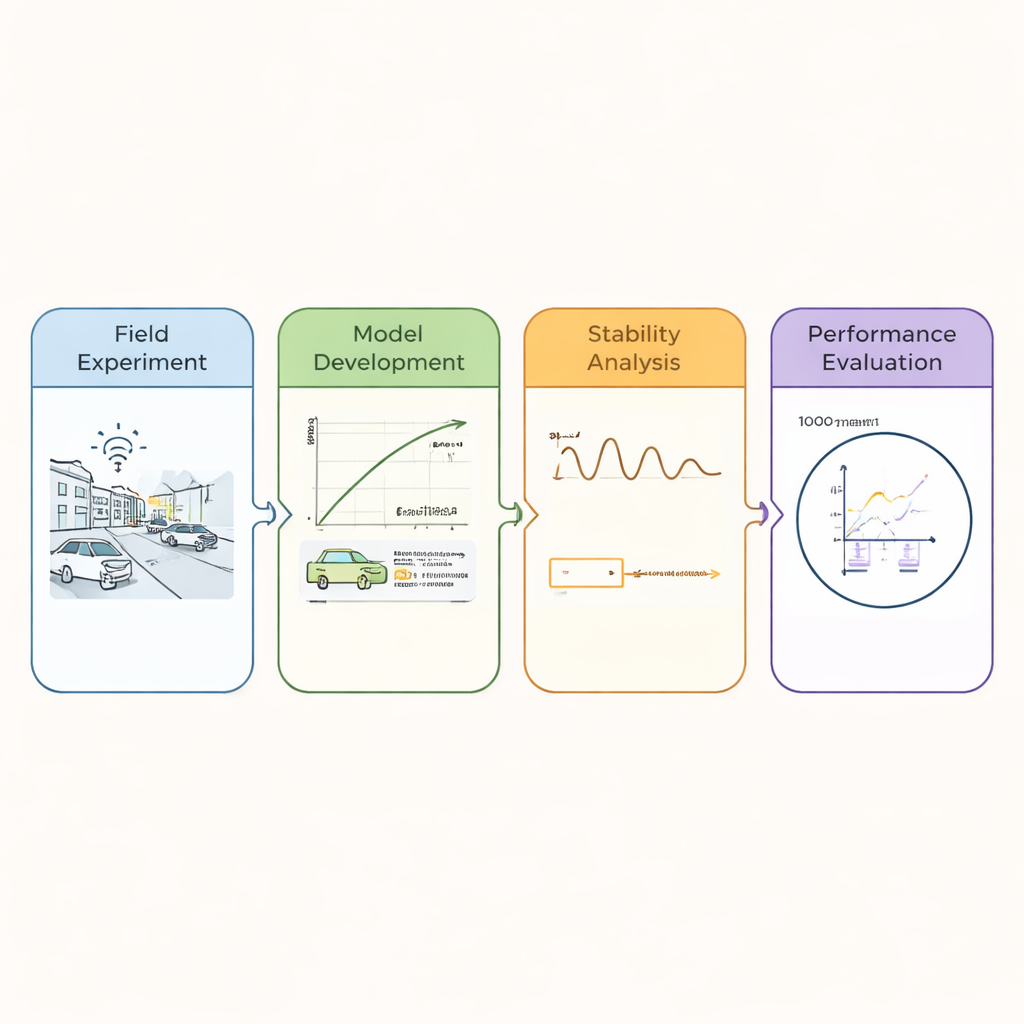
From crowded roads to carbon emissions
Road transportation is one of the largest and fastest‑growing sources of greenhouse gases worldwide. As more vehicles hit the road, congestion worsens and emissions rise, with serious consequences for air quality and climate. Traditional tools for estimating traffic emissions either focus on average speeds over long stretches of road, or rely on complex models with many parameters that are hard to calibrate and apply widely. At the same time, CAVs are beginning to enter the traffic stream, promising safer and more efficient driving, but also changing how cars interact with one another. To understand what this means for emissions, we need models that look at individual vehicles, their spacing, and their reactions to changing conditions.
Measuring how density affects CO₂
The authors began with a field experiment on two everyday commuting routes in Peshawar, Pakistan, one in the morning and one in the evening, each about 7–8 kilometers long. They equipped a car with an on‑board diagnostics scanner linked to a smartphone app and a cloud platform. This setup continuously recorded engine data and CO₂ emissions as the vehicle moved through real traffic. Using established traffic relationships, they converted spacing between vehicles into traffic density, then applied regression analysis to derive a simple mathematical link between density and CO₂ output. As density rose and traffic became more stop‑and‑go, emissions climbed in a clear, quantifiable way.
Building a smoother‑driving traffic model
Next, the team wove this emissions‑density relationship into a well‑known microscopic traffic model called the Intelligent Driver (ID) model, which normally uses a fixed parameter to govern how strongly drivers react to speed differences. Instead of treating that parameter as a constant, the authors allowed it to vary with traffic density, vehicle spacing, and driver reaction time, and explicitly represented the faster reactions of CAVs. In this new formulation, emissions are not a separate target to be optimized; they emerge naturally from how vehicles accelerate and brake under different densities. The model thus captures how CAVs can adjust their headway and speed to maintain smoother flow and avoid sharp starts and stops that waste fuel.
Testing stability and emissions on a virtual road
To see how the new approach behaves, the researchers ran computer simulations on a 1‑kilometer circular road populated by a small platoon of vehicles. They compared their CAV‑aware, emission‑sensitive model against the standard ID model under identical conditions. A detailed stability analysis showed that the new model damps out traffic waves more effectively: small disturbances in spacing and speed fade rather than grow into large congestion waves. In simulations, when vehicles were allowed longer following times (larger headways), traffic density dropped, speed became more uniform, and acceleration spikes nearly vanished. By contrast, tweaking the fixed parameter in the traditional ID model could make traffic appear more stable on paper, but did so in a way that was not tied to realistic driver or vehicle behavior.
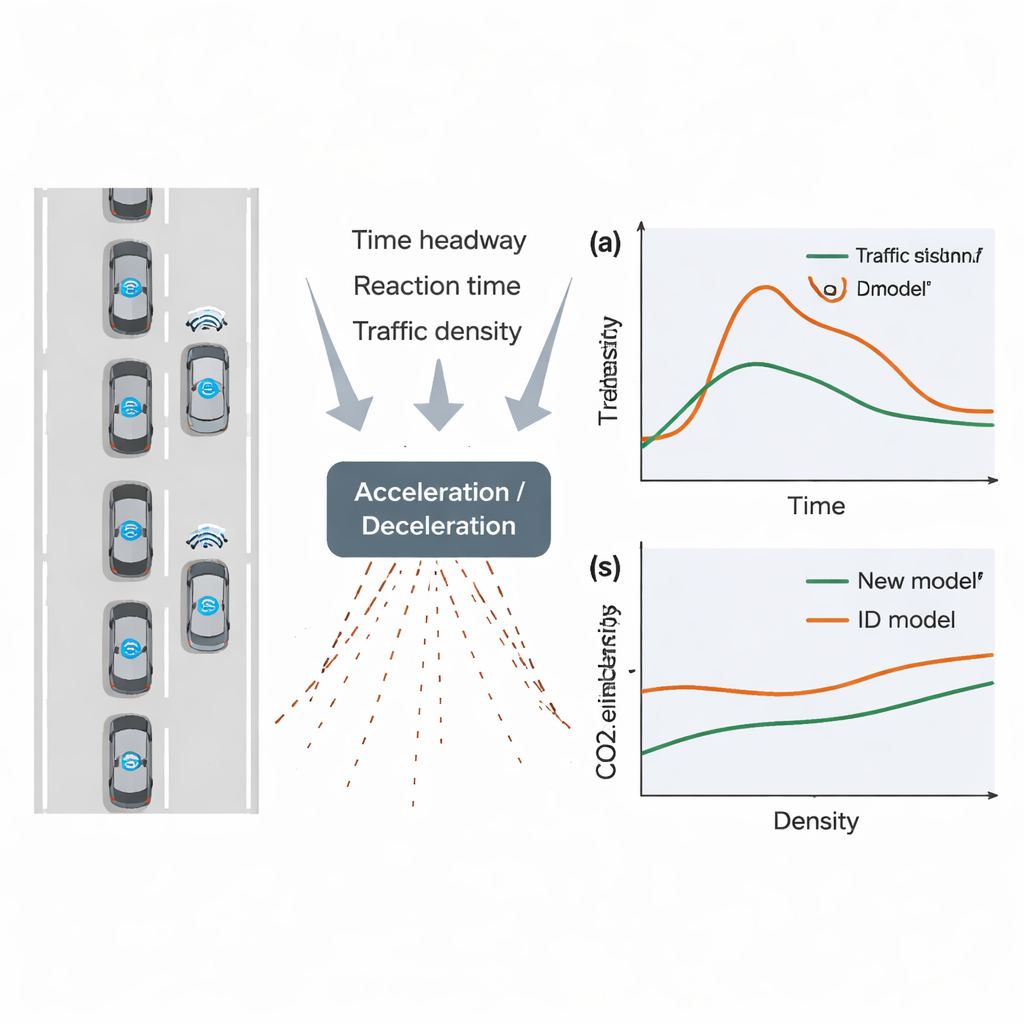
What the results mean for pollution
Because large bursts of acceleration and braking are closely linked to CO₂ emissions, the smoother driving produced by the new model leads directly to lower and more stable emission levels. Quantitative statistics from the simulations show that, as headways increase in the CAV‑based model, the variability in speed, density, and acceleration drops sharply, and the calculated sensitivity of CO₂ emissions to density becomes small and steady. In the older ID model, pushing its key parameter higher actually amplifies fluctuations and would imply much higher emissions. The study therefore suggests that traffic systems which encourage CAVs to maintain safe but generous following distances, and to react quickly yet smoothly to changes ahead, can simultaneously reduce congestion and cut carbon pollution.
How this could shape future roads
In everyday terms, the work argues that cleaner traffic is not just about cleaner engines but also about how cars are spaced and controlled. By grounding their model in roadside data and realistic CAV behavior, the authors provide a tool that traffic planners can use to test strategies such as coordinated speeds, eco‑driving guidance, and CAV‑based control schemes before they are deployed on real roads. If adopted widely, such strategies could help cities design road systems where fewer stop‑and‑go waves form, travel becomes more predictable, and the climate impact of driving is significantly reduced.
Citation: Khan, Z.H., Ali, F., Gulliver, T.A. et al. A microscopic traffic characterization considering the impact of density on carbon emissions from CAVs. Sci Rep 16, 7648 (2026). https://doi.org/10.1038/s41598-026-37851-x
Keywords: connected autonomous vehicles, traffic density, CO2 emissions, microscopic traffic model, traffic stability