Clear Sky Science · en
A temperature- and impedance-aware LSTM–PINN framework for physically consistent battery SOH prediction
Why smarter battery health matters
Lithium-ion batteries power our phones, laptops, electric cars and even parts of the electric grid. Yet every battery quietly wears out over time, losing capacity and gaining resistance until it can no longer do its job safely or efficiently. Knowing how “healthy” a battery is—and how fast it is aging—is crucial for designing safer vehicles, avoiding costly downtime, and squeezing more life out of expensive battery packs. This study presents a new way to forecast battery health that blends modern artificial intelligence with the basic physics of how batteries age.
A new way to read a battery’s lifespan
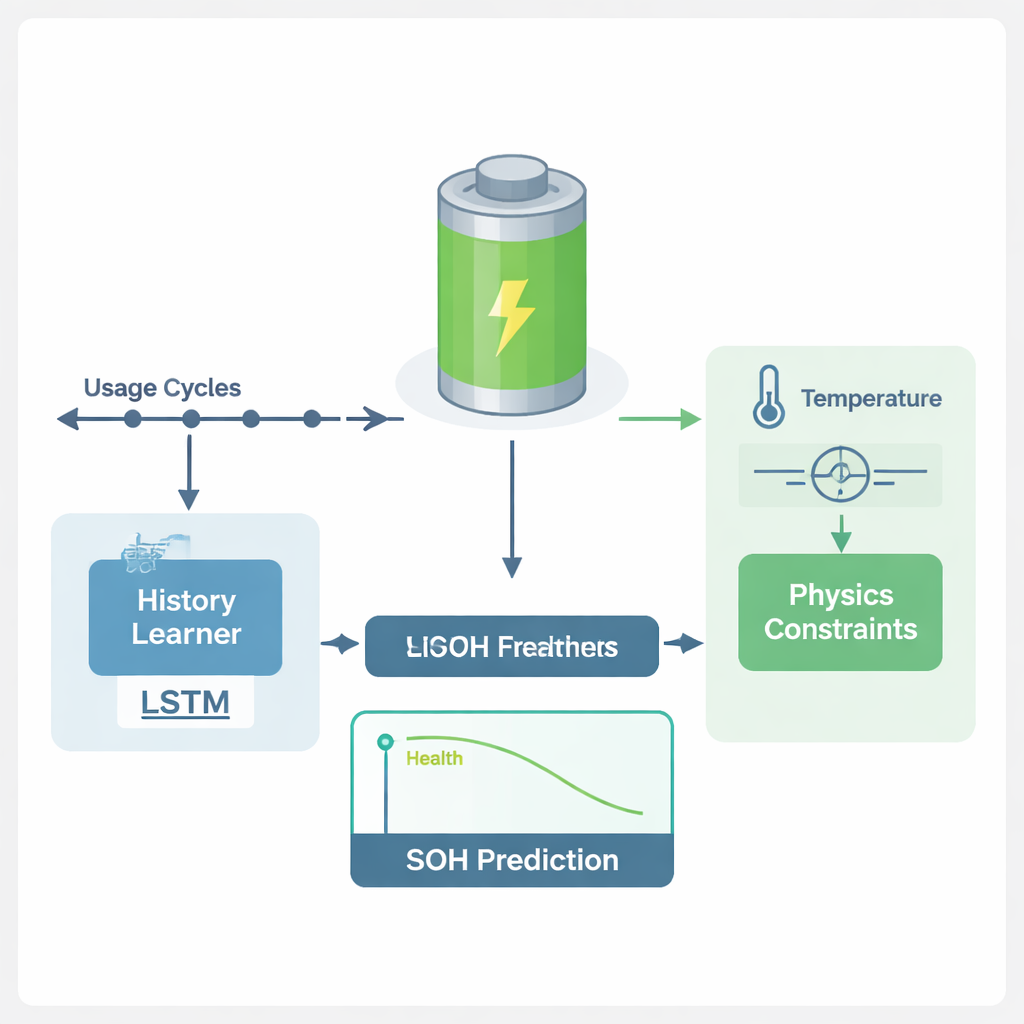
The authors focus on a key measure called State of Health (SOH), which reflects how a battery’s usable capacity compares with its original state. Traditional deep-learning tools such as recurrent neural networks can learn complex patterns in SOH over many charge–discharge cycles, but they often require huge datasets and can produce clearly wrong behaviour—such as a worn battery magically “recovering” capacity. Pure physics-based models, on the other hand, obey the laws of chemistry but tend to be slow and hard to deploy in everyday devices. The work described here combines both worlds using a hybrid framework called LSTM–PINN, which couples a sequence‑learning neural network with a physics‑informed module that enforces realistic aging trends.
Teaching the model real-world battery behaviour
In this framework, an LSTM (long short‑term memory) network watches how a battery’s SOH evolves over a window of past cycles along with its temperature and electrical resistance. From this history, it learns a compact internal summary of the battery’s condition. That summary is then passed to a physics “head” that encodes simple but powerful ageing laws: the battery must degrade monotonically over time; higher temperatures should speed up ageing in an Arrhenius‑like fashion; and growing internal resistance should further accelerate wear. Instead of solving complicated equations that are too slow for everyday use, the model uses a small neural network to mimic how impedance (a measure of resistance inside the cell) affects the degradation rate, while still keeping the overall shape of ageing grounded in established electrochemistry.
How well the hybrid approach performs
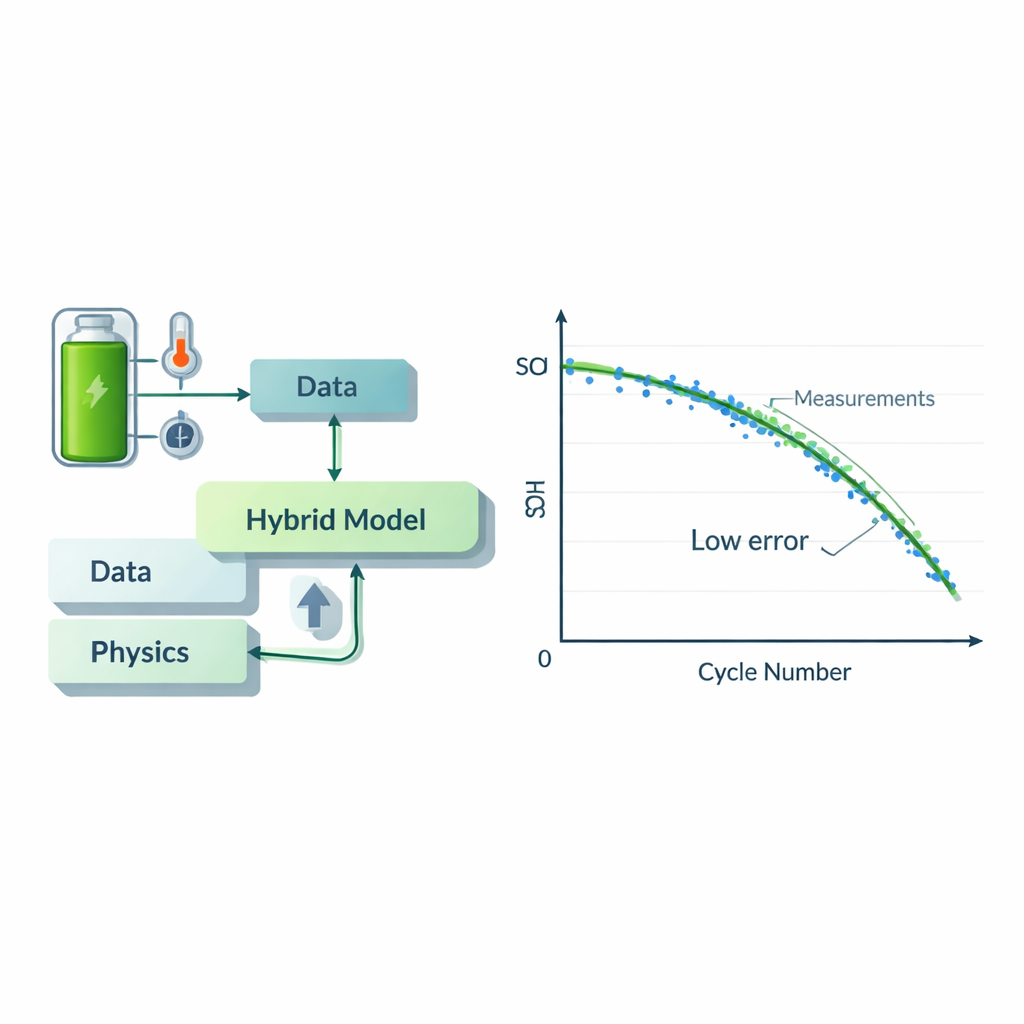
The researchers tested their model on a widely used NASA dataset that tracks dozens of lithium‑ion cells as they age under controlled laboratory conditions. Compared with standard tools such as pure LSTM networks, convolutional networks and other physics‑guided approaches, the new LSTM–PINN achieved notably better accuracy and produced smoother, more realistic SOH curves. Its average prediction error was about one percentage point, with a very high correlation between predicted and actual health over the battery’s entire life. Sensitivity tests showed that each physics ingredient plays a different role: the monotonicity rule prevents impossible “healing” events, the impedance term keeps long‑range forecasts from drifting, and the temperature term ensures that cells age faster when run hot, as experiments suggest.
Handling quirks and planning ahead
Not all batteries age perfectly smoothly. Some show brief capacity “regeneration” after being rested, which appears as a temporary uptick in measured SOH. Because the model deliberately enforces a steady decline, it refuses to chase these local bumps. That choice can create larger errors at those few points but leads to more trustworthy long‑term forecasts, which is what most applications care about. The authors also show that the physical parameters learned by the network—such as the activation energy that controls how temperature speeds degradation—fall within ranges reported in laboratory studies, suggesting that the model is not just fitting curves but discovering meaningful, interpretable laws. They outline future steps such as predicting remaining useful life, estimating uncertainty for safety‑critical decisions, and adapting the approach to different cell designs with limited data.
What this means for everyday technology
For non‑specialists, the main message is that blending physics with machine learning can make battery health predictions both smarter and more trustworthy. Instead of treating the battery as a black box, this hybrid model respects how real cells age—faster when hot, faster as internal resistance rises, and always in a generally downhill direction. That combination of accuracy, stability and interpretability could help car makers design better battery management systems, give more reliable range estimates, and extend the useful life of expensive packs. In the long run, approaches like this may support safer, cheaper and more sustainable use of the batteries that increasingly power our world.
Citation: Kumar, P.N., Upadhya, P.R., Nischay, S. et al. A temperature- and impedance-aware LSTM–PINN framework for physically consistent battery SOH prediction. Sci Rep 16, 7568 (2026). https://doi.org/10.1038/s41598-026-37850-y
Keywords: lithium-ion batteries, battery state of health, physics-informed neural networks, battery degradation, machine learning prognostics