Clear Sky Science · en
A near zero refractive indexed non-uniform metasurface for broadband RCS reduction of an antipodal Vivaldi antenna
Why hiding from radar still matters
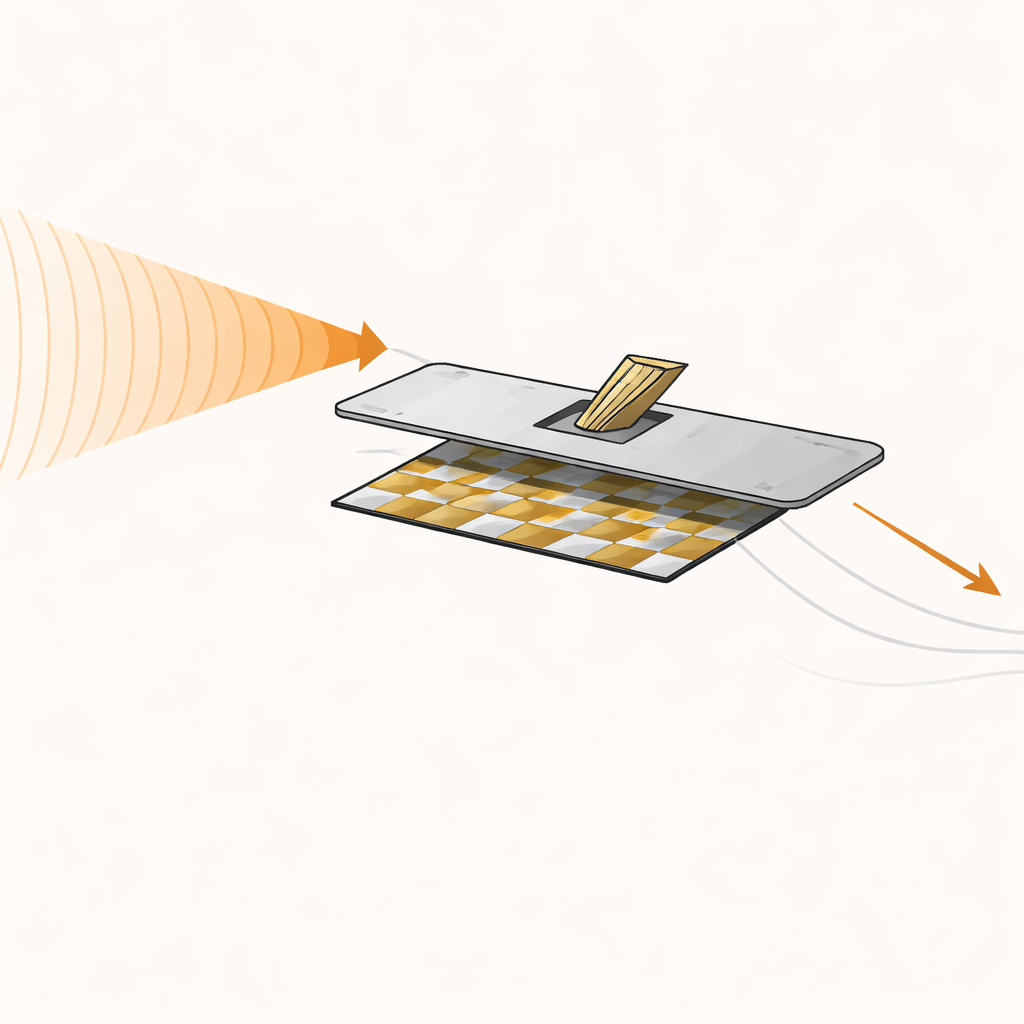
From fighter jets to future 5G and 6G communication gear, many devices must talk with radio waves without becoming easy targets for radar. Traditional stealth tricks often come at a cost: adding heavy, bulky materials or degrading antenna performance. This paper introduces a compact “skin” made of engineered tiles, called a metasurface, that can be slipped under a popular type of antenna to dramatically cut how strongly radar sees it—without sacrificing how well the antenna works.
A smarter surface for radio waves
The work focuses on reducing radar cross-section (RCS), a measure of how large an object appears to radar. Instead of simply soaking up energy like a sponge, the proposed surface reshapes how radio waves bounce off. It is built from tiny repeating metal patterns on a flat circuit board—much smaller than the wavelength of the incoming waves. These patterns are carefully designed so that an incoming wave with one polarization (a particular orientation of its electric field) is reflected with its polarization rotated by 90 degrees. At the same time, reflections that preserve the original polarization are strongly suppressed. By tuning this behavior across a wide range of frequencies, the surface can keep radar echoes small over a broad band.
A checkerboard that cancels echoes
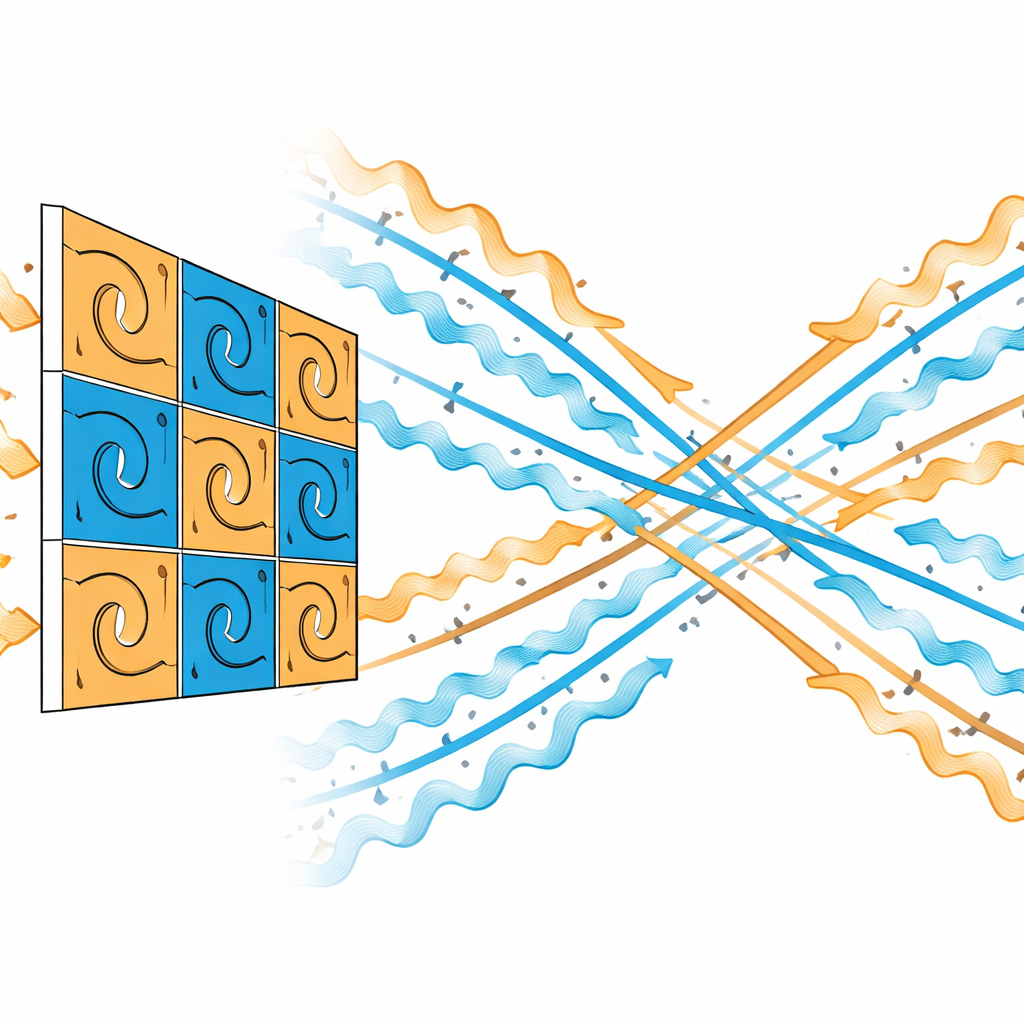
The key trick is how these tiny patterns are arranged. Four identical elements form a small square “supercell.” Next to it, another supercell is rotated by 90 degrees, and these two types are tiled in a checkerboard fashion. When radar waves hit this layout, neighboring patches send back cross-polarized reflections that are almost 180 degrees out of phase with each other. That means their contributions to the backward echo mostly cancel, while both types also reduce the ordinary, co-polarized reflections. The result is a strong drop in the RCS compared with a simple metal plate of the same size, and this effect holds not just straight-on but also when the waves arrive from slanted angles.
Teaming up with a high-speed antenna
To show that stealth and performance can coexist, the authors pair this metasurface with an antipodal Vivaldi antenna—a flared, end-fire design commonly used at millimeter-wave frequencies, such as in advanced wireless links and radar. The antenna itself is shaped to provide wide bandwidth and good gain around 25–30 GHz. The metasurface is mounted a few millimeters beneath it, with a small opening for the feed connector. Measurements and detailed simulations reveal that the antenna’s input matching and radiation pattern are preserved: peak gain stays around 9 dBi, and the main beam continues to point along the same direction, even though the underlying surface is now actively reshaping scattered waves.
Wideband stealth without heavy trade-offs
Performance tests show that the combined system achieves up to 30 dB reduction in monostatic RCS—equivalent to shrinking the apparent radar size by a factor of 1000—over a very wide frequency span from 14 to 36 GHz. The design also maintains good performance when transmitter and receiver are separated in angle (bistatic conditions), with substantial RCS reduction over an angular window as wide as ±85 degrees at a key operating frequency. Importantly, these gains are achieved with a metasurface that is both compact in area and thin in profile compared with other reported approaches, and whose internal behavior is well captured by simplified circuit models and mode analysis.
What this means for future stealthy links
In practical terms, this study demonstrates that a thin patterned coating can make a high-speed antenna much less visible to radar while keeping its communication or sensing abilities largely intact. By rotating and phasing the scattered waves rather than merely absorbing them, the metasurface offers broadband, angle-stable stealth in a relatively small footprint. Such designs could help future aircraft, vehicles, and even infrastructure hide their most conspicuous radio hardware, enabling systems that are both strongly connected and far harder to spot.
Citation: Das, P., Kundu, S. & Kumar, R. A near zero refractive indexed non-uniform metasurface for broadband RCS reduction of an antipodal Vivaldi antenna. Sci Rep 16, 8563 (2026). https://doi.org/10.1038/s41598-026-37848-6
Keywords: stealth antenna, metasurface, radar cross section, Vivaldi antenna, millimeter-wave