Clear Sky Science · en
Regional disparities in breast cancer mortality in Brazil: a spatial analysis using uncorrected and adjusted data, 2000–2023
Why this matters for women’s health
Breast cancer is the leading cause of cancer death among Brazilian women, but official statistics can give a misleading picture of where the problem is worst. This study shows that in some poorer parts of Brazil, many deaths were effectively “hidden” in the records, making it harder for health authorities to see who most needs help. By cleaning and correcting more than two decades of national data, the researchers reveal a more accurate—and more unequal—map of breast cancer mortality across the country.
Seeing past the limits of the numbers
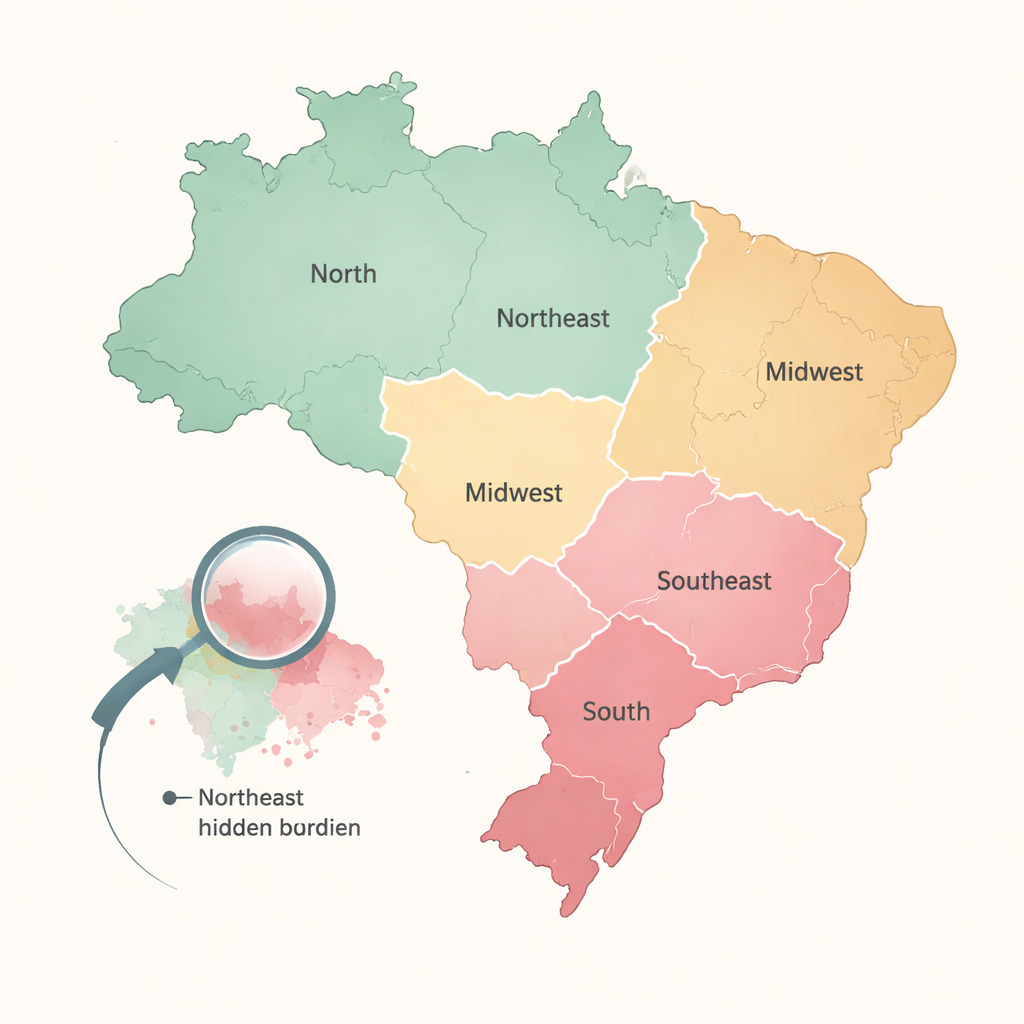
Health data are only as good as the way deaths are recorded. In Brazil, some death certificates list vague causes such as “unknown” or “unspecified tumor,” and some deaths are never registered at all. These problems are more common in less developed regions, especially in the North and Northeast. The team used methods from the World Health Organization and Brazil’s statistical agency to reassign vague causes to specific diseases, correct incomplete cancer diagnoses, and account for deaths and people who were missed in the official counts. They then calculated breast cancer death rates for women aged 20 and older in every state from 2000 to 2023.
Hidden deaths come into focus
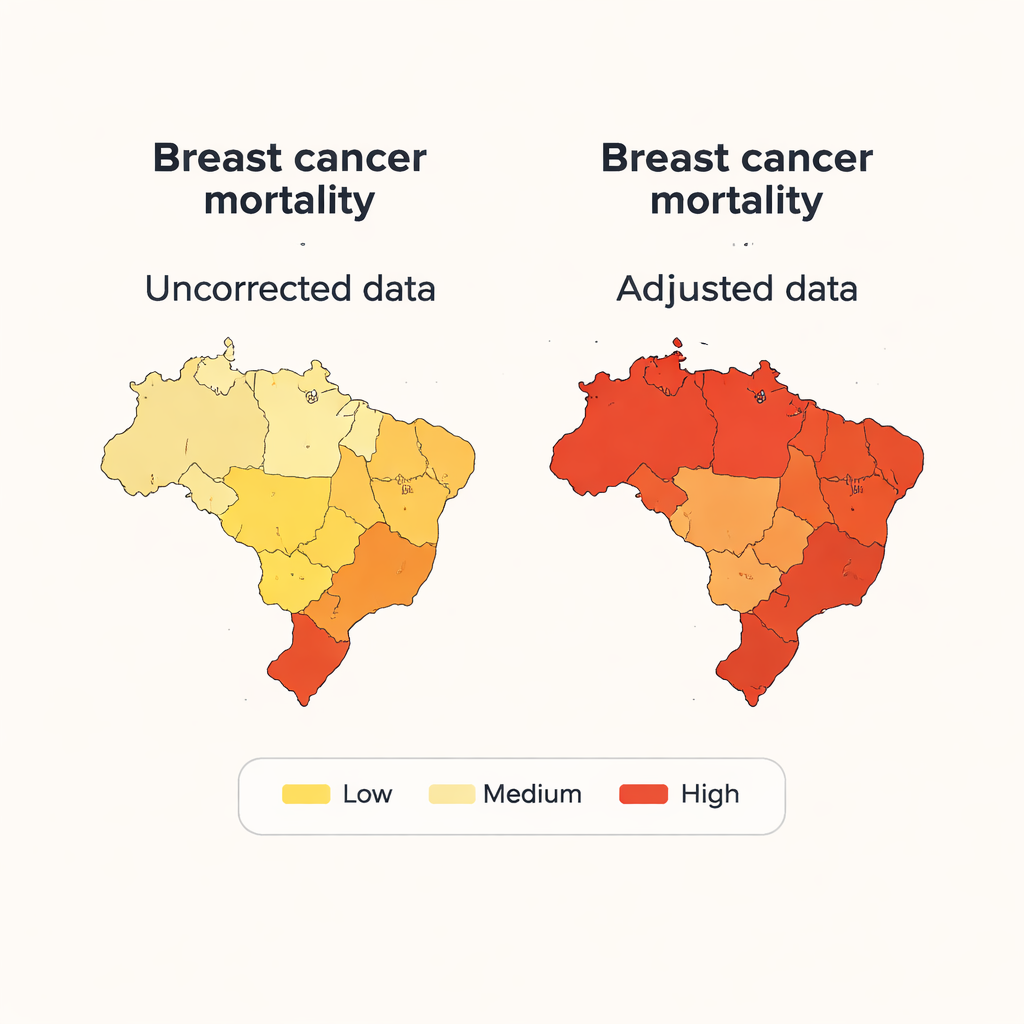
Before correction, the records showed 328,319 breast cancer deaths across Brazil during the study period. After adjusting for ill-defined causes, incomplete diagnoses and data gaps, the number jumped to 385,068—an increase of 17.3 percent. The impact of these corrections was not uniform. In the early 2000s, some states in the North and Northeast saw their breast cancer death rates rise by more than two-thirds once the data were corrected, and in a few cases by more than 80 percent. By contrast, richer states in the Southeast and South showed much smaller changes, suggesting their reporting systems were already more reliable.
Unequal burden across the map
Even after cleaning the data, breast cancer mortality remained highest in the wealthier Southeast and South and lower in the North and Northeast. However, the corrected numbers revealed that earlier figures had seriously underestimated the problem in poorer regions. Over time, differences between raw and adjusted rates shrank nationwide—from nearly 40 percent extra deaths detected in 2000–2004 to about 11 percent in 2020–2023—pointing to gradual improvements in death reporting. The researchers also used spatial analysis to look for clusters of neighboring states with similar risks. While they did not find strong nationwide patterns, local analyses consistently highlighted high-risk clusters in states like Minas Gerais, São Paulo and Paraná, and low-risk clusters in parts of the North and Northeast—though some of these “safer” areas looked much less protected once the data were corrected.
What drives these differences
The study suggests that regional gaps in income, education and health services are key to understanding who dies from breast cancer in Brazil. In the South and Southeast, better detection and recording systems make deaths more visible, but women may also face higher exposure to urban lifestyle risks and older populations. In the North and Northeast, weaker health infrastructure and poorer data quality have long masked the true toll. Even today, corrections of 10 percent or more in most states indicate that underreporting and vague diagnoses still distort the picture. The authors argue that cleaning the data is not just a technical exercise: it is essential for fair funding, planning screening programs, and ensuring timely treatment in the places that need them most.
What this means going forward
For a lay reader, the message is clear: when the numbers are carefully corrected, breast cancer turns out to be an even bigger and more uneven problem in Brazil than the raw statistics suggest. The findings call for stronger cancer screening and treatment services in vulnerable regions, continued investment in accurate death certification, and health policies tailored to each area’s realities. By revealing where women are most at risk—and where the risks have been underestimated—this study gives public health leaders a sharper tool to reduce preventable deaths and move toward more equitable care.
Citation: de Araújo Santos Camargo, J.D., Camargo, S.F., de Souza, A.T.B. et al. Regional disparities in breast cancer mortality in Brazil: a spatial analysis using uncorrected and adjusted data, 2000–2023. Sci Rep 16, 6770 (2026). https://doi.org/10.1038/s41598-026-37844-w
Keywords: breast cancer mortality, Brazil health inequality, spatial analysis, data quality in health records, cancer screening access