Clear Sky Science · en
Deep neural network-based coupling model of inter-organizational knowledge flow and agent collaborative decision-making
Why smarter sharing between organizations matters
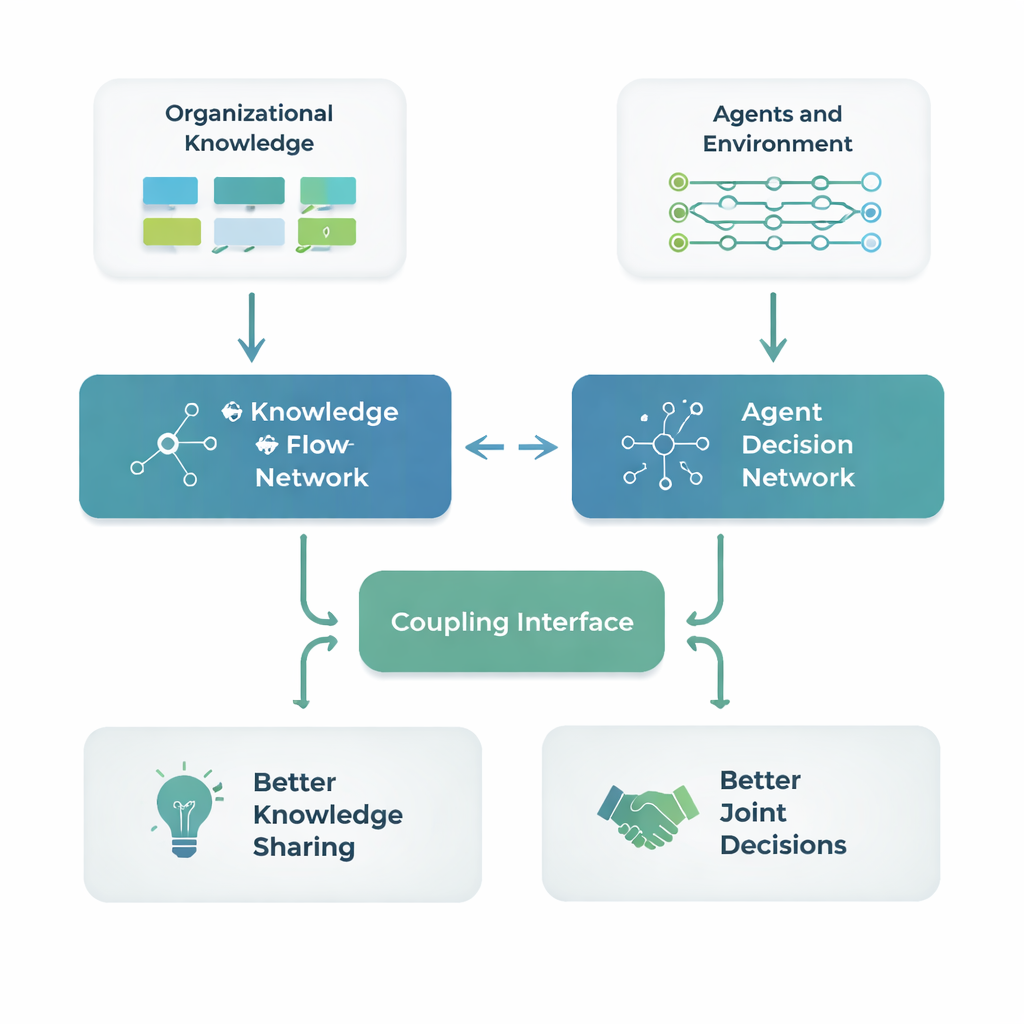
Companies, hospitals, and public agencies increasingly depend on one another’s information to make good decisions—whether that means planning production, routing deliveries, or responding to a crisis. Yet in most real-world networks, knowledge and decisions are handled separately: one group focuses on collecting and sharing data, while another focuses on choosing actions. This paper asks what happens if we treat those two processes as a tightly linked system and uses modern artificial intelligence to model how information flows between organizations and how software agents learn to coordinate their choices on top of that flow.
From scattered facts to a living knowledge network
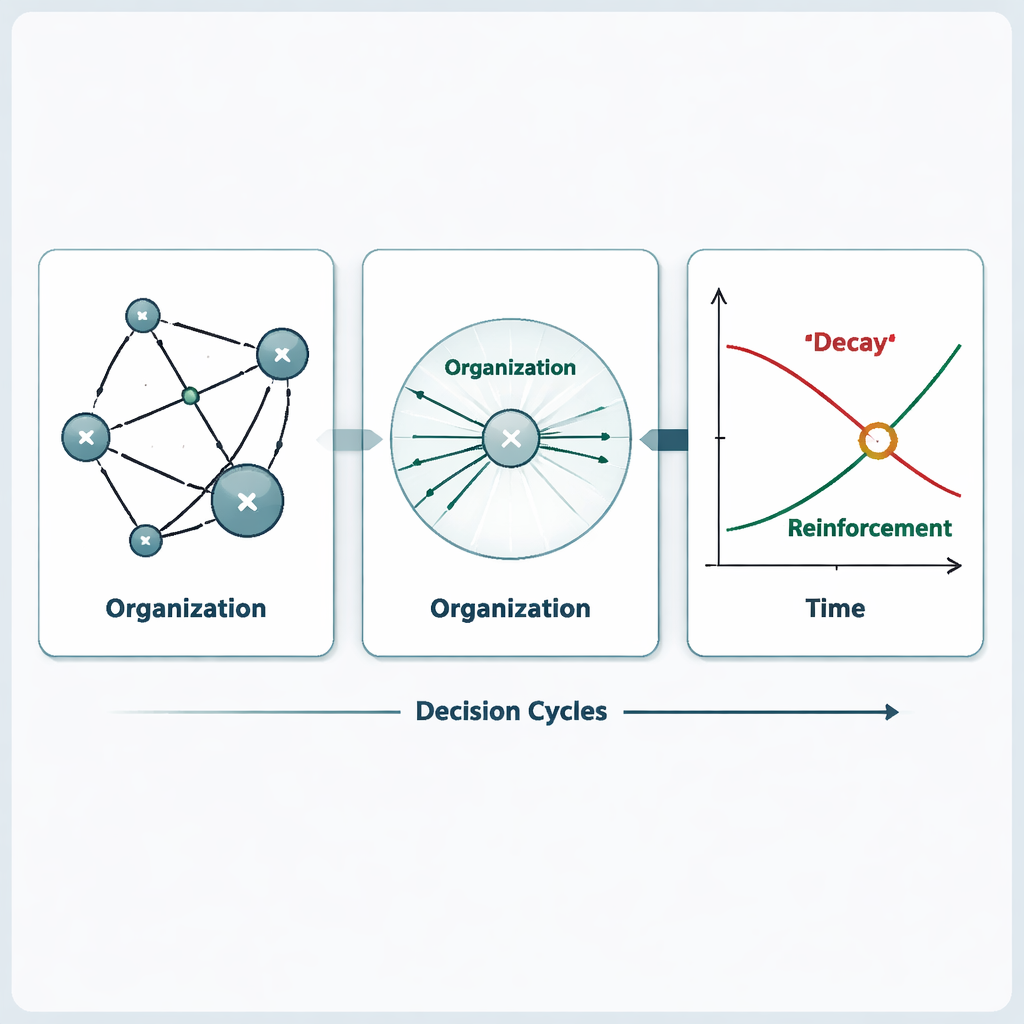
The authors start from a simple observation: knowledge does not sit still. Reports, forecasts, and expert insights move between firms through partnerships, shared platforms, and personal contacts—and they lose value over time if not refreshed. Traditional studies of “knowledge flow” describe who is connected to whom and what makes sharing easier or harder, such as trust, distance, and compatibility. This work keeps those ideas but embeds them in a digital network where each organization is represented as a node whose stock of knowledge changes as information arrives, decays, and is reinforced by use. A deep learning component called a graph attention network learns which connections matter most at any moment, emphasizing paths that reliably carry timely, high‑quality information.
Agents that learn to decide together
On top of this knowledge network sit many software agents, each standing in for a decision-maker such as a factory planner or logistics coordinator. Rather than being centrally controlled, these agents learn to cooperate through reinforcement learning: they repeatedly act, see the results, and adjust their strategies to improve shared outcomes such as lower cost or fewer shortages. Crucially, their view of the world includes not just local facts, but also the evolving knowledge state of their own and partner organizations. An attention mechanism helps each agent focus on the other agents and pieces of information that are most relevant to the current task, supporting flexible coalitions instead of rigid command chains.
A two-way link between knowing and doing
The heart of the paper is the “coupling” between knowledge and decisions. Rather than assuming that better information simply feeds into choices, the model lets the relationship run in both directions. When agents make successful joint decisions, the system treats the supporting knowledge as more valuable, strengthens those information routes, and slows their decay. When coordination fails, it flags missing or misleading knowledge, encouraging the network to seek better sources or new partners. This creates a feedback loop in which knowledge sharing and decision strategies co‑evolve. The strength of the link is tracked over time, revealing how closely changes in information align with changes in performance.
Testing the model in simulated and real worlds
To see whether this coupled approach offers more than a neat theory, the authors run extensive computer experiments. They build large synthetic datasets describing thousands of organizations, millions of knowledge transfers, and many types of multi‑agent decision tasks, from allocating resources to reaching consensus. They compare their framework with several alternatives that either model knowledge without decisions, decisions without knowledge, or simply bolt the two together without a feedback loop. Across a range of benchmarks, the coupled model improves knowledge transfer accuracy and decision success rates by 8–24 percent and learns stable strategies faster, even as scenarios grow more complex. Finally, they deploy the system in a regional supply chain involving manufacturers, logistics providers, and distributors. There, the model helps partners share demand signals more intelligently, cutting overall costs by 18.5 percent, reducing stockouts by 71 percent, and boosting inventory turnover by 42.7 percent.
What this means for everyday organizations
For non-specialists, the key message is that information systems and decision systems work best when designed together. Treating knowledge as a living network that both shapes and is shaped by day‑to‑day choices leads to more reliable forecasts, leaner inventories, and faster, more coordinated responses to change. While the technical machinery relies on deep neural networks and advanced learning algorithms, the underlying idea is intuitive: organizations should pay attention not only to what they know, but also to how using that knowledge changes what gets shared next. The framework in this paper offers a blueprint for turning that intuition into practical tools that can help firms, supply chains, and other networks act smarter as a whole, not just as isolated parts.
Citation: Li, M., Yu, W. & Li, Y. Deep neural network-based coupling model of inter-organizational knowledge flow and agent collaborative decision-making. Sci Rep 16, 6923 (2026). https://doi.org/10.1038/s41598-026-37838-8
Keywords: knowledge sharing, multi-agent systems, collaborative decision-making, graph neural networks, supply chain coordination