Clear Sky Science · en
Bifurcation analysis and soliton solutions of the generalized third-order nonlinear Schrödinger equation using two analytical approaches
Ripples of Light That Refuse to Fade
When we send information through optical fibers or study waves in plasmas and fluids, we rely on special wave packets that can travel long distances without losing their shape. These stubborn waves, called solitons, are the workhorses behind ultra-fast communications and many natural phenomena. This paper explores a more realistic, higher-order model of such waves and shows how they can change, split, or even become chaotic when the surrounding conditions are tweaked.
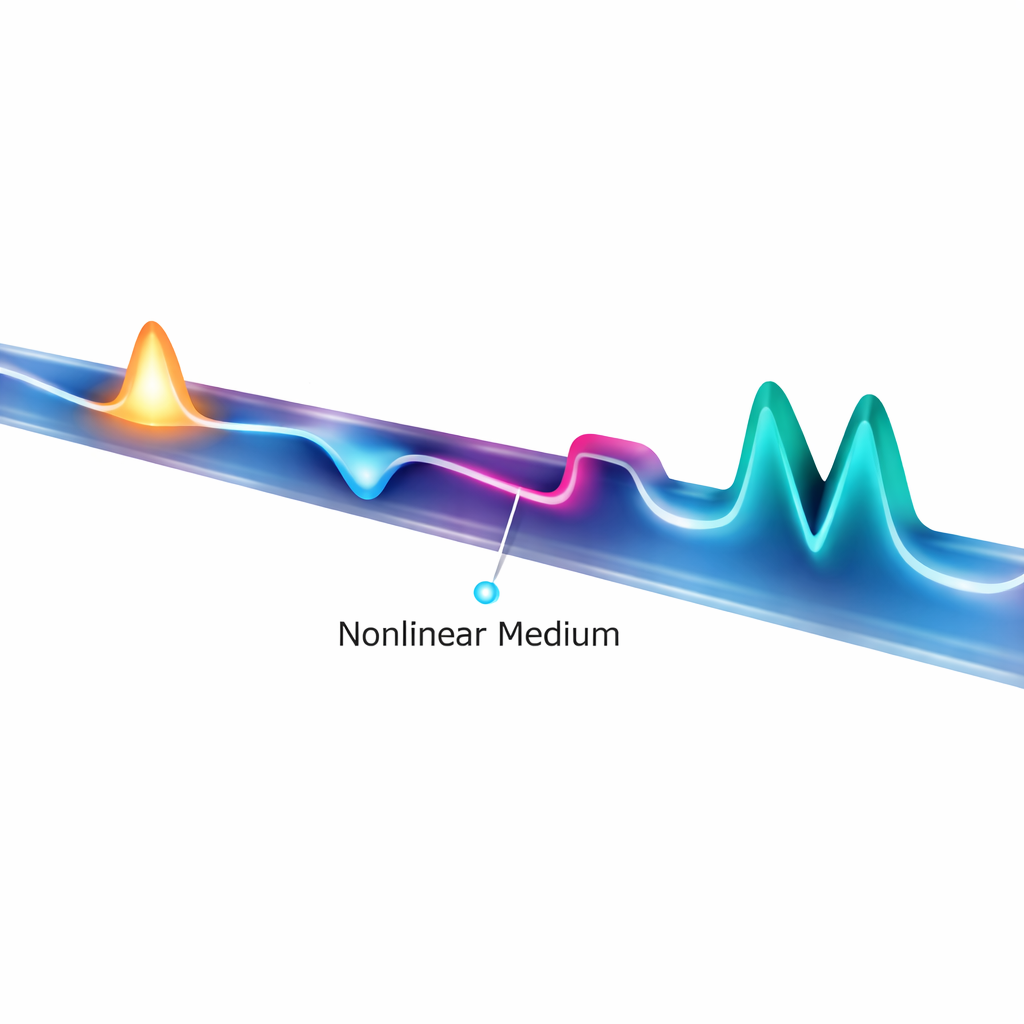
A More Realistic Picture of Traveling Waves
The authors focus on a mathematical model known as the generalized third-order nonlinear Schrödinger equation. While the classic version of this equation already describes how stable wave packets move, the generalized form includes extra terms that become important for very short or very broad pulses, such as those used in modern photonic crystal fibers and plasma systems. These extra ingredients account for effects like tiny delays between different parts of the pulse and subtle distortions in its shape. By working with this richer model, the study aims to capture the full variety of wave patterns that can appear in real-world nonlinear media.
New Ways to Build Wave Shapes
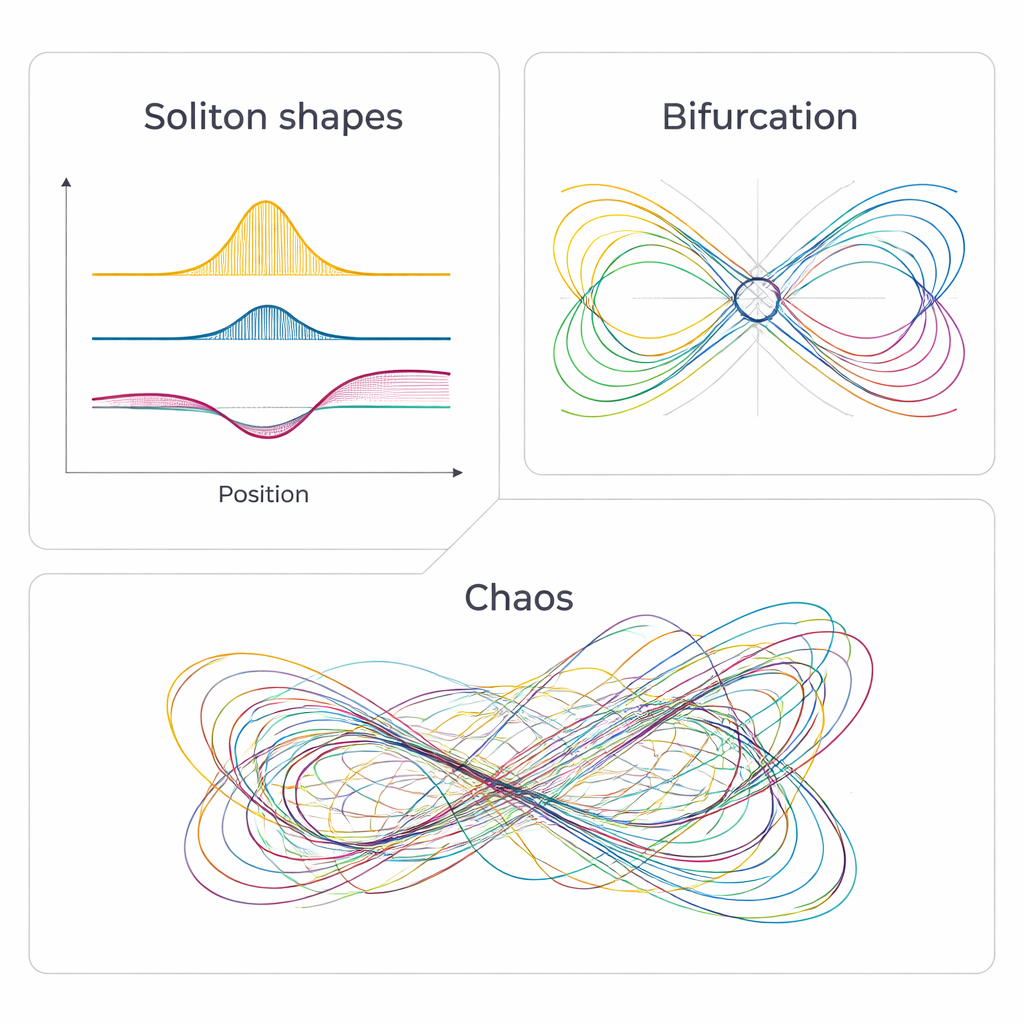
To uncover possible wave patterns, the researchers apply two analytical tools: the generalized auxiliary equation method and the improved modified Sardar-sub equation method. Both techniques turn the original, complicated equation into simpler forms whose solutions are partly known. By cleverly matching terms and balancing derivatives against nonlinear effects, the authors construct exact formulas for many types of solitons. These include bell-shaped (bright) pulses, dips on a background (dark solitons), step-like kinks and anti-kinks, multi-peaked M- and W-shaped waves, periodic wave trains, and even singular waves that spike sharply or become unbounded. Using two different methods on the same model not only broadens the catalog of solutions, but also cross-checks that the behavior is not an artifact of a single technique.
From Orderly Waves to Chaos
Beyond listing possible shapes, the study asks how these waves behave when system parameters change. By rewriting the equation as a planar dynamical system, the authors analyze its fixed points and draw phase portraits that reveal centers, saddles, and the transitions between them—features known as bifurcations. These diagrams show where the system supports stable oscillations, where it flips to new patterns, and where it becomes sensitive to small shifts. The team then adds a periodic disturbance, mimicking external forcing or noise, and observes how the trajectories in phase space can turn from regular loops into tangled, chaotic curves. This chaotic regime illustrates how a system that normally produces clean, stable pulses can, under certain conditions, yield irregular, hard-to-predict waveforms.
Testing Stability and Sensitivity
The authors also perform sensitivity analysis, asking what happens when they nudge key parameters such as those controlling higher-order dispersion and nonlinear strength. By tracking how soliton profiles respond to small changes, they show that many of the constructed waves are robust—retaining their overall shape and stability—while certain parameter combinations trigger qualitative shifts or instabilities. This type of testing is crucial for applications like optical fiber communications, where pulses must remain reliable in the face of manufacturing tolerances, temperature variations, and other real-world imperfections.
Why This Matters for Future Technologies
In plain terms, the paper extends our toolbox for understanding and designing stubborn waves of light and other media. It shows that a more complete equation, combined with advanced analytical methods, can generate a rich family of pulse shapes—from smooth, single peaks to exotic multi-humped patterns—and map out when these patterns are stable, when they bifurcate, and when they descend into chaos. For engineers and physicists, these insights help in predicting when an optical system will deliver clean, well-formed pulses and when it might produce erratic signals. For the broader scientific community, the work deepens our grasp of how complex, nonlinear systems can move seamlessly from order to disorder as their internal knobs are turned.
Citation: Parveen, S., Abbas, M., Nazir, T. et al. Bifurcation analysis and soliton solutions of the generalized third-order nonlinear Schrödinger equation using two analytical approaches. Sci Rep 16, 7065 (2026). https://doi.org/10.1038/s41598-026-37836-w
Keywords: optical solitons, nonlinear waves, chaos and bifurcation, optical fibers, nonlinear Schrödinger equation