Clear Sky Science · en
Ixekizumab for the treatment of psoriatic arthritis: an Italian multicentric retrospective observational study
Why this matters to everyday people
Psoriatic arthritis is a painful condition that affects joints, skin, and daily life, often striking people in their most active years. Many patients cycle through different medicines before finding one that actually works and that they can stay on for the long haul. This study looks at how well a newer drug, ixekizumab, performs in real-world clinics across Italy—not just in carefully controlled trials—asking a simple but crucial question: does it really help people feel better and keep their disease under control over time?
A stubborn disease that hits joints and skin
Psoriatic arthritis combines swollen, stiff, and painful joints with the red, scaly patches of psoriasis on the skin and nails. It can also inflame the spine, the places where tendons attach to bone, and even organs such as the eyes or gut. Many patients are overweight and live with other problems like high blood pressure or depression, which together add to the burden of disease. Because of this complexity, doctors now often speak of "psoriatic disease" rather than just arthritis, highlighting that it is a whole-body condition that can deeply affect quality of life and the ability to work, exercise, and enjoy everyday activities.

A targeted medicine put to the real-world test
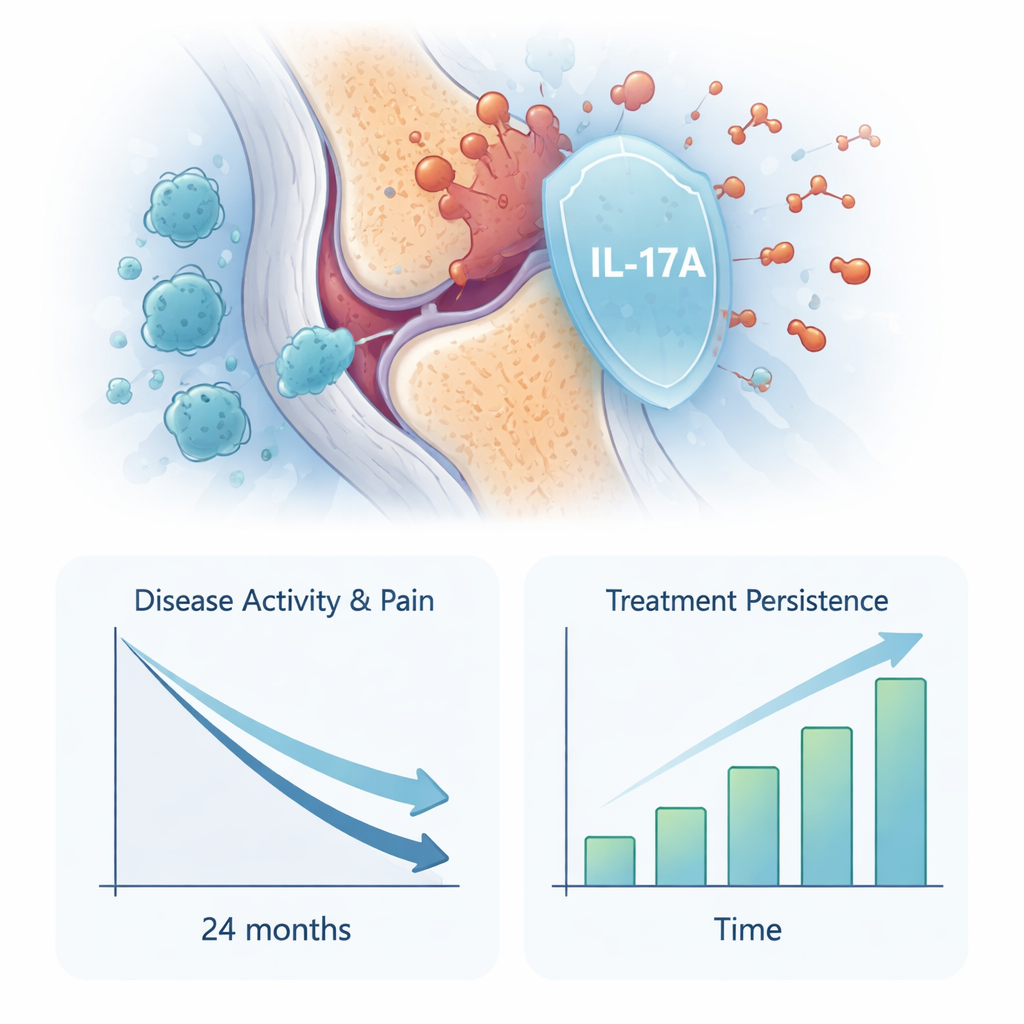
Ixekizumab is an engineered antibody that blocks a key messenger of inflammation called interleukin-17A. It is given as a periodic injection under the skin. Previous clinical trials showed that ixekizumab could reduce joint swelling and skin plaques, but those studies involved highly selected patients under strict protocols. To see how the drug works in routine care, rheumatologists at seven centers in Italy reviewed the records of 132 adults with psoriatic arthritis who had taken ixekizumab for at least three months. Most had painful peripheral joints, about one in three also had spine involvement, and more than half had already tried other advanced drugs before starting ixekizumab.
Fast relief and broad improvements
The researchers tracked several measures over two years, including joint tenderness and swelling, back pain scores, blood markers of inflammation, pain levels, and a questionnaire about daily functioning. Within just three months, patients already showed clear improvements in nearly all of these areas, and these gains were largely maintained over the 24‑month follow-up. By the end of the study, nearly half of the patients who remained on treatment met strict criteria for "remission," meaning their joint disease was almost silent, and more than nine in ten had at least low disease activity. A meaningful share also reached more demanding targets that capture not only joints, but also skin, tendon pain, and daily functioning, indicating that the drug can help several faces of the disease at once.
Sticking with treatment over time
Another important question is whether patients stay on a medicine long enough to benefit from it. In this study, about 82% of people were still on ixekizumab after one year and 73% after two years, a result known as a high drug retention rate. Most of those who stopped did so because the medicine did not work well enough for them over time; a smaller number left due to side effects, which were mostly mild issues such as injection-site reactions or non-serious infections. Previous experience with other biologic drugs, having psoriasis on the skin, or being overweight did not seem to reduce the chances of staying on ixekizumab. However, women were somewhat more likely than men to discontinue the drug, echoing other research showing that women with psoriatic arthritis often report more pain and somewhat poorer responses overall.
What this means for patients and families
For people living with psoriatic arthritis, these findings suggest that ixekizumab can bring rapid and lasting relief of joint pain, stiffness, and skin symptoms in everyday clinical practice, not just in trials. Many patients improved enough to reach low disease activity or remission and were able to remain on therapy for years, with mostly mild side effects. While the study cannot prove cause and effect and did not compare ixekizumab head‑to‑head with other drugs, it supports the idea that this targeted treatment is a strong option for a wide range of patients, including those who are overweight or have already tried other biologic medicines. Ongoing research is exploring why women may respond differently and how ixekizumab stacks up against competing therapies, but for now, the message is encouraging: this drug appears to be a durable and versatile tool in the fight against psoriatic arthritis.
Citation: Gentileschi, S., Terribili, R., Gaggiano, C. et al. Ixekizumab for the treatment of psoriatic arthritis: an Italian multicentric retrospective observational study. Sci Rep 16, 7051 (2026). https://doi.org/10.1038/s41598-026-37835-x
Keywords: psoriatic arthritis, ixekizumab, biologic therapy, interleukin-17, real-world study