Clear Sky Science · en
Anticancer activity of curcumin loaded hybrid system of silver-amine functionalized silica nanoparticles
Turning a Kitchen Spice into a Smarter Cancer Fighter
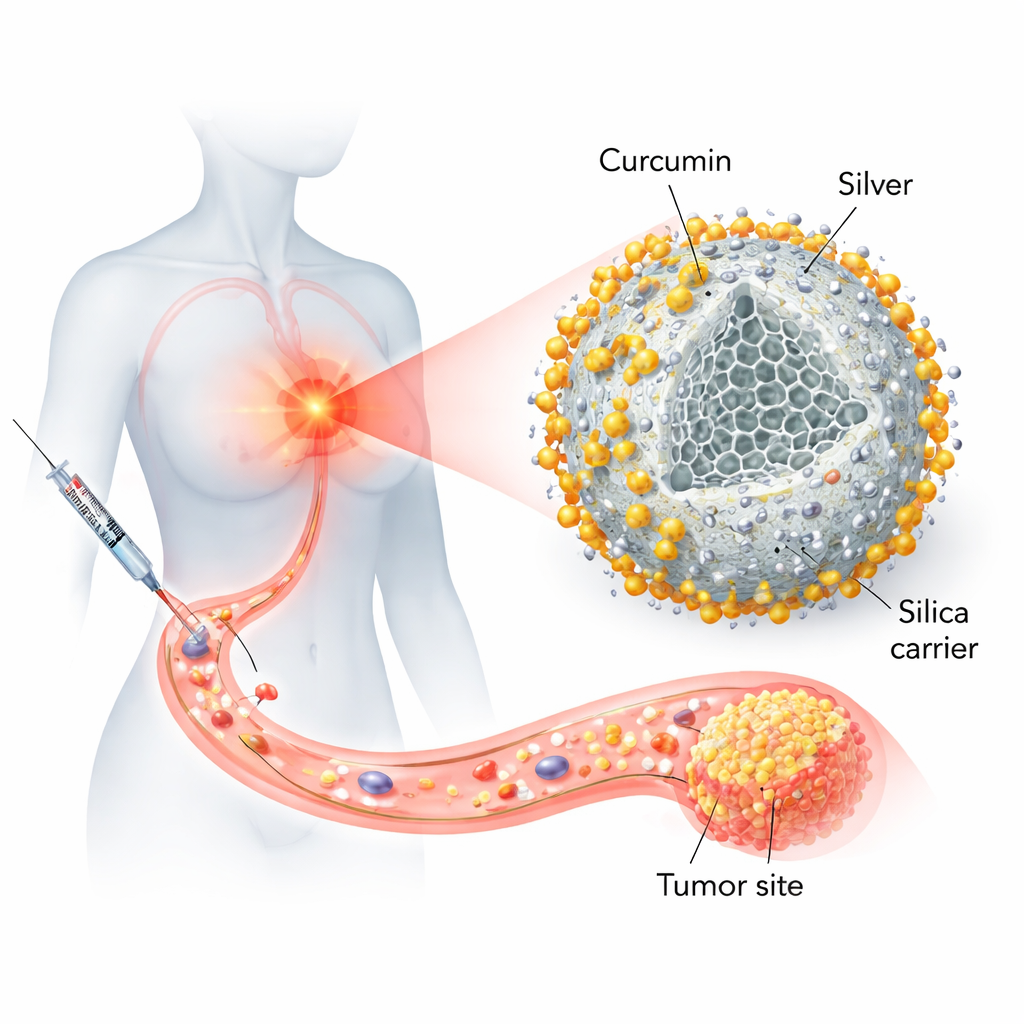
Turmeric, the bright yellow spice in many curries, contains curcumin—a natural compound long touted for its health benefits, including anticancer activity. But curcumin on its own dissolves poorly in water, breaks down quickly in the body, and struggles to reach tumors at helpful doses. This study describes a new way to package curcumin inside tiny engineered particles so that it becomes more stable, more targeted to tumors, and more powerful against cancer cells, while aiming to limit harm to healthy tissue.
Why a Promising Natural Drug Needs a Better Ride
Curcumin can disrupt multiple processes that cancer cells rely on to grow and survive. Unfortunately, when people take curcumin, most of it never reaches the tumor: it clumps instead of dissolving, is cleared from the bloodstream quickly, and cannot be safely injected in high doses. Existing delivery systems—such as fat-based particles or polymer capsules—have improved things somewhat, but they often carry only a small amount of drug, may be unstable, or require complex manufacturing. At the same time, silver nanoparticles are known to damage bacteria and cancer cells by generating reactive molecules inside them, but they, too, can be unstable and sometimes toxic. The researchers set out to combine these two agents—curcumin and silver—inside a carefully designed silica “shell” that could steady both and release the drug where it is most needed.
Building Tiny Carriers from Sand, Silver, and Curcumin
The team first created silica nanoparticles—nanometer-scale spheres made from the same basic material as sand—using a solution-based method that forms uniform, porous particles. They then decorated the surface with amine groups, chemical hooks that improve the attachment of both silver ions and curcumin. Silver was introduced so that it bound tightly to these amines, forming a hybrid silver–silica framework. Finally, curcumin extracted from turmeric roots was loaded into this structure from an alcohol solution. The resulting particles, called CUR@Ag-AFS, packed in a relatively high amount of drug while remaining solid and uniform. A suite of laboratory techniques confirmed that the particles were spherical, that the elements silicon, oxygen, nitrogen, carbon, and silver were all present, and that curcumin was embedded in a more disordered, stable form rather than as brittle crystals.
Designed to Release More Drug Inside Tumors
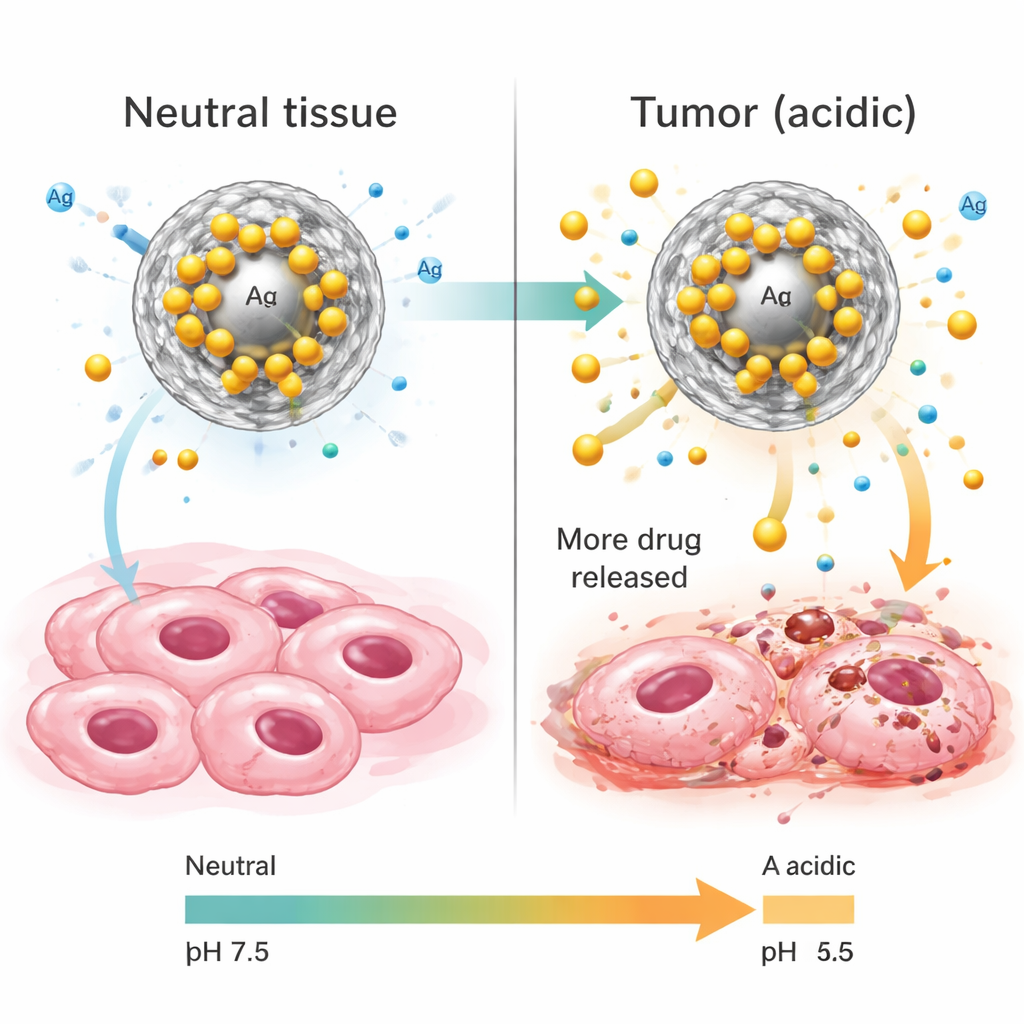
To test how the new carriers behave in different environments, the researchers placed them in fluids that mimicked normal blood and tissues (near-neutral pH) versus the more acidic surroundings typical of tumors and cancer cell compartments. Over 24 hours, the particles released curcumin slowly and steadily, but with a clear pH dependence: they let out the most drug—over 90 percent of their cargo—under acidic conditions similar to those inside tumor cells, and much less under neutral conditions. Mathematical analysis of the release data showed that curcumin primarily diffuses out through the silica’s pores, with acidity weakening the attraction between curcumin and the particle surface. In practical terms, this means the system is tuned to stay relatively quiet in healthy tissues but become far more active in cancerous ones, potentially reducing side effects while maintaining strong local action.
Putting the Particles to the Test Against Cancer Cells
The team then exposed human breast cancer cells (MCF-7) to various formulations: plain silica, silica with amine groups, silica with silver, free curcumin, and the combined CUR@Ag-AFS particles. They measured cell survival after treatment using a standard color-change test that reflects metabolic activity. Among all nanoparticle systems, the curcumin–silver–silica hybrid was the most effective at killing cancer cells, second only to the conventional chemotherapy drug doxorubicin used as a positive control. The hybrid particles achieved the same level of cancer cell death at markedly lower concentrations than free curcumin or silver-containing particles alone, suggesting a synergistic effect. Importantly, the underlying silica framework itself showed comparatively low toxicity, indicating that most of the anticancer punch came from the curcumin–silver combination and the way it was delivered.
What This Could Mean for Future Cancer Care
In accessible terms, the researchers have built a kind of smart, microscopic sponge from silica that soaks up curcumin and silver, protects them during circulation, and then lets them go faster once they reach the acidic environment of a tumor. This design both boosts the cancer-killing power of curcumin and helps aim it more directly at diseased cells, while the silica structure adds stability and control. Although this work was done in the lab and on cell cultures—not yet in animals or patients—it points toward a future in which natural compounds like curcumin, paired with carefully engineered nanomaterials, could contribute to cancer treatments that are more targeted, longer lasting, and potentially easier on the rest of the body.
Citation: Shafqat, S.S., Wakeel, M., Zubair, M. et al. Anticancer activity of curcumin loaded hybrid system of silver-amine functionalized silica nanoparticles. Sci Rep 16, 7026 (2026). https://doi.org/10.1038/s41598-026-37829-9
Keywords: curcumin nanoparticles, targeted cancer therapy, silver nanocarriers, pH-responsive drug delivery, breast cancer cells