Clear Sky Science · en
Climate change impacts on agricultural production in Ethiopia using panel data
Why this matters for food and families
Across the globe, more people are relying on farmers to fill their plates, even as the climate becomes less predictable. Ethiopia, where most food is grown by small family farms, is on the front line of these shifts. This study asks a simple but vital question: as temperatures rise and rains change, what happens to the income farmers earn from their land—and what does that mean for the country’s food supply?
Farms under pressure
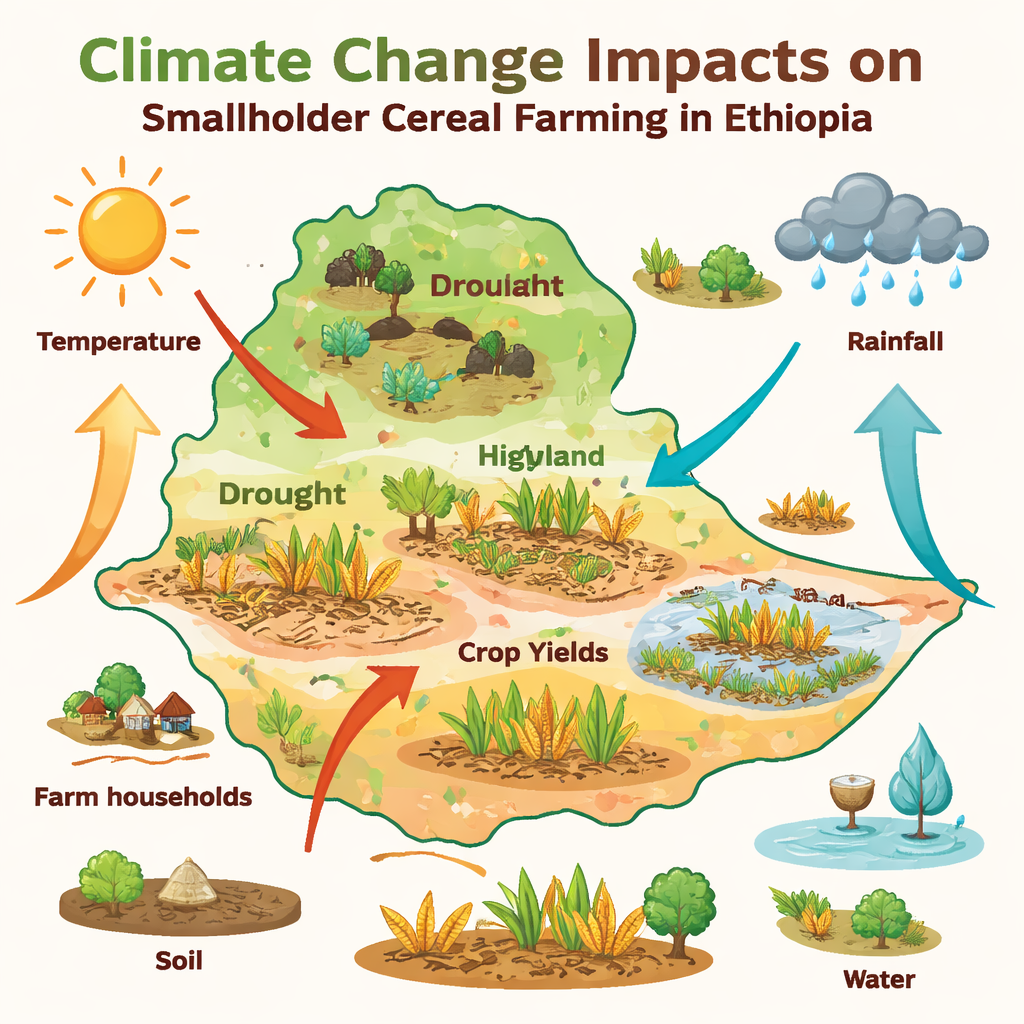
Ethiopia’s economy depends heavily on agriculture, especially cereals such as maize, wheat, barley, sorghum, millet, and teff. Most of these crops are grown by smallholders who already struggle with poor soils, limited technology, and erratic weather. Climate change adds another layer of stress: hotter days, shifting seasons, and bursts of heavy rain or prolonged dry spells. Because many Ethiopian farms rely on rainfall rather than irrigation, even small changes in temperature and rainfall can make the difference between a good harvest and a failed one.
Following farms over time
To understand what is really happening on the ground, the researchers followed the same farm households over two points in time, in 2018/19 and again in 2021/22. They combined detailed Ethiopian survey data on thousands of individual plots with long-term weather records from NASA satellites and future climate projections from several leading global climate models. Instead of just counting bags of grain, they focused on net farm revenue—how much money farmers keep after paying for seeds, fertilizer, and other costs. Using an approach known as the Ricardian method, they examined how this revenue changes with different levels of temperature and rainfall, while taking into account factors like soil type, land slope, and farmers’ adaptation choices such as fertilizer use, soil conservation, and improved seeds.
What the climate is already doing to crops
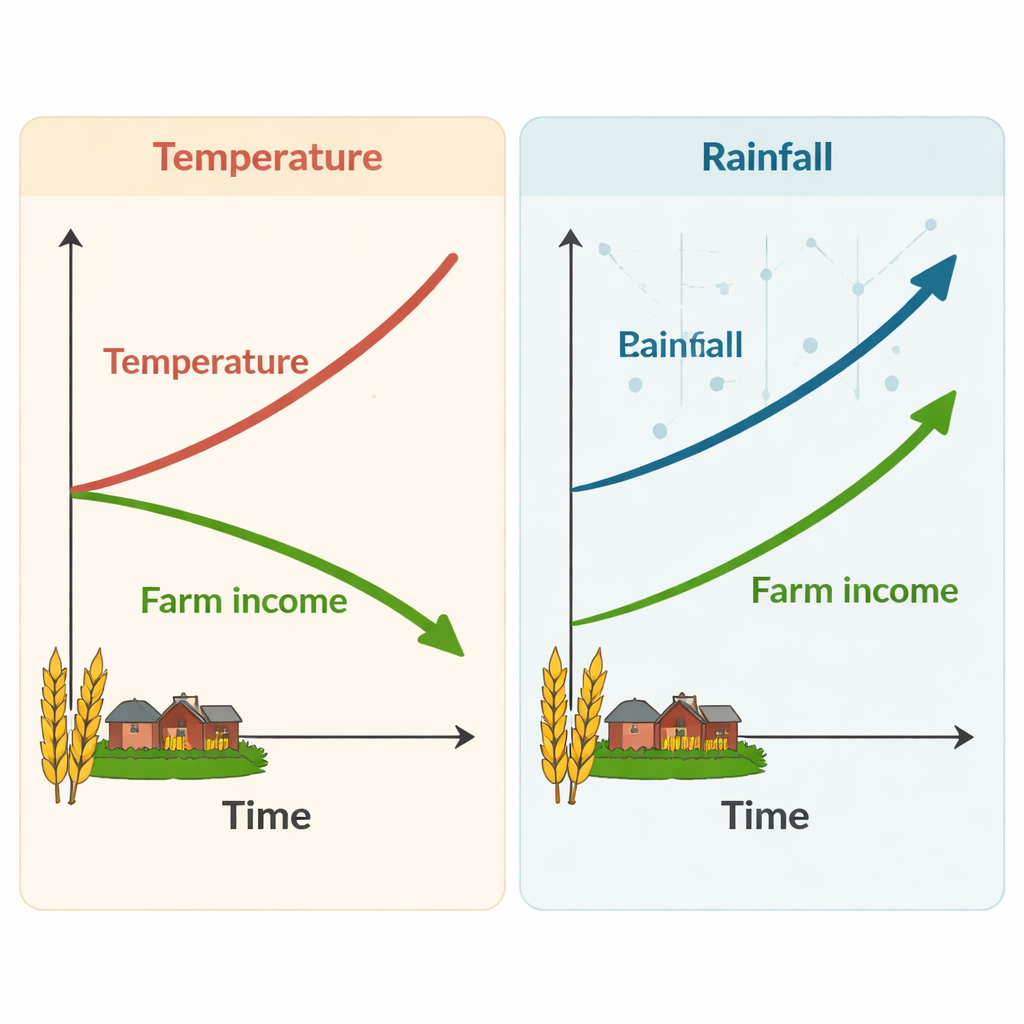
The analysis shows that climate change is not some distant threat; it is already shaping earnings from Ethiopian cropland. On average, higher annual temperatures today are linked to lower farm revenue, while more rainfall—especially during the main rainy seasons—tends to raise incomes. When rains are adequate in the Belg (short rains) and Kiremt (main rains) seasons, crops get the water they need and farmers earn more. But hotter conditions speed up water loss from plants and disturb growth, cutting into yields and profits. These effects are not uniform across the country. In cooler, highland areas, modest warming can sometimes help crops grow, whereas in warmer, mid-altitude zones, further heat is largely harmful. Still, across the six major cereal crops, the pattern is strikingly similar: too much heat lowers returns, and well-timed rain helps.
Looking ahead to 2055 and 2100
Using the latest global climate scenarios, the study projects that Ethiopia will warm by roughly 1 °C by the mid‑2050s and between about 1 and 4 °C by the end of the century, depending on future greenhouse gas emissions. Rainfall is expected to rise overall in most models, though not in every season or every region. When these future climates are fed into the farm-income model, a clear picture emerges. Rising temperatures are projected to have a consistently negative impact on smallholder crop revenue in both 2055 and 2100, while increased rainfall generally improves it—up to a point. The balance between heat and moisture will matter: more rain cannot fully make up for the damage from excessive heat, especially if it falls at the wrong time of year, such as during harvest, when overly wet conditions can ruin crops.
Finding smart ways to adapt
The study also examines how farmers’ choices can soften climate impacts. Households that combine several adaptation strategies—such as using organic and chemical fertilizers, rotating crops, conserving soil, and planting improved seed varieties—often earn more than those who make no changes or adopt a single measure. However, piling on too many costly measures can reduce profits if expenses outrun gains. Farm characteristics matter as well: secure land rights, better soil quality, and plots free from erosion are all linked to higher earnings. These findings suggest that practical support—from credit and extension advice to affordable inputs—can help farmers select a sensible mix of low-cost, high-return adaptations.
What this means for food security
For a lay reader, the message is straightforward but sobering. As Ethiopia gets hotter, climate change is set to chip away at the incomes of small cereal farmers, even if rainfall increases. This threatens both household livelihoods and national food supplies. Yet the study also shows that the damage is not inevitable. With well-designed policies that encourage soil conservation, smarter water use, better seeds, and secure land rights—tailored to different local environments—farmers can capture the benefits of good rains and shield themselves from some of the harm caused by rising temperatures. In plain terms, investing now in climate‑savvy farming is one of the surest ways to keep food on the table in a warming world.
Citation: Asmare, G.W., Beyene, A.D., Mussa, E.C. et al. Climate change impacts on agricultural production in Ethiopia using panel data. Sci Rep 16, 7015 (2026). https://doi.org/10.1038/s41598-026-37818-y
Keywords: climate change, Ethiopia agriculture, smallholder farmers, cereal crops, climate adaptation