Clear Sky Science · en
Field study on heat transfer performance and thermo-mechanical properties of pre-bored PHC energy pile
Turning Building Foundations into Silent Energy Helpers
As cities search for cleaner ways to heat and cool buildings, engineers are eyeing something that already lies beneath our feet: the foundations that hold structures up. This study looks at a new kind of foundation pile that can quietly move heat in and out of the ground while still doing its main job of supporting a building. By testing these “energy piles” at full scale, the researchers show how well they transfer heat and how safely they handle the extra push and pull that temperature changes create inside the concrete.
Why Use the Ground for Heating and Cooling?
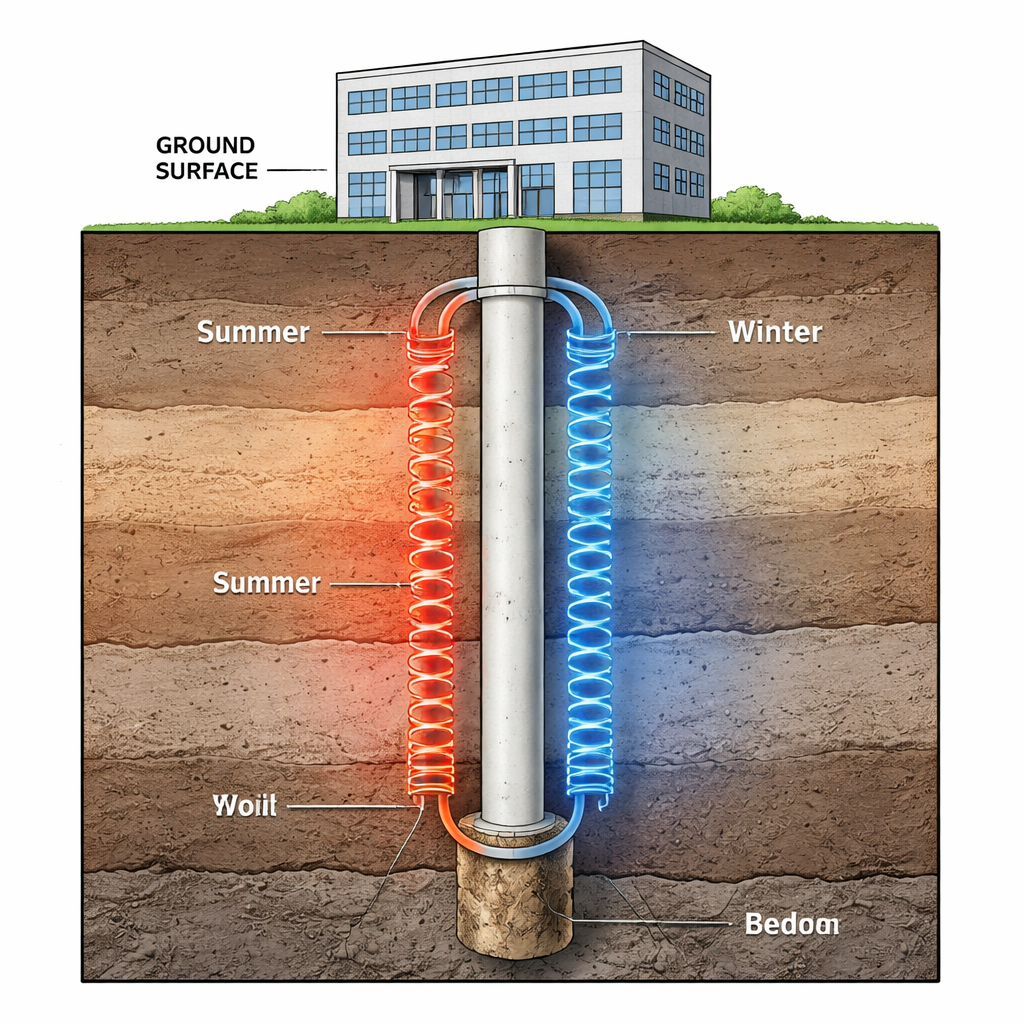
Conventional ground source heat pump systems cool and heat buildings by circulating fluid through long pipes buried in boreholes. While efficient, these systems require extra drilling that takes up underground space and raises construction costs. Energy piles combine structural support and heat exchange in one element: the same concrete piles that carry the weight of a building also host plastic pipes that move heat-carrying water. This research focuses on a particular version called a pre-bored PHC energy pile, where a high-strength concrete pile is lowered into a pre-drilled, grout-filled hole, with the heat exchange pipes fixed to the outside of the pile rather than tucked inside it. That simple shift in pipe location turns out to matter a lot for both performance and durability.
A New Pile Design That Protects the Pipes
In dense Chinese cities, traditional bored piles create messy slurry and driven piles can overly compact the soil, limiting their use. The pre-bored grouted planted (PGP) pile avoids both problems by drilling a hole, filling it with cemented soil, and then inserting the precast pile into this soft column. The authors adapted this method into a “pre-bored PHC energy pile” by gluing plastic heat exchange pipes directly to the outside of the concrete pile before insertion. Because the pile slides into still-fluid cemented soil, the pipes see very little resistance and are shielded from damage. In a real project with 46 such piles, the pressure in every pipe stayed unchanged after installation, indicating that none were broken—a 100% survival rate, which is noticeably better than many conventional approaches.
Measuring Heat Flow Deep Underground
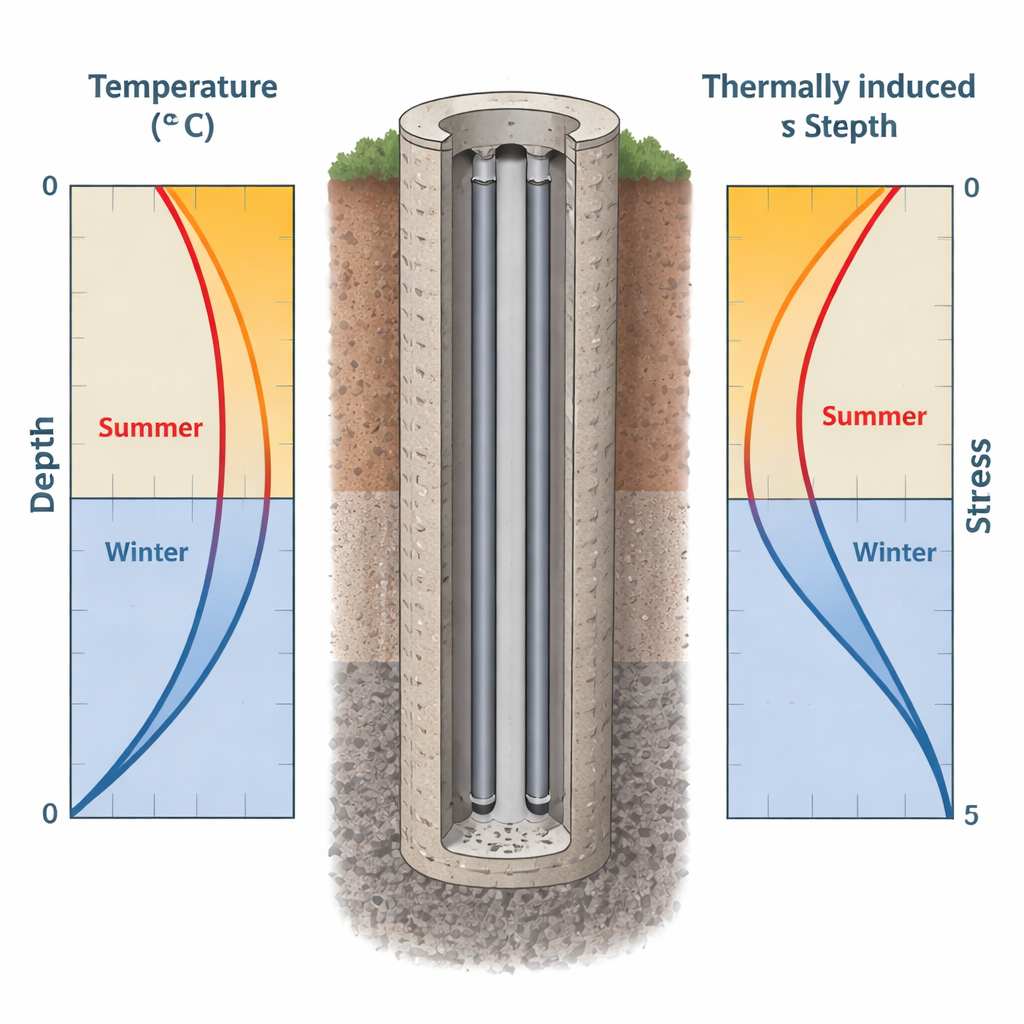
To see how well these piles move heat, the team instrumented two full-scale piles, each 45 meters long, with distributed fiber optic sensors bonded along the concrete surface. These ultra-thin glass fibers measure temperature and strain continuously along the pile depth. First, the researchers ran a constant heat flow test to determine how readily the surrounding soil conducts heat, finding an overall thermal conductivity of about 1.98 watts per meter per degree Celsius—typical for moist clays and silts. Then they mimicked real building operation. Under “summer” conditions, warm water at about 35 °C was circulated through the pipes for 48 hours. Each pile delivered around 77–85 watts of heat per meter of length, giving an average of 81.3 W/m. That is higher than typical values for many conventional energy piles and even better than many standard ground source heat pump boreholes, likely because the pipes are in direct contact with the surrounding soil rather than buried in the cooler interior of the concrete.
How Heat Makes a Foundation Expand and Contract
Whenever the pile is heated or cooled, it wants to expand or contract, but the surrounding soil and the building above partly hold it in place. This restraint turns temperature change into mechanical stress inside the concrete. The fiber optic sensors captured tiny stretches and squeezes (measured as microstrain) along the pile as it warmed and cooled. Under summer heating, the piles expanded, showing the largest strains at the free head and base but the greatest internal compression in the middle, where movement was most restricted by the soil. The resulting thermally induced compressive stress peaked at about 2 megapascals (MPa), far below the concrete’s compressive strength of roughly 80 MPa. Under winter conditions, when 8 °C water cooled the pile, the concrete shrank and tensile (pulling) strains appeared. The maximum tensile stress reached about −1.6 MPa near mid-depth—still below the pile’s tensile strength but already around 20% of its estimated limit, a sign that repeated cycles over many seasons could become important for long-term safety.
What This Means for Future Buildings
The study shows that pre-bored PHC energy piles can reliably combine structural support with efficient heat exchange, with excellent pipe survival during installation and higher-than-usual heat output per meter. For everyday building owners and city planners, this means foundations could quietly help cut energy use and emissions without demanding extra underground space. At the same time, the work flags a key design concern: in cold-season operation, the piles experience noticeable tensile stresses that need to be accounted for, especially over many years of heating and cooling cycles. Future research will focus on how these stresses build up over time, but the early message is promising—our foundations can do double duty as hidden, long-lived components of cleaner heating and cooling systems.
Citation: Zhou, Jj., Zhang, Rh., Yu, Jl. et al. Field study on heat transfer performance and thermo-mechanical properties of pre-bored PHC energy pile. Sci Rep 16, 7781 (2026). https://doi.org/10.1038/s41598-026-37817-z
Keywords: energy piles, ground source heat pump, geothermal foundations, building heating and cooling, urban underground energy