Clear Sky Science · en
COL8A1 promotes prostate cancer progression via modulating tumor immune infiltration and activating the FAK/PI3K/AKT pathway through ADAMTS2 regulation
Why this research matters
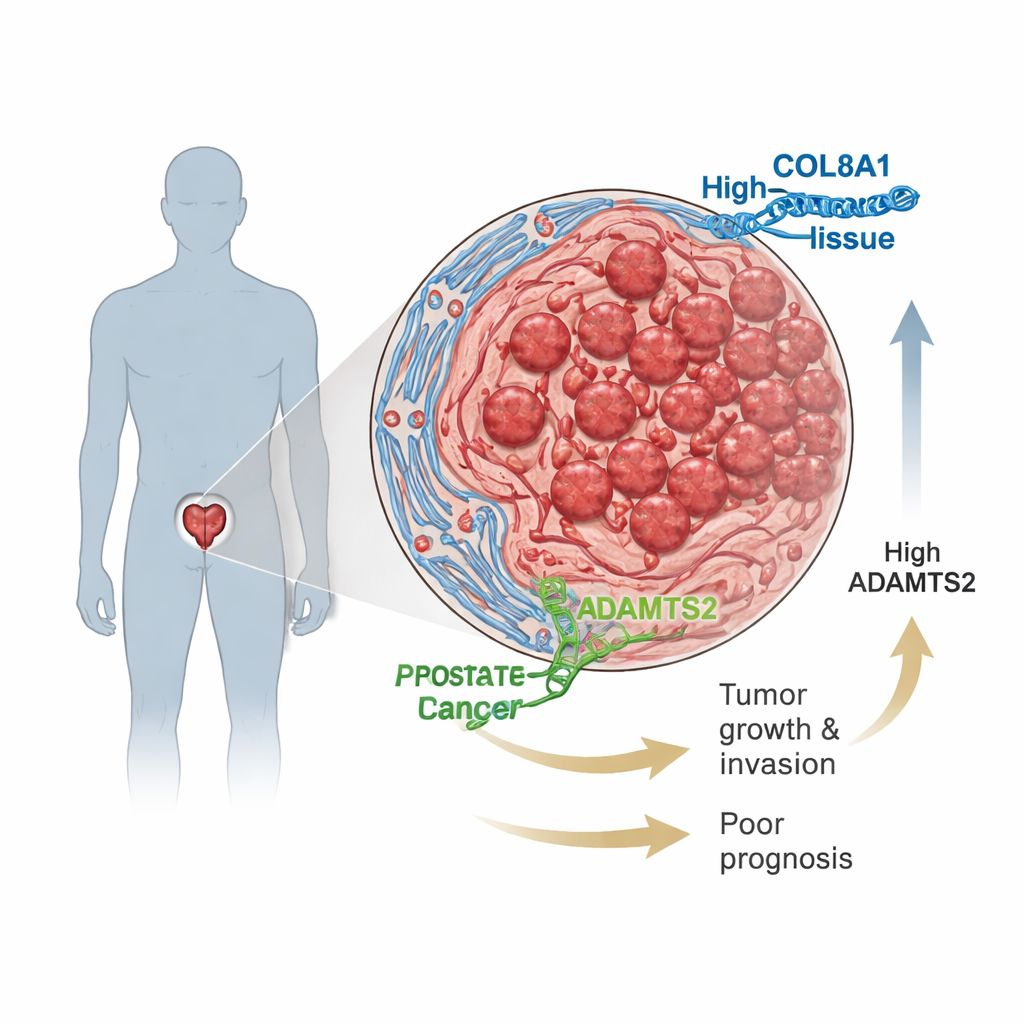
Prostate cancer is one of the most common cancers in men, yet doctors still struggle to predict who will develop aggressive disease and how best to stop it. This study uncovers how a little-known structural protein, COL8A1, helps prostate tumors grow, spread, and interact with the body’s immune system. Understanding this hidden driver could open the door to more accurate tests and new targeted treatments.
A structural protein with a dark side
COL8A1 is part of collagen, the scaffolding that helps hold our tissues together. Normally, it resides in blood vessel and supporting cells, quietly maintaining structure. The researchers used large public cancer databases and samples from men undergoing prostate surgery to ask a simple question: is COL8A1 altered in prostate cancer? They found that COL8A1 levels were much higher in tumor tissue than in nearby healthy prostate, and that patients with the highest levels tended to have more advanced disease, higher Gleason scores, and shorter periods before their cancer worsened. This pattern held even in men with low PSA levels, hinting that COL8A1 might flag dangerous tumors that current blood tests miss.
From lab dish to living mice
To see what COL8A1 actually does, the team manipulated its levels in prostate cancer cells grown in the lab. When they forced cells to make more COL8A1, the cells multiplied faster, moved more easily, invaded through artificial barriers, and were less likely to undergo programmed cell death. Dialing down COL8A1 had the opposite effect: growth slowed, invasion dropped, and more cells died. These are all hallmarks of a more or less aggressive cancer cell. The scientists then implanted prostate cancer cells with or without COL8A1 into mice. Tumors lacking COL8A1 grew much more slowly and were smaller, confirming that this protein helps drive tumor growth in living organisms.
A molecular partner in crime
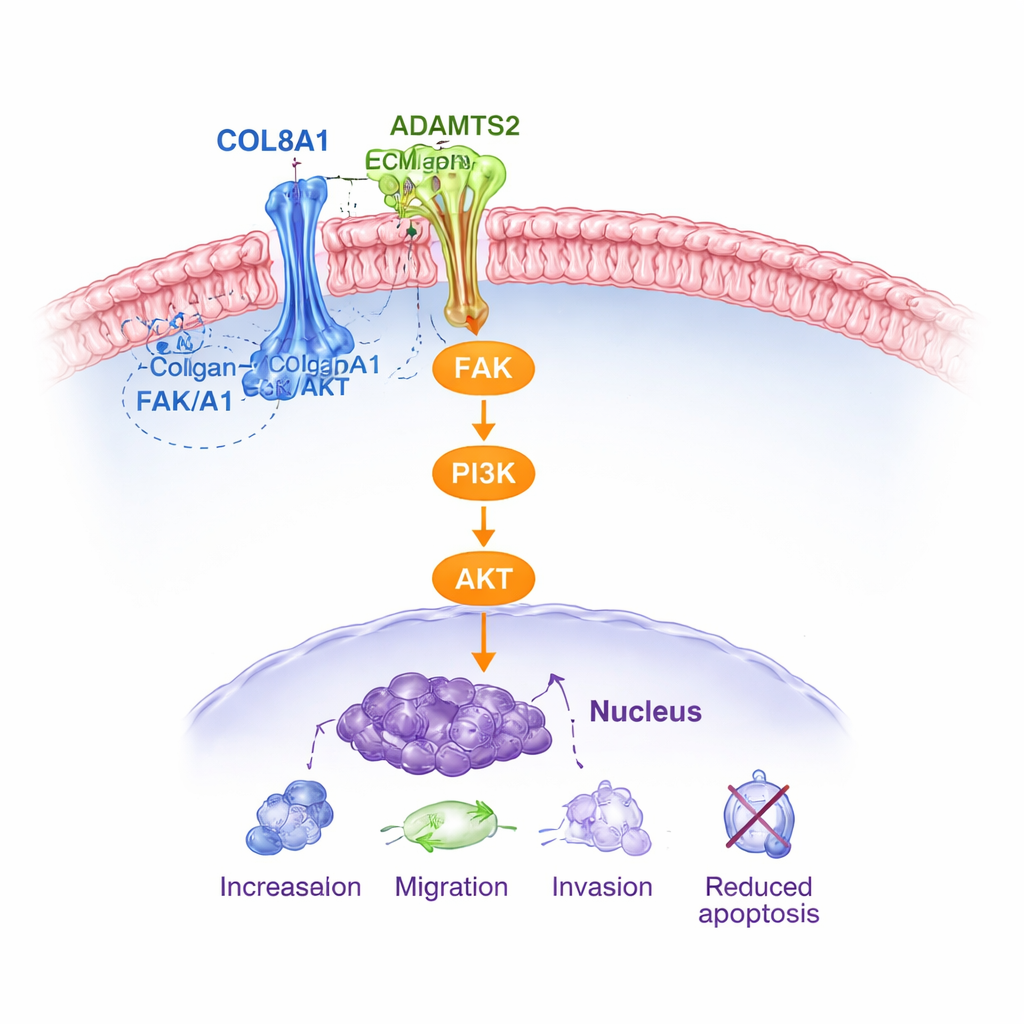
Diving deeper, the researchers searched for other genes that track closely with COL8A1 in prostate tumors. One, called ADAMTS2, stood out. ADAMTS2 is an enzyme that remodels the tissue environment around cells. In both patient datasets and hospital samples, ADAMTS2 was also elevated in prostate tumors and linked to worse clinical features and outcomes. In cancer cells, boosting COL8A1 increased ADAMTS2 protein, while reducing COL8A1 lowered it, even though ADAMTS2’s genetic message (mRNA) stayed the same. This suggested COL8A1 protects or stabilizes the ADAMTS2 protein. Experiments confirmed that the two proteins physically bind to each other. When the team turned down ADAMTS2, many of the aggressive behaviors triggered by COL8A1 weakened, showing that ADAMTS2 is a key middleman in this harmful pathway.
Switching on a powerful growth circuit
The study also reveals how this COL8A1–ADAMTS2 duo communicates with the cell’s core growth machinery. Using computer analyses and protein measurements, the authors showed that high COL8A1 is linked to activation of a well-known signaling chain inside cells called the FAK/PI3K/AKT pathway. This pathway tells cancer cells to survive, divide, move, and resist death. Extra COL8A1 raised the “on” signal (phosphorylated forms) of FAK, PI3K, and AKT, while removing COL8A1 dampened it. Importantly, interfering with ADAMTS2 partially turned this signal down, both in cultured cells and in mouse tumors. Together, the data outline a clear route: COL8A1 binds and stabilizes ADAMTS2, which in turn helps flip the FAK/PI3K/AKT switch that fuels prostate cancer progression.
Reshaping the immune neighborhood
Beyond cancer cells themselves, the team looked at the surrounding immune landscape. By comparing tumors with high versus low COL8A1 in a large patient cohort, they found that high COL8A1 went hand in hand with heavier infiltration by several immune cell types, including macrophages and certain T cells that have been linked to worse outcomes in prostate cancer. While the study does not yet prove that COL8A1 directly summons or reprograms these cells, it suggests that this protein helps sculpt an immune environment that ultimately favors the tumor.
What this means for patients
In accessible terms, this research shows that COL8A1 is more than a passive building block: in prostate cancer, it behaves like an accomplice that stiffens the local tissue, stabilizes a damaging enzyme, and flips on growth signals inside tumor cells, while also being associated with a more hostile immune neighborhood. Because high COL8A1 and ADAMTS2 reliably mark more aggressive disease, they could serve as new biomarkers to refine risk prediction beyond PSA alone. Even more promising, drugs that disrupt the COL8A1–ADAMTS2 connection or block the downstream FAK/PI3K/AKT pathway might one day slow tumor growth and spread, offering men with high-risk or treatment-resistant prostate cancer new options grounded in the biology of their disease.
Citation: Wang, J., Ning, J., Xu, L. et al. COL8A1 promotes prostate cancer progression via modulating tumor immune infiltration and activating the FAK/PI3K/AKT pathway through ADAMTS2 regulation. Sci Rep 16, 6744 (2026). https://doi.org/10.1038/s41598-026-37799-y
Keywords: prostate cancer, COL8A1, ADAMTS2, tumor microenvironment, PI3K AKT signaling