Clear Sky Science · en
Silicon and methionine enhance cowpea water stress tolerance
Helping crops face longer dry spells
In many dry regions, farmers depend on cowpea, a hardy bean that feeds both people and livestock. Yet longer and more frequent droughts driven by climate change are pushing even tough crops to their limits. This study explores whether two inexpensive substances sprayed on leaves—silicon and the amino acid methionine—can help cowpea plants better endure a severe lack of water and bounce back quickly once rains return.
Testing simple sprays in tough conditions
The researchers grew a Brazilian cowpea variety called “BRS Exuberante” in pots inside a greenhouse in northeastern Brazil. After the plants were established, they stopped watering them for ten days to mimic a sharp drought, then resumed irrigation for two days to simulate a brief recovery. Some plants received only water (the control), while others were sprayed with a silicon solution, a methionine solution, or a combination of both at doses drawn from earlier studies. Throughout vegetative and early reproductive stages, the team carefully measured leaf water content, cell damage, protective molecules, leaf pigments, and growth and yield-related traits such as leaf area, total dry mass, and water use efficiency. 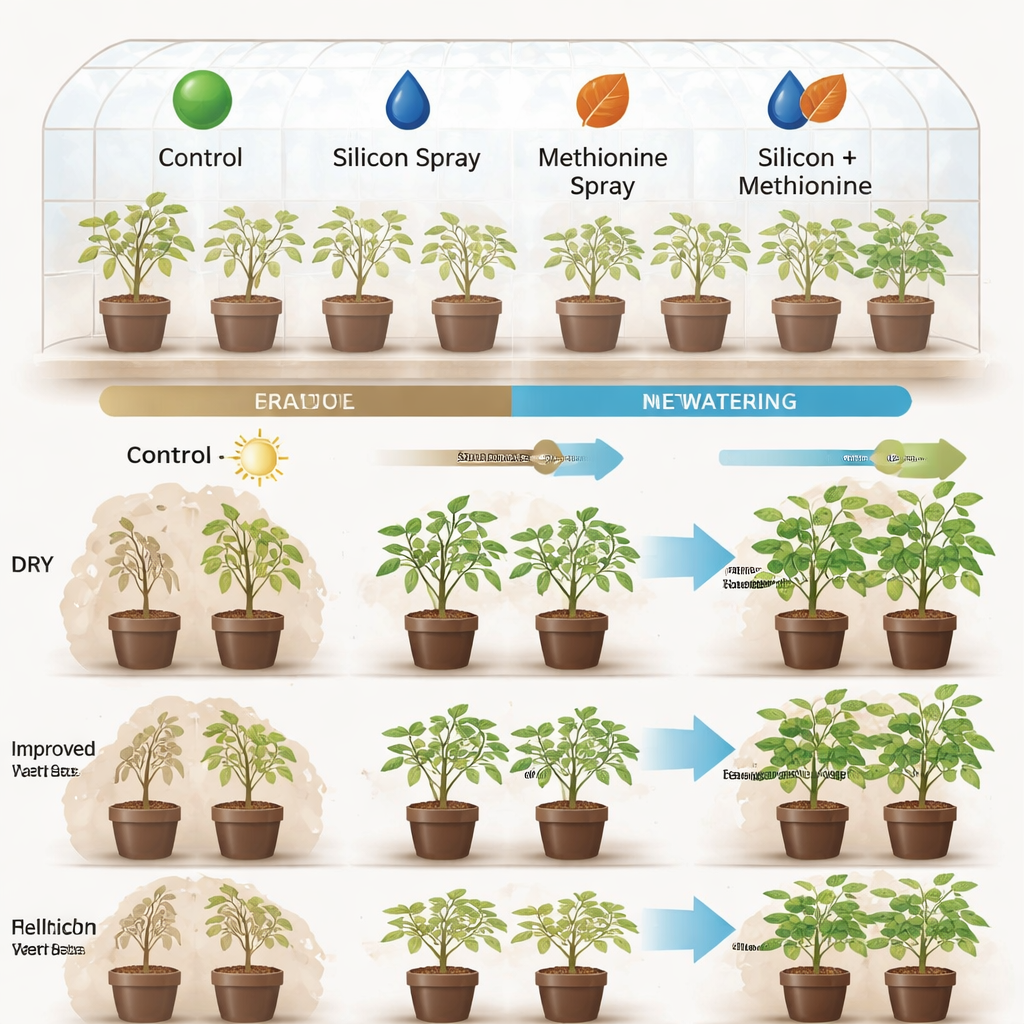
How silicon and methionine protect thirsty plants
Under drought, untreated plants quickly lost water from their leaves, showed more damage to cell membranes, and accumulated molecules that signal stress. Plants sprayed with silicon or methionine, however, held onto water better and suffered less internal damage. Silicon treatments were especially effective at keeping leaf tissues hydrated and reducing markers of membrane breakdown. Methionine, in turn, boosted the pool of soluble proteins and helped reinforce antioxidant enzymes that neutralize harmful reactive oxygen species produced during stress. In practical terms, silicon tended to strengthen the physical and water-handling side of the plant, while methionine bolstered its biochemical defenses.
Recovering when the water returns
Once irrigation resumed, all plants began to recover, but those treated with silicon or methionine rebounded faster and more completely. They restored leaf water content more efficiently, showed steeper drops in stress-related compounds, and rebuilt their internal balance of sugars and other small molecules. These reserves were then channeled into renewed growth. Treated plants produced larger total leaf area, accumulated more dry biomass, and improved their water use efficiency—that is, they created more plant material per unit of water supplied. In several cases, the combination of silicon and methionine offered benefits similar to or slightly better than each substance alone, pointing to complementary modes of action. 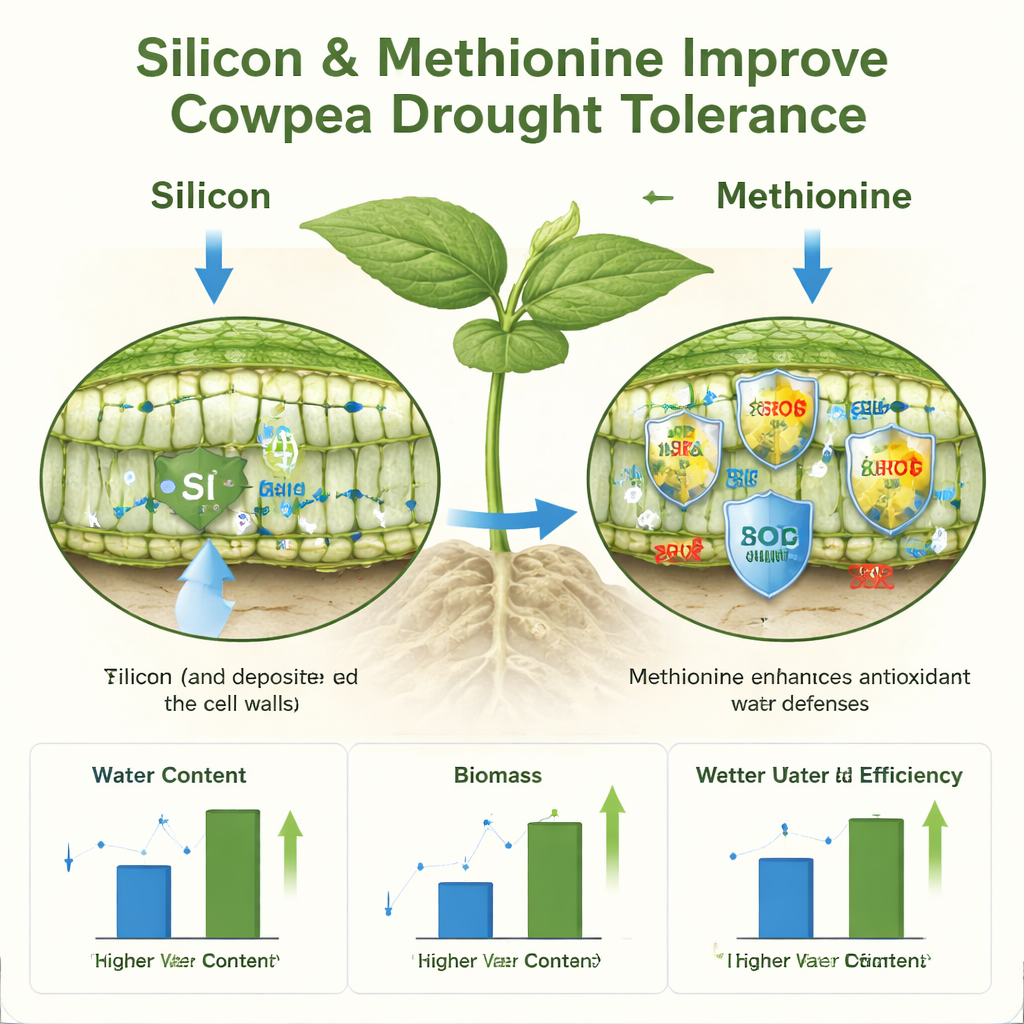
Greener leaves and steadier photosynthesis
Drought usually causes leaves to yellow as chlorophyll breaks down and photosynthesis falters. In this study, silicon in particular helped maintain chlorophyll a and b and total chlorophyll, especially during the most critical stages of water shortage. Treated plants also preserved accessory pigments like carotenoids and anthocyanins, which protect the photosynthetic machinery from excess light and oxidative stress. As a result, growth indicators such as crop growth rate, leaf area duration, and net assimilation rate stayed higher in silicon- and methionine-treated plants than in the control group, even under restricted irrigation. This suggests that the sprays allowed cowpea to keep capturing light and turning it into biomass more effectively throughout the stress and recovery cycle.
What this means for farmers and food security
For a non-specialist, the key message is straightforward: a few foliar sprays of silicon and methionine helped cowpea plants stay healthier during a harsh dry spell and recover more strongly afterward. Silicon mainly acted like a structural helper that reduced water loss and preserved leaf function, while methionine acted like a metabolic booster that strengthened internal repair and protection systems. Together, they increased the plant’s flexibility to cope with changing water availability. Although this work was done in a greenhouse, it points to a promising, relatively low-cost strategy to make drought-prone crops more resilient, supporting yields and food security in semi-arid regions.
Citation: Dias, G.F., Bonou, S.I., de Oliveira Viana, P.M. et al. Silicon and methionine enhance cowpea water stress tolerance. Sci Rep 16, 6800 (2026). https://doi.org/10.1038/s41598-026-37795-2
Keywords: drought tolerance, cowpea, silicon, methionine, water stress recovery