Clear Sky Science · en
A continuous artificial bee colony algorithm for solving uncapacitated facility location problems
Smarter Ways to Place Warehouses
Any company that ships goods faces a basic but costly question: where should we put our warehouses or service centers so we can serve customers cheaply and reliably? This paper tackles that puzzle using an algorithm inspired by the way honey bees search for food, and shows how a refined version of this bee-inspired method can plan such locations more accurately and more consistently than many rival techniques.
The Challenge of Choosing Locations
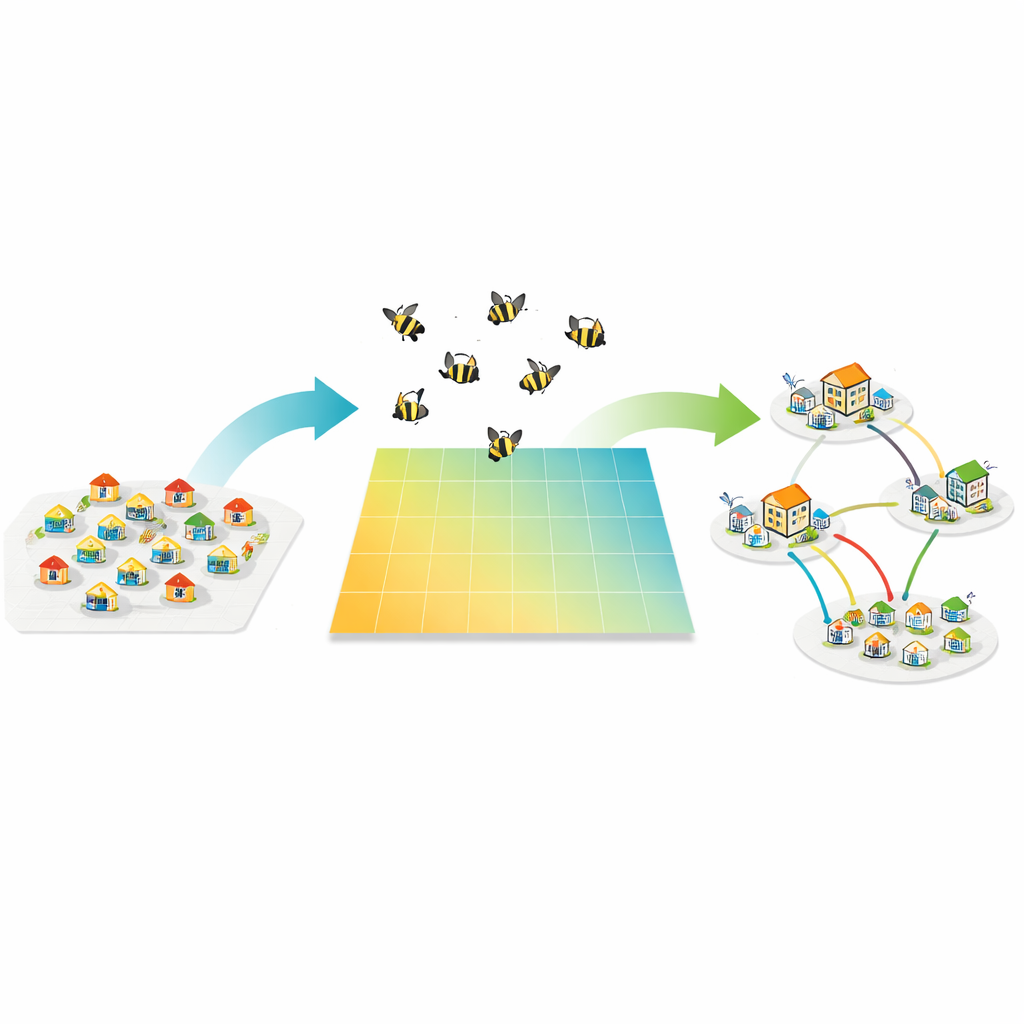
The mathematical problem behind warehouse siting is called the uncapacitated facility location problem. Imagine a list of potential places where you could open warehouses, each with a fixed opening cost, and a map of customers, each of whom must be served from exactly one open site, at some delivery cost. The goal is to decide which sites to open, and which customers each site should serve, so that the total of opening and delivery costs is as low as possible. Even for computers, the number of possible combinations grows explosively as the network gets larger, which means we need clever search strategies rather than brute force.
Learning from the Way Bees Forage
The artificial bee colony (ABC) algorithm borrows from how real bees explore their environment. In the algorithm, each “bee” represents one possible solution. Employed bees explore around their current solution, onlooker bees focus on promising ones, and scout bees abandon poor choices and jump to new regions. ABC was originally built to tweak continuous numerical values, like sliding a dial up or down. However, warehouse siting decisions are essentially yes-or-no choices: open this site or not; assign this customer here or elsewhere. Classic ABC therefore struggles unless it is wrapped in extra machinery to translate between smooth numbers and on/off decisions.
Turning Smooth Search into Sharp Decisions
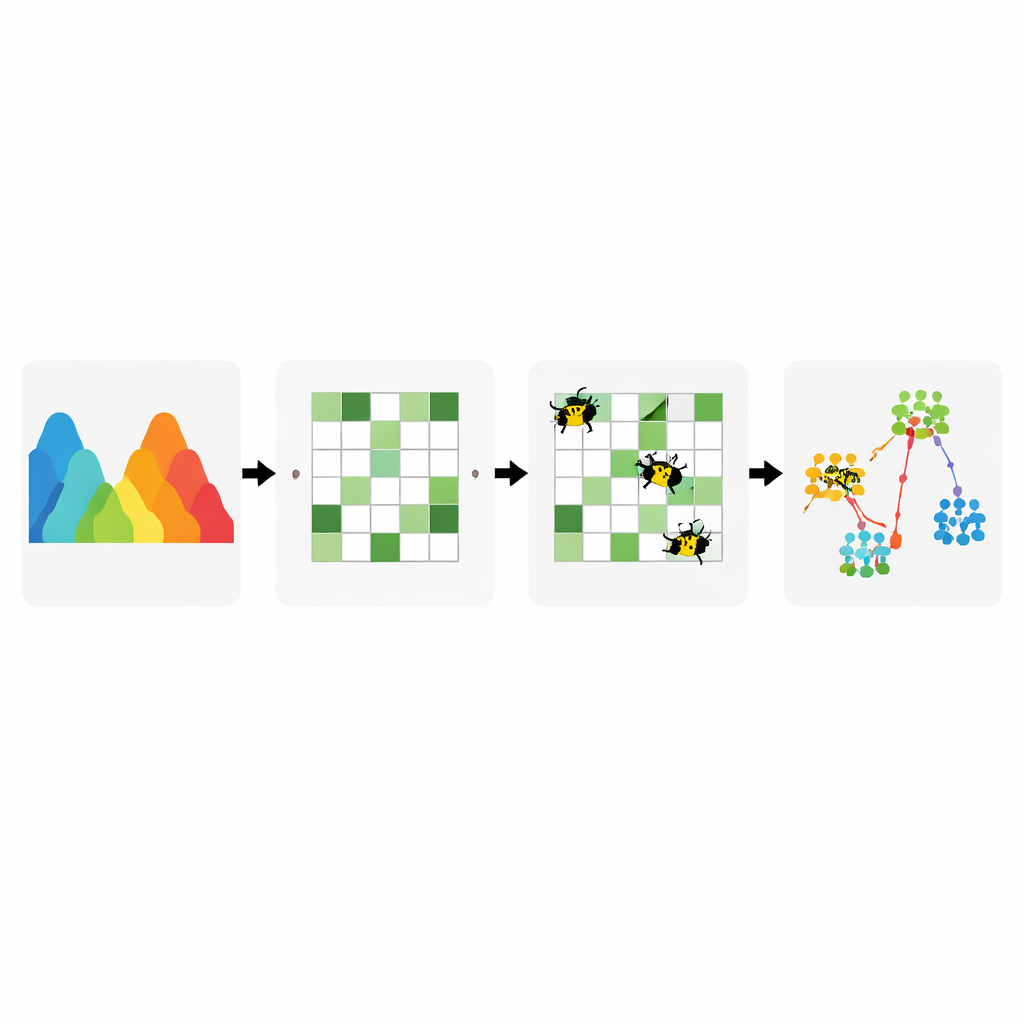
The authors propose a variant they call continuous ABC, or cABC, that keeps the smooth search of the original method but makes it naturally handle on/off choices. It lets the algorithm roam in a continuous space between 0 and 1, treating each value as the probability that a facility is open. A simple rule then converts these into crisp open-or-closed decisions. To avoid starting from a poor or narrow set of guesses, cABC uses a “chaotic” pattern to scatter its initial solutions widely across the search space. When a trial solution implies that no facility is opened at all, or otherwise breaks the rules, a dynamic repair process automatically adjusts several of its choices so that it becomes workable without drifting too far from promising regions.
Guided Swarms and Adaptive Tweaks
Beyond this basic setup, cABC adds several refinements to help the virtual bees cooperate more effectively. Instead of always adjusting a bee’s position based only on itself and a random partner, the algorithm sometimes lets other randomly chosen solutions guide the change, occasionally using very good ones and sometimes poorer ones to keep both focus and variety. A time-varying scheme gradually perturbs more parts of a solution as the search progresses, allowing deeper sharing of information among bees. During the stage where onlooker bees choose which solutions to refine, a modified probability rule ensures that even mediocre candidates get some attention, reducing the risk that the swarm collapses too quickly around a single option. Finally, when a bee’s position has failed for too long, cABC does not throw it away; instead, it creates an “opposite” version of that solution, which often lands closer to better territory while still reusing knowledge already gained.
Putting the Bee Swarm to the Test
To see whether these ideas pay off, the authors ran cABC on two large collections of standard test problems drawn from the operations research literature, covering networks from modest to very large in size. They compared its results with those of the original ABC and with eleven other advanced algorithms based on different metaphors, including fireflies, crows, grasshoppers, and tree seeds. Across these tests, cABC not only matched or improved on the very best known costs in most cases, it also did so far more reliably, often hitting the best solution in nearly every independent run. Its advantage was especially clear on the largest and most demanding examples, where other methods frequently got stuck in more expensive arrangements.
What This Means for Real-World Planning
In plain terms, this work delivers a more dependable “bee-inspired” planner for deciding where to put warehouses, plants, or service hubs. By letting the algorithm think in smooth probabilities and then cleanly snap them into yes-or-no decisions—while repairing bad guesses and maintaining diversity—cABC explores the landscape of options both broadly and deeply. The outcome is a tool that can find cheaper layouts and do so consistently, making it a strong candidate for companies and planners who need to design cost-effective distribution networks in a world of complex, large-scale logistics.
Citation: An, M., Xiang, W., Jiang, Y. et al. A continuous artificial bee colony algorithm for solving uncapacitated facility location problems. Sci Rep 16, 8780 (2026). https://doi.org/10.1038/s41598-026-37792-5
Keywords: facility location, swarm intelligence, metaheuristic optimization, logistics planning, artificial bee colony