Clear Sky Science · en
Longitudinal associations between cognitive ability and socioeconomic status are partially genetic in nature
Why some people get ahead
Why do some young adults end up with more education and better jobs than others, even when they grow up in similar homes or schools? This study looks at a surprisingly sensitive piece of that puzzle: how much of the link between intelligence test scores and later success in education and work can be traced back to genes, and how much to life experiences. Understanding this balance helps us think more clearly about opportunity, fairness and what social policies can—and cannot—easily change.
Following twins into early adulthood
The research drew on TwinLife, a large study that has been tracking thousands of twin families across Germany. Twins are especially useful because identical twins share essentially all their genes, while same-sex fraternal twins share only about half, yet both usually grow up in the same family. In this project, twins were given an intelligence test at around age 23, and their education levels and jobs were measured four years later, at about age 27. Education was captured with two scales that range from basic schooling to doctoral degrees, and jobs were rated both by prestige and by how high they stand in the labor market hierarchy. 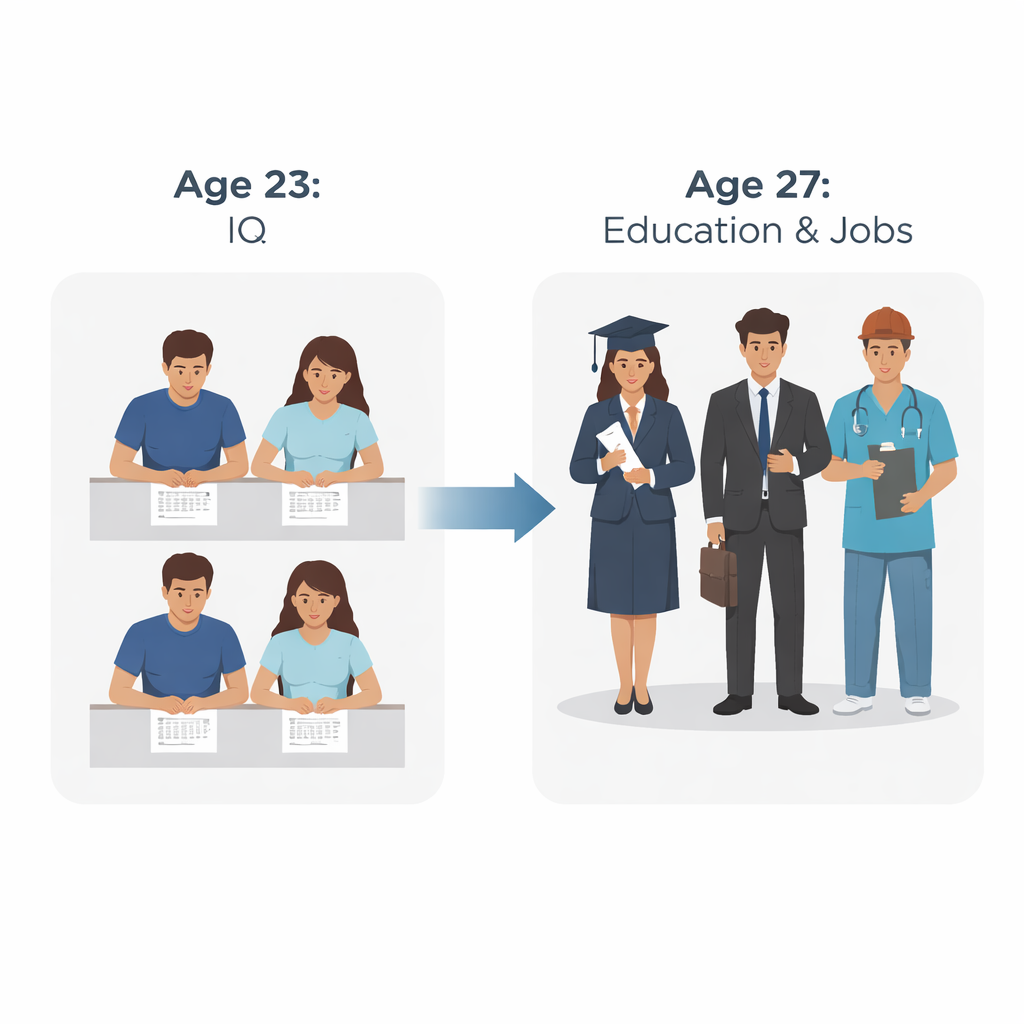
Testing brains, books and jobs
Cognitive ability was measured with a well-established test that asks people to spot patterns, solve visual puzzles and reason under time pressure—skills that underlie many kinds of problem-solving rather than knowledge of specific school subjects. By the late twenties, many participants had already moved into university studies, vocational training or full-time work. This made it possible to ask: do higher test scores at 23 actually foreshadow more years of education and more desirable jobs at 27, and if so, are these links mostly shared by identical twins or do they differ within twin pairs?
Genes loom large in both IQ and status
Using standard twin methods, the study first split differences in intelligence and socioeconomic status into three parts: genetic influences, family-wide influences (such as parents’ income or parenting style) and individual experiences (such as particular teachers, friends or lucky breaks). Intelligence in these young adults turned out to be highly heritable—about three quarters of the differences between people could be traced to genetic differences, with the rest linked to unique experiences and measurement noise. Measures of education and occupation were also partly genetic, on average showing close to half of their variation tied to genes. Family-wide influences played a smaller and less consistent role than often assumed.
Most of the IQ–success link is genetic
The key question was how much of the connection between early-adult intelligence and later education and jobs comes from shared genes versus shared experiences. Bivariate models that follow traits over time showed that the bulk of the association was genetic: for links between IQ and education, roughly 70–80% of the connection reflected overlapping genetic factors; for links between IQ and occupational measures, this figure climbed to about 98%. In contrast, shared environmental pathways from IQ to later education or job status were modest, and for occupation in particular, almost negligible. In other words, the same inherited factors that help raise a person’s test scores also tend to make further schooling and higher-status jobs more likely. 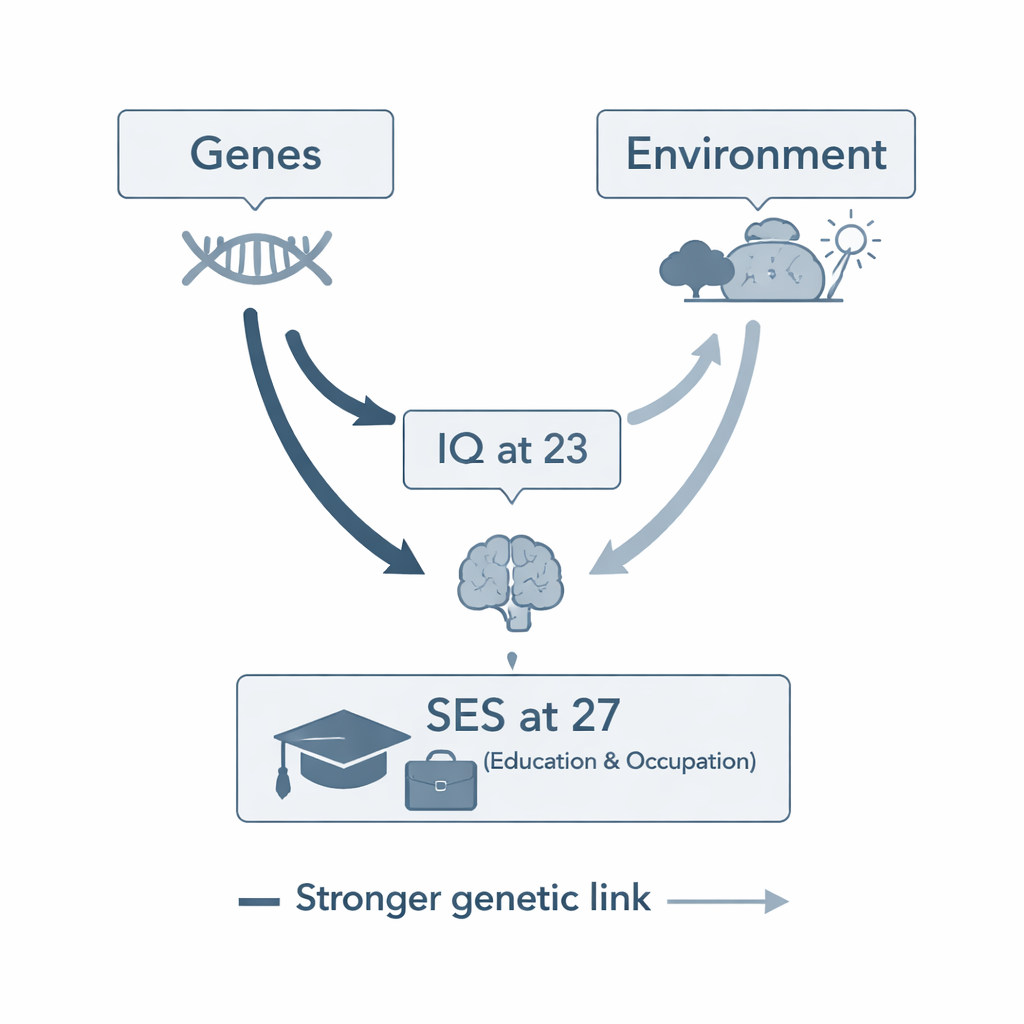
What this does—and does not—mean
These findings do not imply that there are specific “social class genes” or that fate is fixed. Intelligence itself is only one ingredient of life success, and in this sample it explained at best a quarter of the differences in education and job outcomes. Policies, institutions and personal choices still matter greatly, and the four-year window studied here captures only an early slice of adult life. What the results do suggest is that genetic differences between individuals play a substantial role in who gets which opportunities, even in a society with broad access to schooling. For researchers and policymakers, the message is that efforts to reduce inequality must reckon with inborn differences as well as environments, or risk drawing misleading conclusions about what interventions can achieve.
Citation: Kajonius, P.J. Longitudinal associations between cognitive ability and socioeconomic status are partially genetic in nature. Sci Rep 16, 4315 (2026). https://doi.org/10.1038/s41598-026-37786-3
Keywords: intelligence and education, genetics of social mobility, twin studies, socioeconomic status, IQ and careers