Clear Sky Science · en
Spatiotemporal variation and decomposition of early neonatal mortality in Ethiopia using demographic health survey data
Why the First Week of Life Matters
The first seven days after birth are the riskiest time in a child’s life, especially in low-income countries. This study looks at how and where newborns die in their first week in Ethiopia, and what is driving changes over time. Understanding these patterns is important not only for families and health workers in Ethiopia, but also for anyone interested in how data and mapping can guide life‑saving care for the world’s most vulnerable babies.
Following Newborns Across a Changing Country
To uncover long‑term patterns, the researcher combined data from five large national health surveys carried out between 2000 and 2019, covering more than 80,000 babies in their first week of life. These surveys record whether a baby survived, where the family lives, how and where the birth took place, and details such as the mother’s education and age, birth spacing and breastfeeding. Using this information, the study tracked changes in early neonatal deaths — deaths within the first seven days — across both time and geography.
Gains in Survival, but Progress Is Uneven
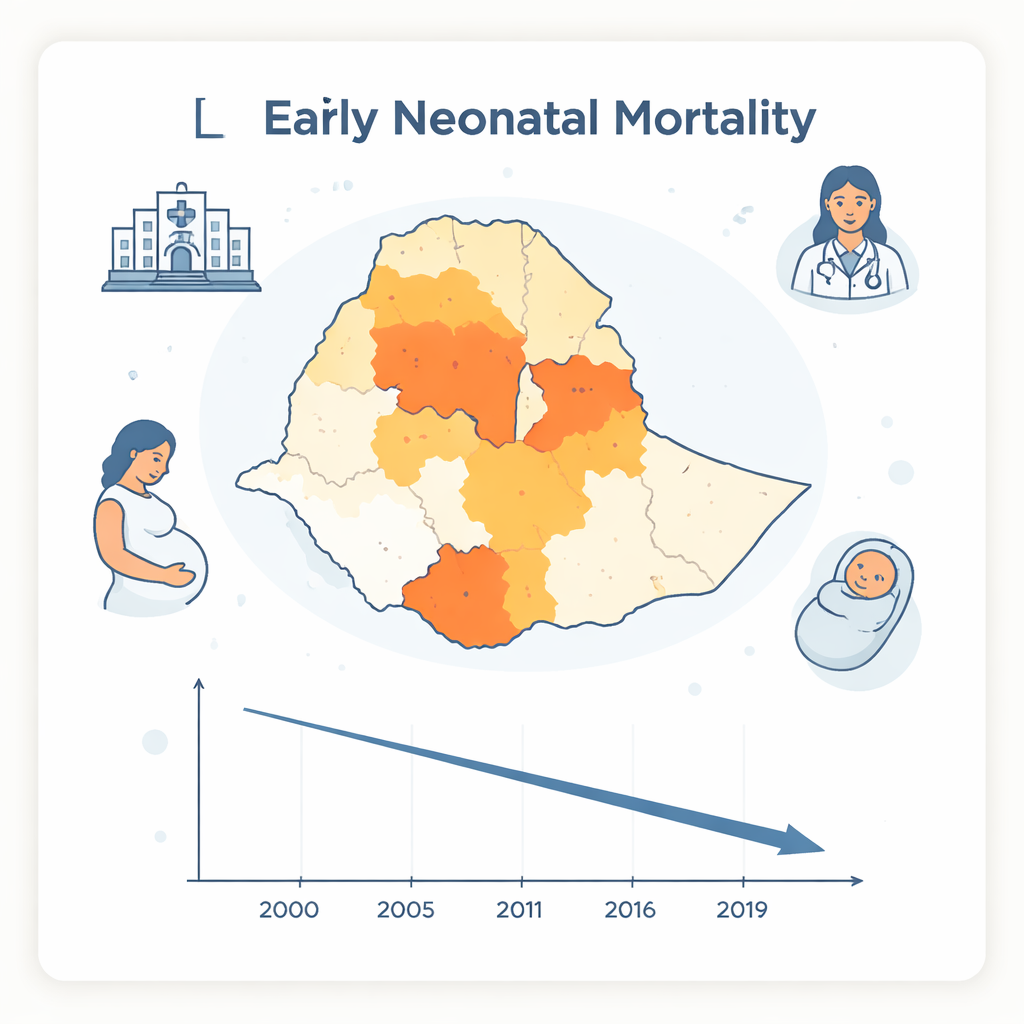
The analysis shows that early neonatal deaths in Ethiopia have fallen, from 43 deaths per 1,000 live births in 2000 to 33 per 1,000 in 2019. That is a substantial improvement over two decades, but the decline has slowed in recent years, and the rate remains high compared with several other African countries. At the same time, deaths in the first week now make up a growing share of all newborn deaths, rising from about three‑quarters to more than four‑fifths of neonatal mortality. In other words, while fewer newborns die overall, those who do die are increasingly concentrated in the very first days of life.
Where Newborns Face the Greatest Risk
A major contribution of the study is its detailed mapping of risk across Ethiopia. Using spatial statistics, the researcher showed that early neonatal deaths are not scattered randomly: they cluster in particular regions. Hotspots were consistently found in Benishangul‑Gumuz and in parts of Oromia, Tigray, Amhara, Somali and the Southern Nations, Nationalities and Peoples’ Region. A statistical technique called kriging was then used to estimate risk in areas without direct survey data, producing continuous maps that highlight north‑western and parts of western and south‑eastern Ethiopia as zones of persistently higher danger for newborns. In contrast, cities such as Addis Ababa and Dire Dawa had much lower rates.
What Factors Are Saving Newborn Lives?
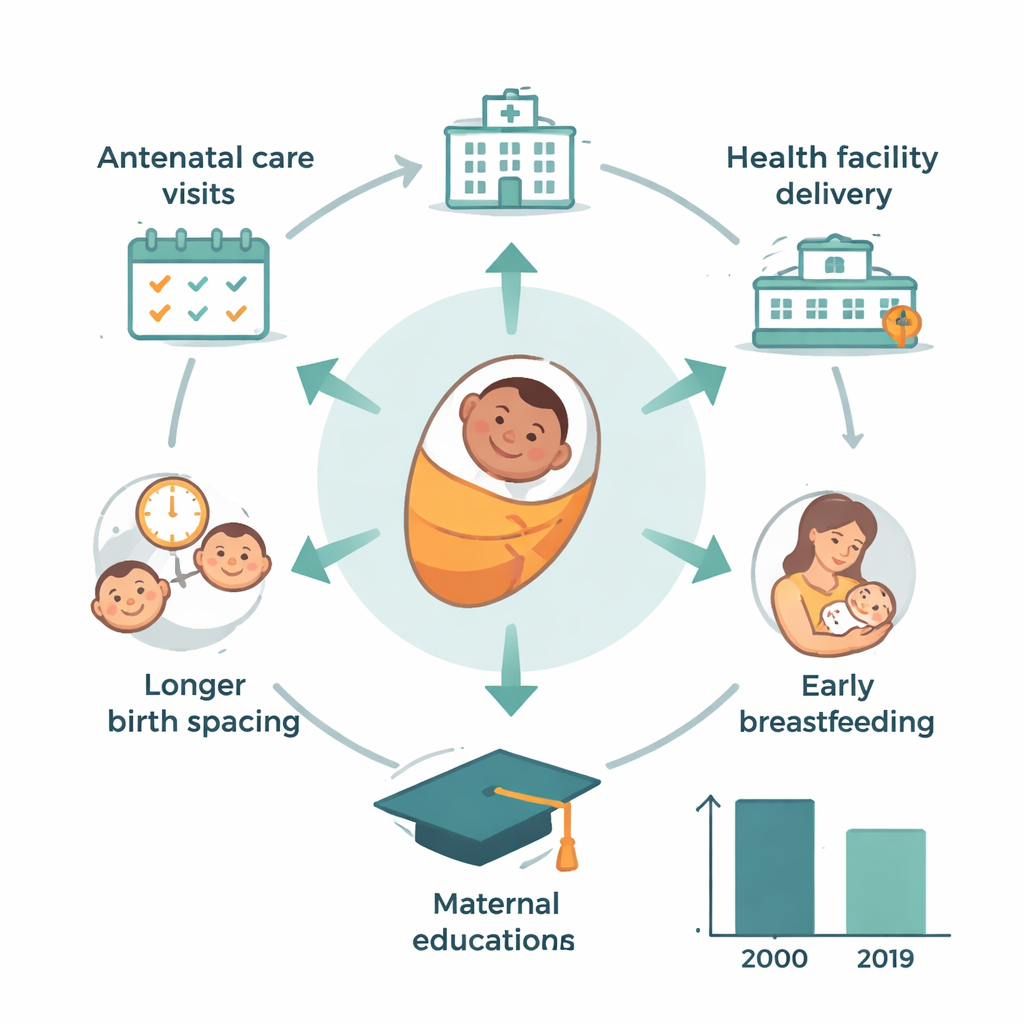
To move beyond describing patterns and toward explaining them, the study used a decomposition approach that separates change into two pieces: shifts in who mothers are and how they give birth (for example, more women delivering in facilities), and shifts in how strongly those factors affect survival. Just under half of the decline in deaths was linked to improvements in the population’s characteristics. More mothers had some schooling, more attended antenatal visits, more delivered in health facilities, more started breastfeeding soon after birth, and more spaced their births at least two years apart. There were also fewer multiple births, which are much riskier. The remaining, slightly larger share of the decline was due to these factors becoming more protective over time — for instance, as the quality of care in clinics improved.
Why Place and Care Still Matter
The study also underscores the gaps that remain. Babies born in rural areas, to mothers with no education, to women who had not attended antenatal care or who gave birth at home, and babies from multiple pregnancies all faced a higher chance of dying in their first week. These patterns point to continuing problems with access to services, transport, information and skilled staff in parts of the country, even as national averages improve.
Turning Maps and Numbers into Saved Lives
For a general reader, the takeaway is straightforward: early neonatal deaths in Ethiopia are declining, but too slowly and too unevenly. The research suggests that progress speeds up when women can reach clinics, see health workers during pregnancy, give birth in facilities, start breastfeeding quickly, and space their pregnancies. By showing exactly where deaths cluster and which conditions matter most, this work gives health planners a practical guide to focus resources — from roads and clinics to education and counseling — on the places and practices that can save the most newborn lives in the first critical week.
Citation: Mitiku, H.D. Spatiotemporal variation and decomposition of early neonatal mortality in Ethiopia using demographic health survey data. Sci Rep 16, 7598 (2026). https://doi.org/10.1038/s41598-026-37784-5
Keywords: newborn health, Ethiopia, neonatal mortality, maternal care, health inequalities