Clear Sky Science · en
Geochemical cycling of arsenic in magmatic systems across supercontinent cycles
Why Earth's hidden poison matters
Arsenic is widely known as a deadly poison at the surface, but deep inside Earth it is also a subtle tracer of how our planet works. This study asks a big-picture question: how has arsenic moved through Earth’s interior and crust over billions of years, and what does that tell us about the rise and fall of ancient supercontinents and valuable metal deposits such as gold? Using tens of thousands of rock analyses and modern data-mining tools, the authors uncover long, slow rhythms in arsenic cycling that mirror the tectonic heartbeat of the planet.
Following arsenic through Earth’s engine
Arsenic doesn’t just appear in groundwater or ore deposits by chance. It is carried upward from Earth’s deep interior in molten rock, then redistributed by volcanic eruptions, hot fluids, weathering, and sedimentation. The researchers assembled a global database of more than 20,000 igneous rocks, carefully filtered by age and chemical quality, to track average arsenic levels through time. They smoothed the data over windows of hundreds of millions of years to focus on long-term trends, and compared these patterns with independent records of magmatic activity and zircon crystals, which are time-stamped markers of crust formation. 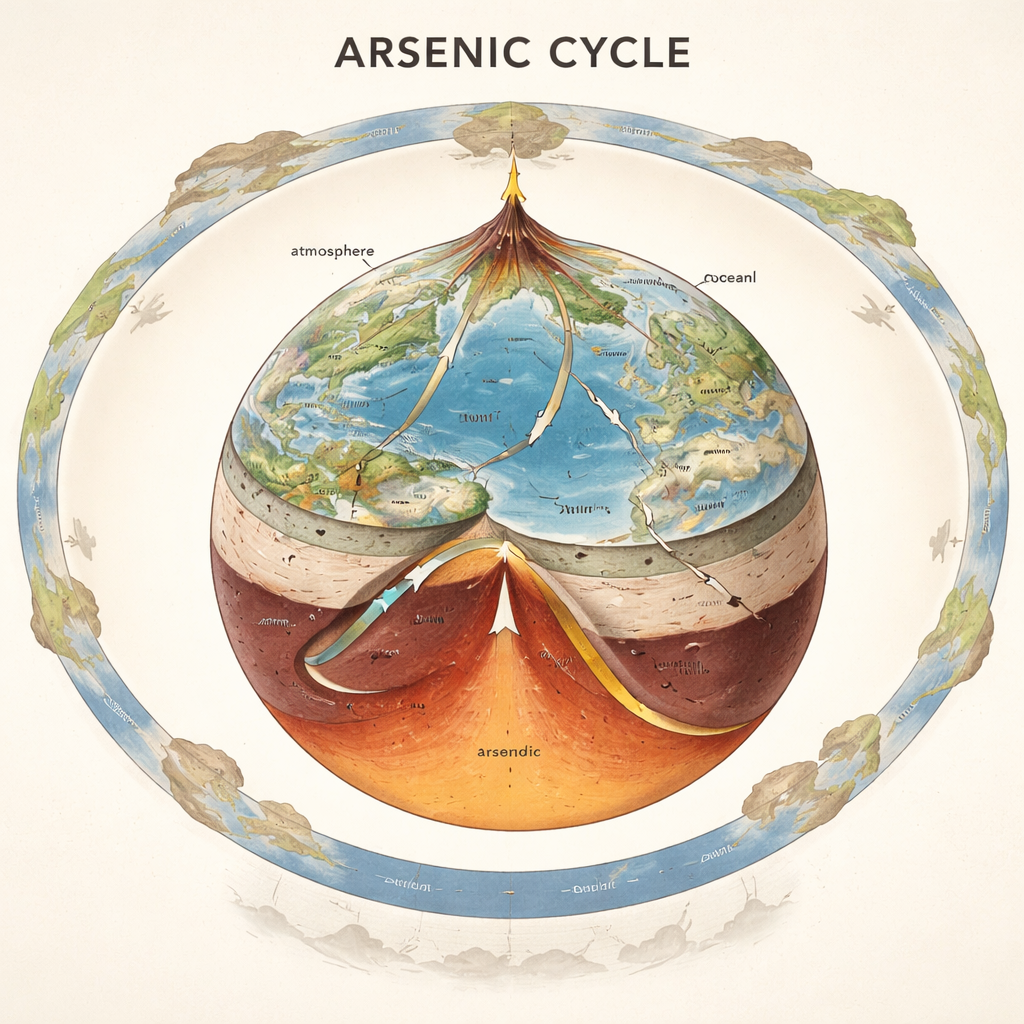
Deep magmas, shallow magmas, and drifting continents
To understand where the magmas came from, the team used a simple chemical ratio (Sr/Y) that acts as a depth gauge. High ratios point to magmas born deeper in the thick crust or upper mantle; low ratios signal shallower sources. They found that magmas sourced from greater depths systematically carry less arsenic, while shallower magmas tend to be richer in it. When these depth-sensitive arsenic curves are plotted against the timing of supercontinent cycles—eras when continents clumped together into giants like Rodinia or Pangea and later broke apart—a clear pattern emerges. During supercontinent assembly, deep-sourced, low-arsenic magmas dominate. During breakup, widespread rifting and crustal recycling feed shallower, arsenic‑rich magmas into the crust and onto the seafloor.
Hidden cycles and echoes in sediments
Beyond broad highs and lows, the arsenic record shows a striking regular rhythm. Using time-series tools known as wavelet analysis and local singularity analysis, the authors detect a repeating cycle of about 436 million years in arsenic concentrations in igneous rocks. When they analyze a completely independent dataset—arsenic locked in pyrite grains from sedimentary rocks—they find very similar periodic behavior. The sedimentary arsenic cycles lag the magmatic ones by roughly 220 million years, as revealed by cross-correlation analysis. This delay reflects the time it takes for arsenic released by deep magmas and volcanoes to be weathered, transported, and ultimately buried in sediments, linking Earth’s interior activity to long-term changes in oceans and the atmosphere.
Clues to gold and other resources
Arsenic also turns out to be a useful signpost for precious metals. By training a machine-learning model on global geochemical data, the researchers classified magmas into continental and oceanic settings and compared their arsenic contents through time. They observed that periods when continental magmas had especially high arsenic compared with oceanic magmas coincide with major episodes of orogenic gold formation—huge, structurally controlled gold deposits formed during mountain building. Because arsenic readily enters certain sulfide minerals that can host gold, high-arsenic magmas may mark “fertile” conditions for forming rich ore systems. 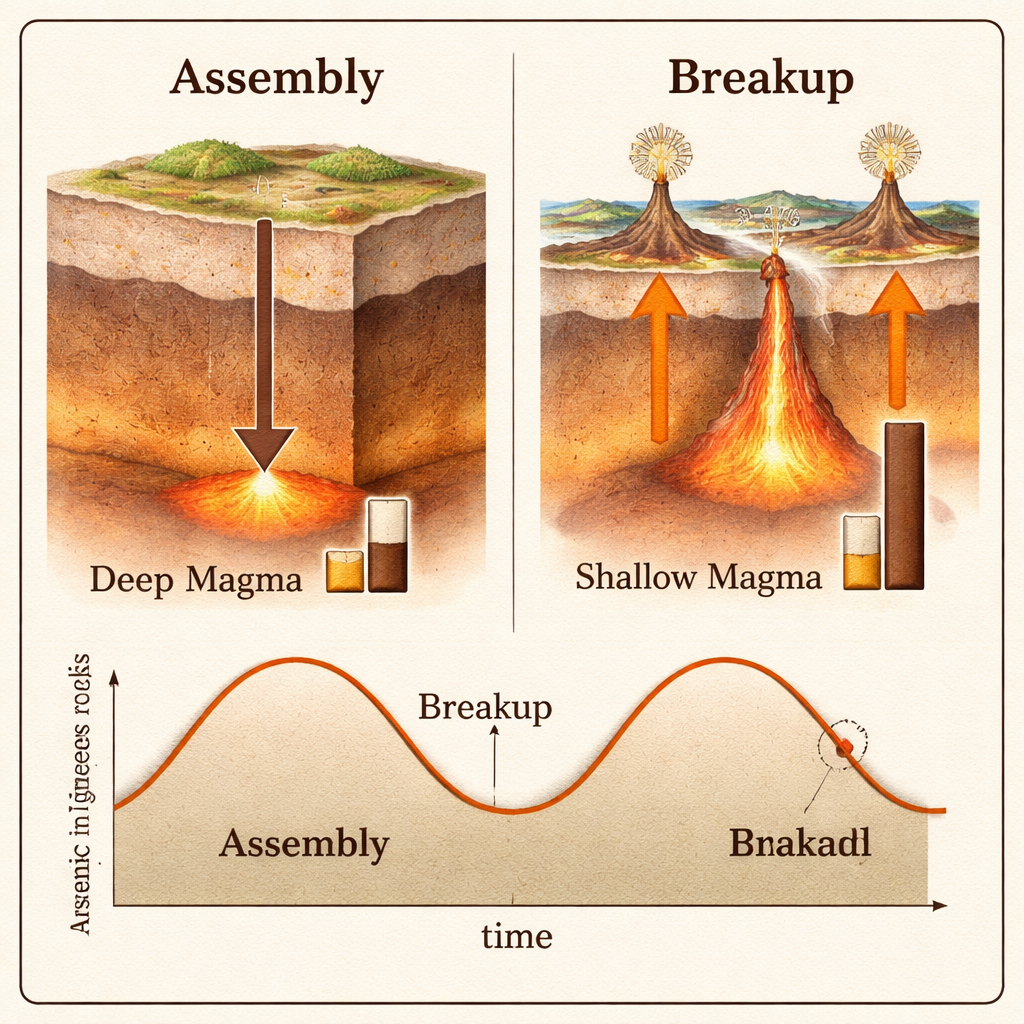
What this means for our planet
In simple terms, this work shows that arsenic behaves like a planetary metronome, keeping time with the supercontinent cycle. When continents weld together, deep, cleaner magmas dominate and newly formed rocks tend to be arsenic-poor. When they break apart, shallower, recycled magmas rich in crustal material generate rocks and fluids with higher arsenic contents, eventually influencing sediments and potentially groundwater. These repeating pulses, lasting hundreds of millions of years, highlight how tightly Earth’s deep engine is connected to surface environments and mineral resources. For non-specialists, the key message is that the distribution of a single trace element—arsenic—records the rise and fall of supercontinents, shapes where some gold deposits form, and helps scientists reconstruct the long-term evolution of our living planet.
Citation: Cheng, Q., Zhou, Y., Yang, J. et al. Geochemical cycling of arsenic in magmatic systems across supercontinent cycles. Sci Rep 16, 6813 (2026). https://doi.org/10.1038/s41598-026-37782-7
Keywords: arsenic, supercontinent cycle, magmatic processes, trace elements, gold mineralization