Clear Sky Science · en
Multi-scale defect detection technology for wind turbine blade surfaces based on the SASED-YOLO algorithm
Why tiny flaws on giant blades matter
Modern wind turbines rely on blades longer than a passenger jet, spinning nonstop in harsh offshore weather. Small chips, cracks, or patches of corrosion on these blades don’t just look bad—they can quietly drain power production, shorten equipment life, and raise maintenance costs. This study presents a new computer-vision technique, SASED-YOLO, designed to spot many kinds of subtle surface damage on wind turbine blades quickly and accurately, even when the telltale marks are faint, tiny, or partly hidden by glare, dirt, or paint.
From manual checks to smart cameras
Traditionally, blade inspections have depended on human experts dangling from ropes or using tools like ultrasound and infrared cameras. While effective in some cases, these methods struggle when the blade surface is uneven, coated, or dirty, and they can be slow, costly, and risky for workers. In recent years, deep-learning systems have begun to analyze photos or video from drones and cameras, automatically drawing boxes around defects. One of the most successful families of such systems is called YOLO, which can locate objects in a single, fast pass through the image. However, standard versions of YOLO still find it hard to detect very small defects, handle large differences in defect sizes, or ignore confusing backgrounds like clouds, reflections, and stains.
A smarter way to see blade damage
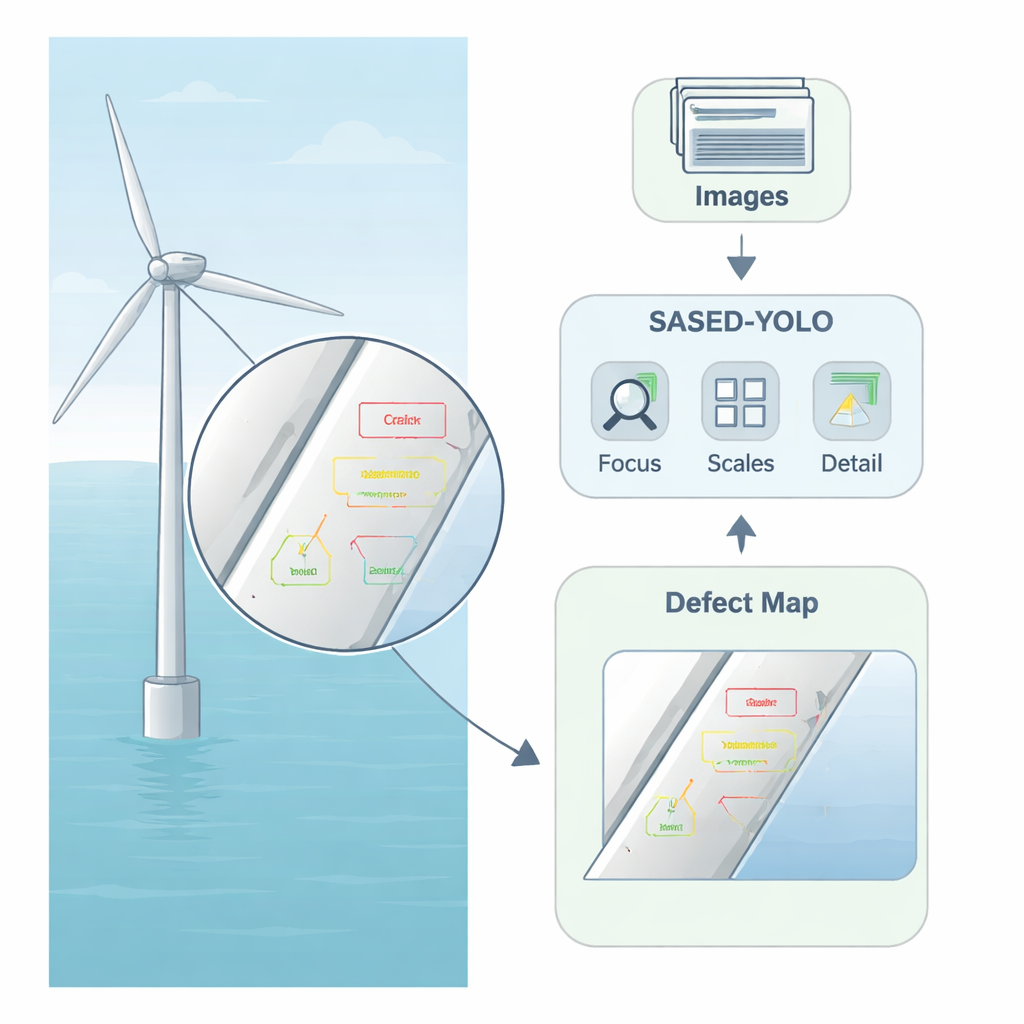
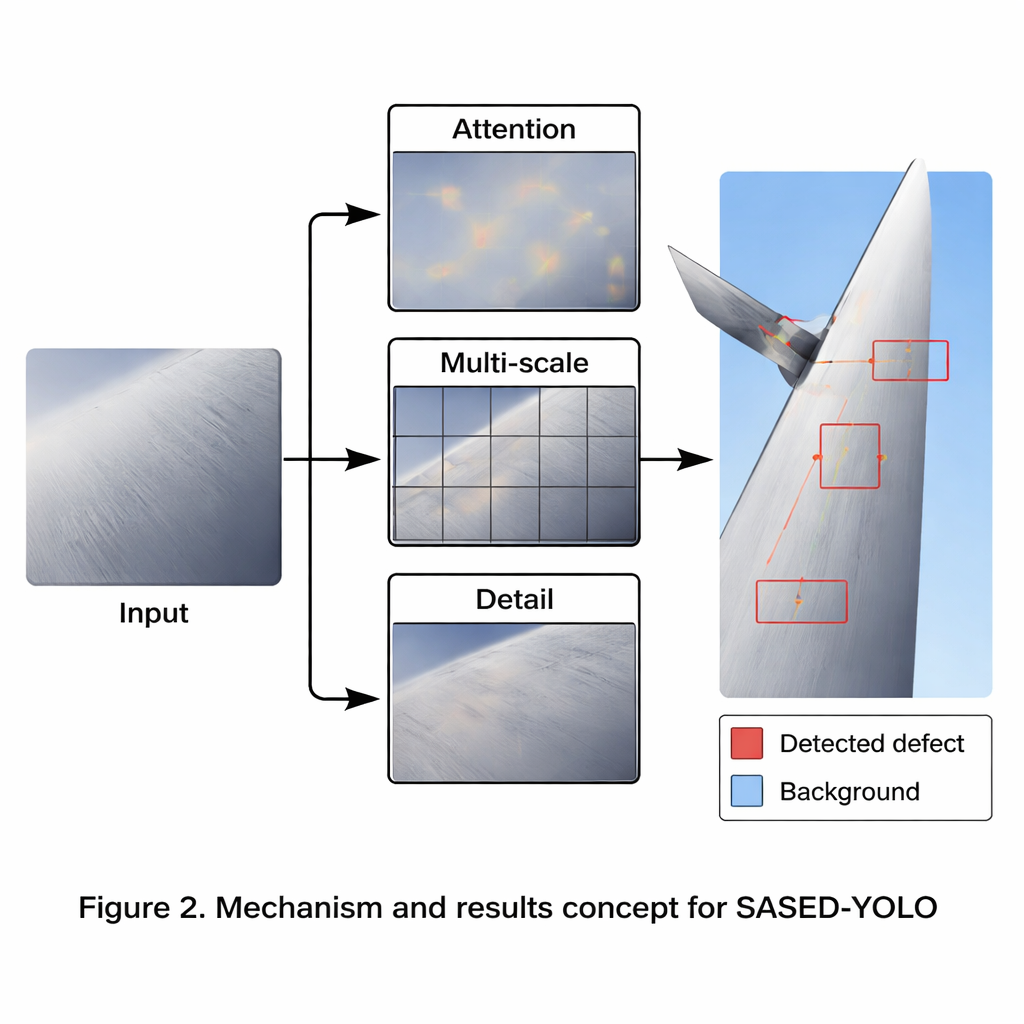
The researchers build on the lightweight YOLOv8s model and reshape it into SASED-YOLO, adding several new components aimed at the specific challenges of blade inspection. First, a collaborative attention module helps the network “focus” on likely defect regions while downplaying sky, tower, or clean blade areas. It does this by looking at the image both across space (where on the blade) and across channels (what kind of texture or color) and combining local and global cues. Second, a multi-scale pooling module lets the system view defects through different “windows,” from tiny patches to larger swaths of blade, then fuse this information so that long cracks, scattered pits, and small spots are all represented clearly. Third, an adaptive downsampling block is introduced so that shrinking images to save computation does not throw away the fine edges and subtle streaks that often mark early damage.
Building and testing a realistic defect library
To rigorously test their approach, the team assembled their own wind turbine blade dataset, WTBD818-DET, because existing public collections were too limited. It contains 7,374 images with eight kinds of surface problems, including cracks, impact injuries, corrosion, lightning strikes, oil stains, crazing, attached objects, and surface eyes (small localized flaws). The images were carefully labeled to mark not just which defect is present, but exactly where it lies on the blade. The defects vary enormously in size and appearance, and some categories have very few examples, making the task close to real industrial conditions. The researchers trained SASED-YOLO and a range of other leading detection models under the same settings, then compared how many defects each system found, how often they were correct, and how fast they ran.
Sharper eyes than previous detectors
On the blade dataset, SASED-YOLO achieved a mean average precision—an overall measure of detection quality—of 87.7 percent, about 10.5 percentage points higher than the baseline YOLOv8s model and clearly ahead of other advanced systems such as RT-DETR, Mamba, and the latest YOLO variants. It was especially strong at picking out fine-grained defects such as hairline cracks, small corrosion spots, and subtle oil films that other models tended to miss or confuse with background noise. Visual comparisons show that SASED-YOLO produces cleaner bounding boxes around damage and fewer false alarms on harmless streaks or reflections. To test whether the method could generalize beyond wind energy, the authors also applied it to a public weld defect dataset and again found that it beat several current state-of-the-art detectors.
What this means for future wind farms
For non-specialists, the key message is that this work significantly improves the “eyes” of automated inspection systems for wind turbines. By combining attention, multi-scale viewing, and careful handling of detail, SASED-YOLO can more reliably flag small or complex surface problems before they grow into costly failures. Although the model runs somewhat slower than the fastest real-time detectors, its accuracy gains make it well suited for periodic drone-based surveys or offline analysis. With further optimization, approaches like this could help keep offshore wind farms running safely and efficiently, quietly improving the reliability and cost-effectiveness of clean energy.
Citation: Lv, F., Wang, R., Wang, Y. et al. Multi-scale defect detection technology for wind turbine blade surfaces based on the SASED-YOLO algorithm. Sci Rep 16, 7334 (2026). https://doi.org/10.1038/s41598-026-37780-9
Keywords: wind turbine inspection, surface defect detection, deep learning, computer vision, offshore wind energy