Clear Sky Science · en
Unraveling hierarchical penetration mechanisms and coupling relationships of safety risks in major transportation infrastructure construction using text mining and complex networks
Why big projects still have big accidents
From high-speed rail lines to sea-crossing bridges, modern transportation projects are feats of engineering—and also hotspots for serious construction accidents. This study looks beyond obvious on-site mistakes to uncover the hidden chains of decisions, management gaps, and design choices that allow disasters to unfold. By turning hundreds of official accident reports into data, the researchers show how small oversights in offices and control rooms can penetrate down through layers of supervision and end up costing lives on the work site.
Reading hidden stories in accident reports
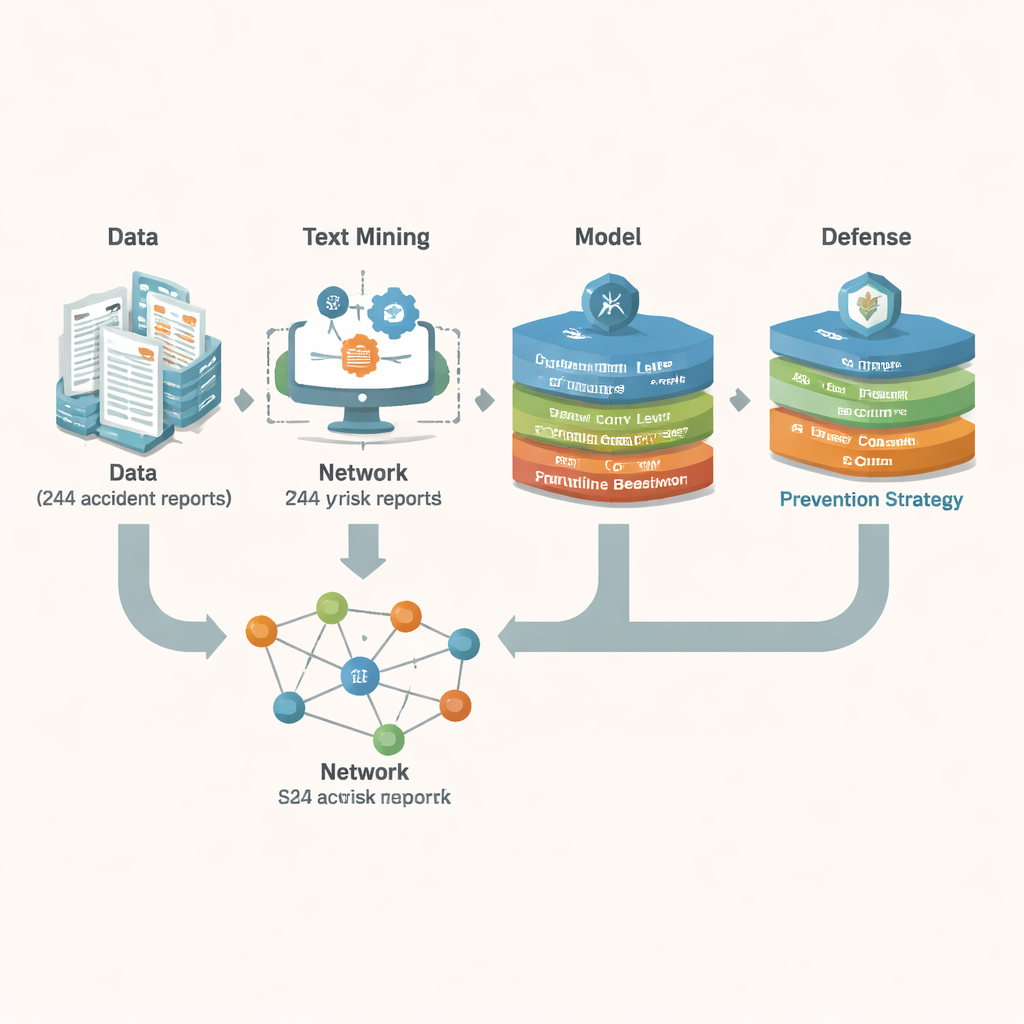
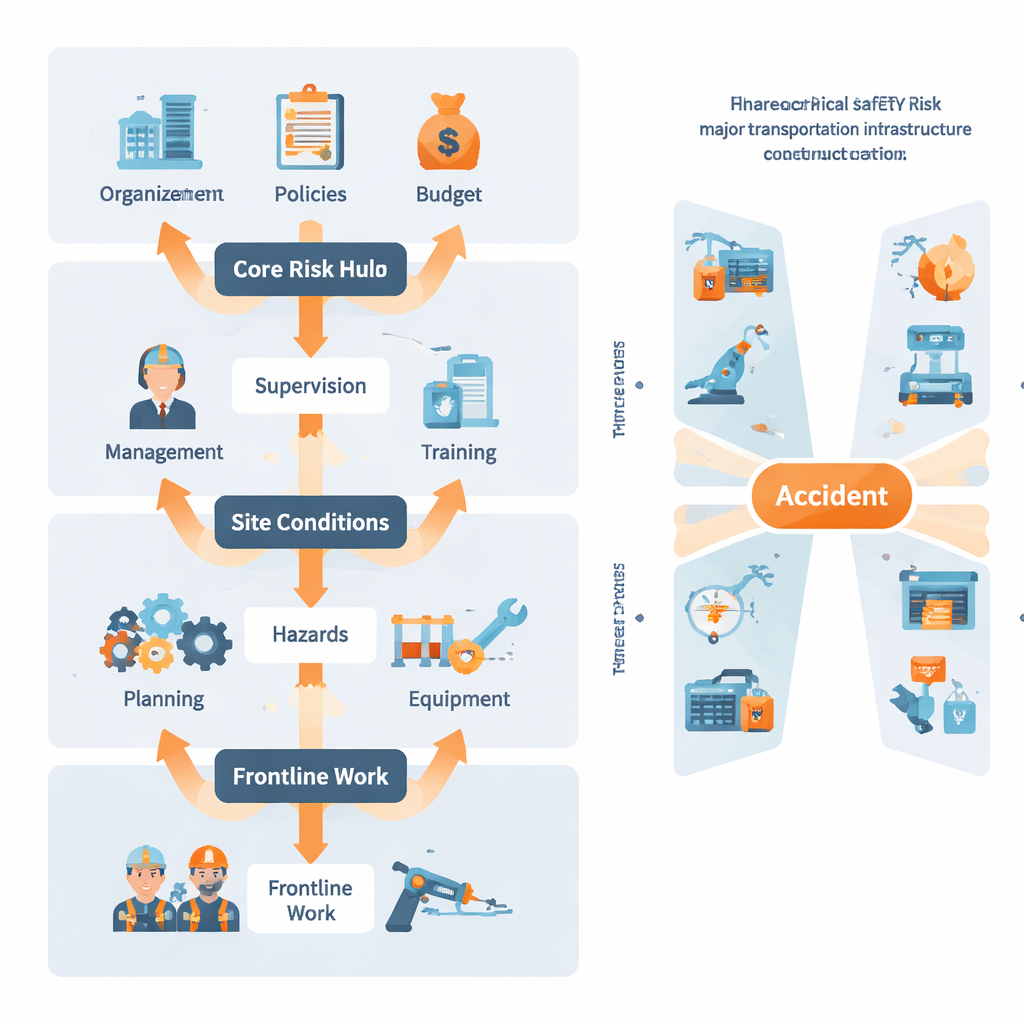
Instead of relying only on experts’ opinions or simple statistics, the team analyzed 244 detailed investigation reports from major Chinese rail, highway, tunnel, and bridge projects between 2010 and 2023. These reports describe what happened, why it happened, and who was responsible. Using text mining—computer methods that sift through large bodies of text—they pulled out 101 key phrases that repeatedly appeared around accidents, such as poor on-site management, weak training, or equipment defects. They then grouped these into 35 distinct risk factors and mapped them onto an improved version of a widely used human-factors framework that separates problems into four layers: organizational decisions, supervision, site conditions, and frontline actions.
From loose factors to a web of risk
Accidents rarely stem from a single cause, so the researchers built what they call a Safety Risk Network. In this network, each node is one of the 35 risk factors, and links show which factors tend to appear together in the same accident. Network analysis tools—borrowed from studies of social media and the internet—allowed them to see which factors sit at the center of the web, which ones cluster tightly, and which ones quietly connect different layers. They found that organizational decisions and supervisory practices form the backbone of this web, with especially strong links between high-level management choices and mid-level supervision, and then down to front-line behaviors like rule-breaking or unsafe operations.
The real trouble starts above the work site
Several clear patterns emerged. Factors like inadequate safety training turned up in many different situations, but on their own had limited power to spread risk through the entire network. By contrast, deeper issues such as weak safety management systems, poor resource allocation, and flawed design and planning acted as powerful “hubs” that fed problems into multiple parts of a project. Equipment failures and obvious unsafe acts by workers did matter, but the analysis showed they were usually the final expression of long-running weaknesses higher up the chain. In other words, focusing only on correcting workers’ mistakes is like mopping up leaks without fixing the broken pipes overhead.
Turning risk maps into defense plans
To make their findings practical, the authors combined their network with a “bow-tie” style safety diagram that shows how hazards turn into accidents and how barriers can interrupt that process. Using their data, they pinpointed the most dangerous paths—such as the route from poor safety management, through weak supervision and training, to frontline errors—and then designed three layers of defenses to block them. These include checking safety during design with digital building models, using real-time monitoring and risk assessment tools during construction, and deploying sensors and smart systems on site to catch equipment problems and unsafe actions early. They even proposed a way to estimate how much each barrier could reduce accident likelihood, based on how influential the targeted factor is within the network.
What this means for safer construction
For a lay reader, the message is straightforward but important: in major transportation projects, accidents are less about a single careless worker and more about chains of weakness that start in boardrooms and planning offices. The study shows that by mining past accident reports and viewing risk as a connected web, managers can see where to invest effort for the biggest safety gains—strengthening systems, supervision, and design decisions rather than only punishing front-line mistakes. This data-driven approach offers a roadmap for turning hard-won lessons from past disasters into smarter, more proactive protection on the next generation of bridges, tunnels, and railways.
Citation: Liu, W., kang, X., Ye, Q. et al. Unraveling hierarchical penetration mechanisms and coupling relationships of safety risks in major transportation infrastructure construction using text mining and complex networks. Sci Rep 16, 7313 (2026). https://doi.org/10.1038/s41598-026-37778-3
Keywords: construction safety, transportation infrastructure, risk networks, text mining, safety management