Clear Sky Science · en
Fractional-order neural network for detecting process deviations in optical fiber cable manufacturing
Why tiny glitches in cable factories matter
Every video call, cloud backup, and online game depends on light racing through hair-thin glass fibers. Making these fibers is a delicate craft: a slight wobble in temperature or tension can turn kilometers of cable into expensive scrap. This article describes a new kind of artificial intelligence that watches a fiber‑optic production line in real time and learns to spot subtle problems long before they show up in final quality checks, helping save material, energy, and money.
Watching the heartbeat of a fiber factory
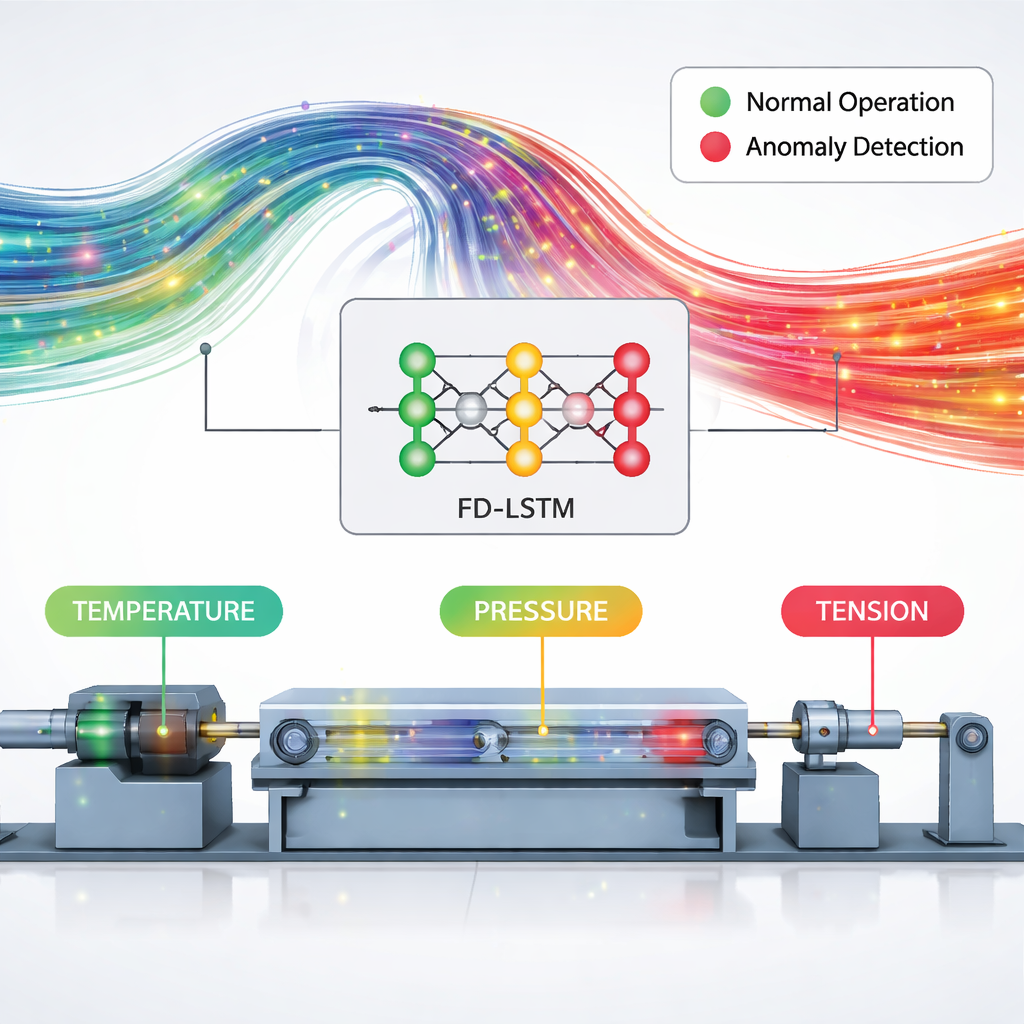
Modern fiber‑optic cables are made in several stages: glass is drawn into thin fibers, coated with protective polymers, pushed into plastic tubes, twisted into bundles, and wrapped in outer jackets. At each step, dozens of sensors track pressures, temperatures, speeds, and tensions. On the extrusion line studied here, 232 sensors send a new measurement every second for years on end. Most of the time the line runs smoothly, but defects are usually discovered only at the very end of production, when the finished cable is tested for signal loss or mechanical flaws. That delay makes it difficult to know exactly when and why a fault began, and the huge volume of data makes manual monitoring impossible.
Teaching machines to find odd behavior on their own
To tackle this, the researchers turned to a family of deep‑learning models called recurrent neural networks, which are good at reading sequences such as speech, text, or sensor streams. Instead of being told exactly what each defect looks like, the model receives only weak hints: some production runs are labeled as having problems, others as clean. The team first compresses the raw sensor data using a mathematical tool called the wavelet transform, which breaks each signal into a set of short‑ and long‑term patterns. They then cluster these patterns to build a set of typical process “states,” ranging from normal operation to several types of abnormal behavior. These states serve as approximate training labels, allowing the network to learn what kinds of temporal patterns tend to precede bad product.
A new kind of memory for neural networks
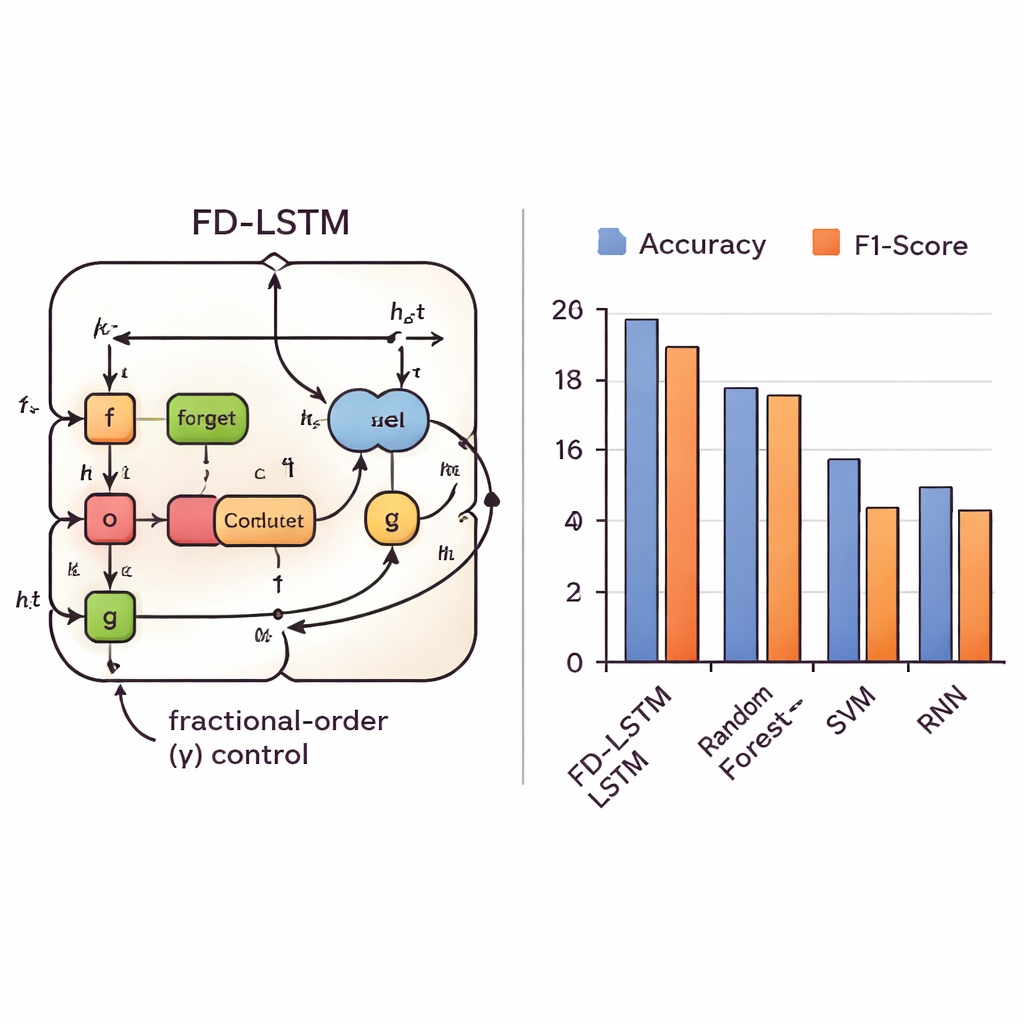
The central innovation of the work is a redesigned memory cell inside the network, called an FD‑LSTM (Fractional‑Derivative Long Short‑Term Memory). Standard LSTM cells decide, at each time step, how much of the past to remember or forget using fixed mathematical functions. The authors replace these with "fractional" versions that effectively give the model a tunable, graded memory of the distant past. Instead of reacting only to recent sensor readings, the FD‑LSTM can smoothly weigh events that happened many minutes earlier, which is crucial in a process where slow drifts in pressure, temperature, or fiber tension gradually lead to defects.
Putting the model to the test on a live production line
The team evaluated their approach on 2.5 years of real data from a fiber‑tube extrusion line at an industrial plant. They sliced the continuous sensor stream into short windows of about four minutes and trained several models under strictly controlled conditions, varying only the way memory was handled. The FD‑LSTM reached about 96.7% accuracy and a high F1‑score (a balance of precision and recall), outperforming a classic LSTM as well as more traditional methods such as random forests, support vector machines, and simpler recurrent networks. A key knob in the design is the fractional order, which controls how far back in time the model effectively “looks.” Values slightly below the standard setting worked best, suggesting that slowly developing drifts, rather than sudden spikes, are the main culprits in this manufacturing line.
From data streams to better cables and greener plants
Beyond statistics, the improved model cleanly separates weak, slow‑building anomalies from healthy states, which is exactly what plant engineers struggle to see in noisy data. By warning operators earlier, the system can shorten the time the line spends in off‑spec conditions, reducing scrap and unnecessary energy use. Although this study focused on a single fiber‑tube line, the authors argue that the same fractional‑memory idea could be applied to any industrial process where many sensors track a complex, slowly drifting system—from chemical reactors to power grids or intensive care monitors. In simple terms, giving neural networks a more nuanced sense of time appears to make them better guardians of both product quality and resource efficiency.
Citation: Gomolka, Z., Zeslawska, E. & Olbrot, L. Fractional-order neural network for detecting process deviations in optical fiber cable manufacturing. Sci Rep 16, 6677 (2026). https://doi.org/10.1038/s41598-026-37770-x
Keywords: fiber optic manufacturing, industrial anomaly detection, fractional neural networks, time series sensors, predictive maintenance