Clear Sky Science · en
Study on reasonable position of mining roadway under repeated mining overburden structure in shallow buried close distance coal seam: A case study
Keeping Underground Roads Safe
Deep below the grasslands of Inner Mongolia, miners work in a maze of tunnels that must stay stable while millions of tons of rock press down from above. This study asks a deceptively simple question with life‑or‑death consequences: where, exactly, should a new roadway be placed in a mine that has already been heavily worked so that it remains as safe and stable as possible?
Why Old Workings Still Matter
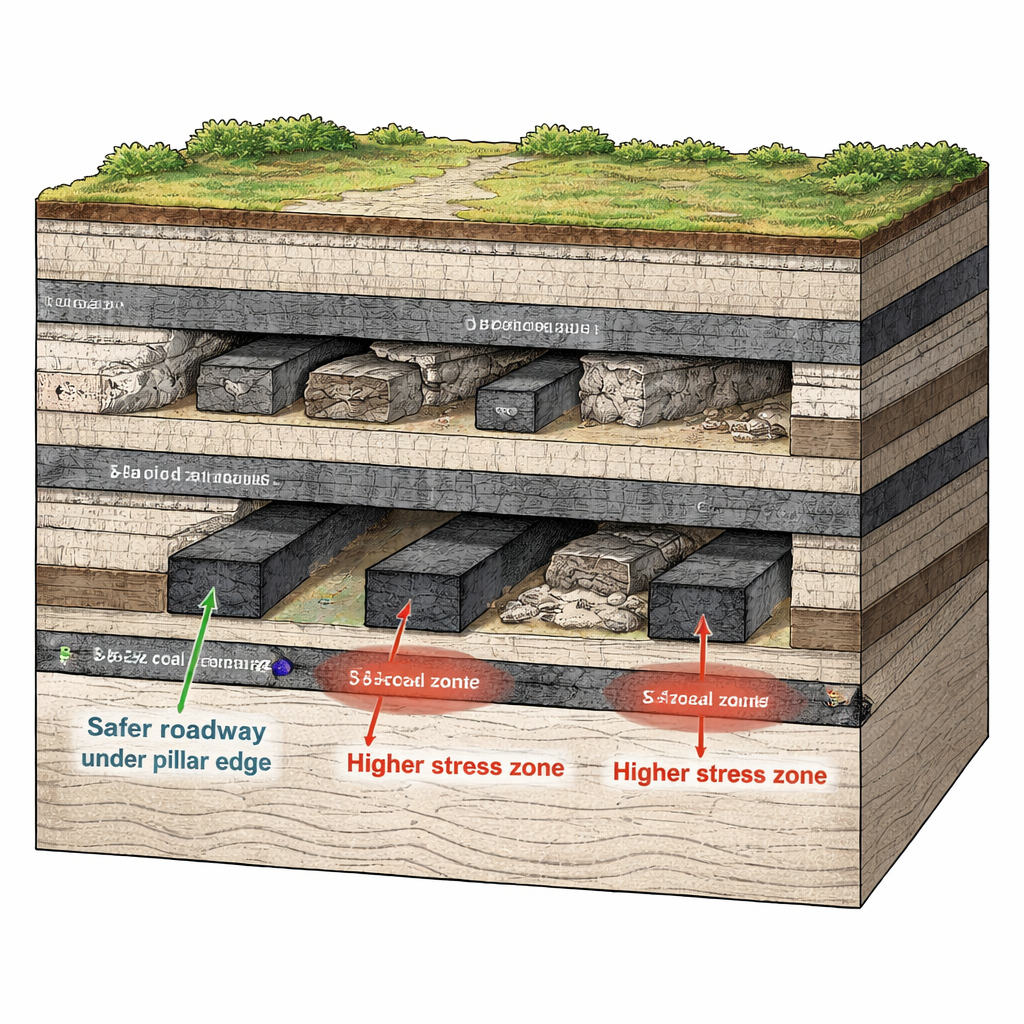
In many coalfields of northern China, coal seams lie close together, sometimes less than 40 meters apart. Mines are usually developed from top to bottom, so by the time a lower seam is ready to be mined, the layers above it may already be riddled with empty spaces (called goafs) and solid blocks of leftover coal (pillars). These pillars end up carrying much of the weight of the overlying rock. That extra burden causes zones of very high pressure in the rock around them. If a new roadway—a horizontal tunnel used for ventilation, transport, and worker access—is dug in the wrong spot beneath this complex structure, the roof and floor can deform badly, supports can fail, and serious accidents can follow.
How the Rock Roof Breaks and Sinks
The researchers focused on the Shigetai Coal Mine in Inner Mongolia, where a new seam called 3‑2‑2 lies just below an older mined seam, 3‑2‑1. They first needed to understand how the rock layers above the old workings had broken and settled. Using established theories of how strong rock layers bend, crack, and rotate when a seam is mined out, they built a step‑by‑step model of the overlying rock structure. Some layers act like hinged stone arches, others like cantilevered beams, and some become “critical” layers that mark where large breaks occur. The team combined this theoretical framework with field data on rock types and thicknesses to map how the overburden—everything above the coal—had fractured after repeated mining of several close seams.
Simulating a Hidden Stress Landscape
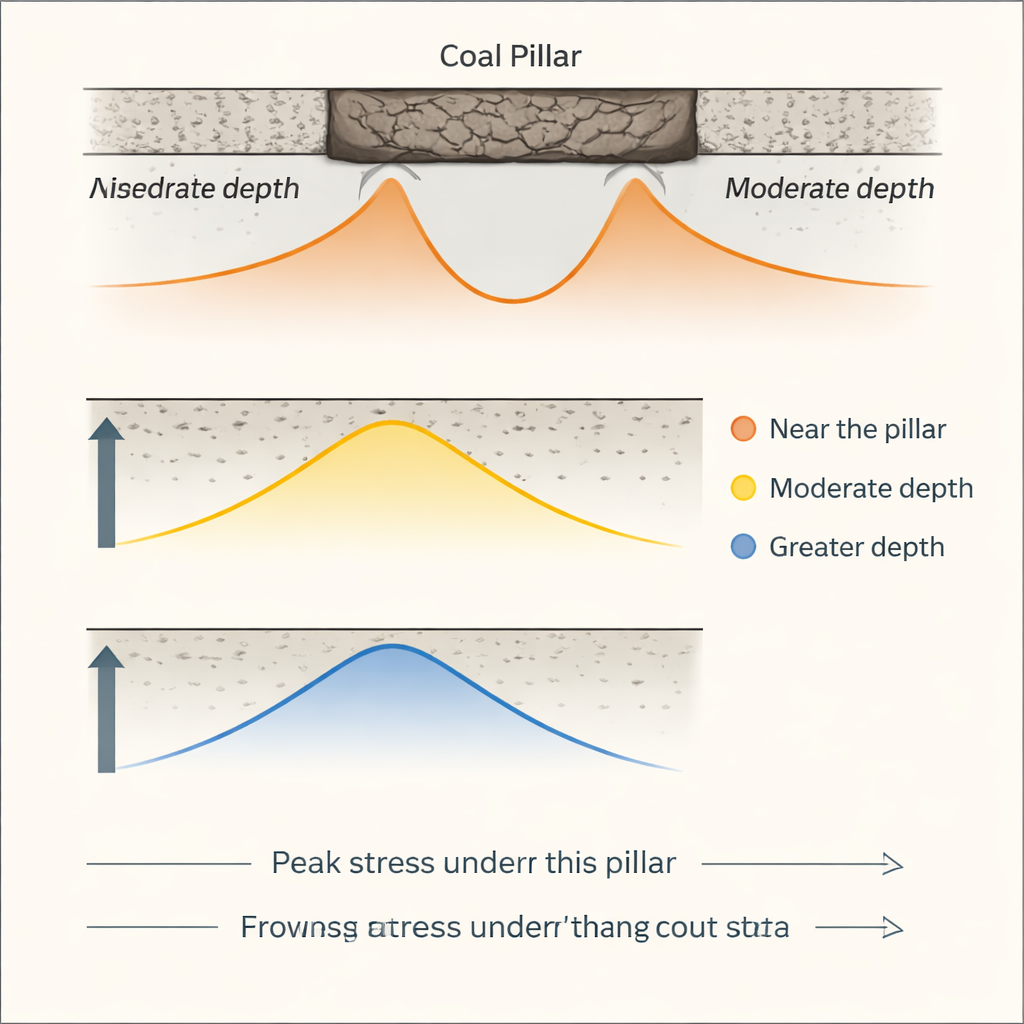
To test and refine their structural model, the authors used powerful three‑dimensional computer simulations. In one set of models, they reproduced the sequence of mining in the area and watched how the rock blocks above the goafs bent and collapsed. The simulations showed that the broken rock above the seams and the intact coal pillars formed a complex “stair‑step” sinking pattern, confirming the theoretical picture. Next, they calculated how this structure concentrates stress in the remaining coal pillars of the 3‑2‑1 seam and how that stress spreads into the rock floor beneath. They found that the vertical load along a pillar’s width forms an “M‑shaped” pattern right at the floor, with two peaks of high pressure near the sides and a smaller, elastic core in the center. As you move deeper below the pillar, that pattern gradually smooths into an inverted U, and then into a sharp inverted V. At the same time, the pressure directly under the pillar decreases, while pressure beneath the adjacent mined‑out area slowly increases.
Finding the Safest Place for a New Tunnel
Armed with this detailed map of hidden stresses, the team evaluated where to place the new 3‑2‑2 seam roadway. They compared two main options under the overlying pillar: one directly under its edge, where the pillar has already been partly damaged and relieved, and another under the relatively intact central “core” of the pillar. Using another set of numerical simulations, they looked at how rock around the roadway would deform first during excavation and then after the new longwall face is mined. The results showed that when the roadway sits beneath the pillar’s elastic core, both sidewalls experience strong concentration of stress and large sideways movements. In contrast, when the roadway is placed under the pillar’s edge, the side beneath the goaf carries much less stress and the overall deformation of the surrounding rock is noticeably smaller, especially after the coal above has been fully extracted and the pillar has largely failed.
From Computer Model to Real Mine
Based on these findings, engineers at Shigetai arranged the 3‑2‑2 roadway directly beneath the edge of the overlying 3‑2‑1 coal pillar and designed a robust pattern of rock bolts, steel cables, and mesh to support the roof and walls. Field measurements then tracked how much the roadway floor and roof moved closer together, and how fractures grew in the surrounding rock. The maximum closure between roof and floor was about 48 centimeters, and new cracks were mostly confined to within three meters of the roadway surface—levels that matched the simulations and were considered acceptable for safe operation.
What This Means for Future Mining
For non‑specialists, the core message is clear: in mines where many thin coal seams are stacked close together, the “ghosts” of earlier workings strongly shape the safety of new tunnels. This study shows that by carefully modeling how rock layers break and how stresses concentrate in remaining pillars, engineers can choose roadway positions that avoid the most dangerous pressure zones. In this case, placing the new roadway beneath the edge, rather than the middle, of an old coal pillar provided a practical and proven route to safer, more reliable underground access.
Citation: Miao, K., Tu, S., Tu, H. et al. Study on reasonable position of mining roadway under repeated mining overburden structure in shallow buried close distance coal seam: A case study. Sci Rep 16, 6440 (2026). https://doi.org/10.1038/s41598-026-37768-5
Keywords: coal mining, rock mechanics, mine roadway stability, coal pillar stress, numerical simulation