Clear Sky Science · en
Spatial and temporal variation of benthic ecological quality evaluation in the Bohai Bay (China) using benthic indices
Why the Health of a Busy Chinese Bay Matters
Bohai Bay in northern China is a shallow, semi-enclosed sea that serves as a nursery for many fish and shellfish, and supports shipping, aquaculture, and coastal cities. For decades, these human uses have poured pollution and disturbance into the bay, raising concerns about damaged seafloor habitats and dwindling marine life. This study asks a simple but important question: after China launched a major cleanup campaign in 2018, is the undersea life on the bay’s muddy bottom actually recovering?
Taking the Bay’s Pulse from the Seafloor Up
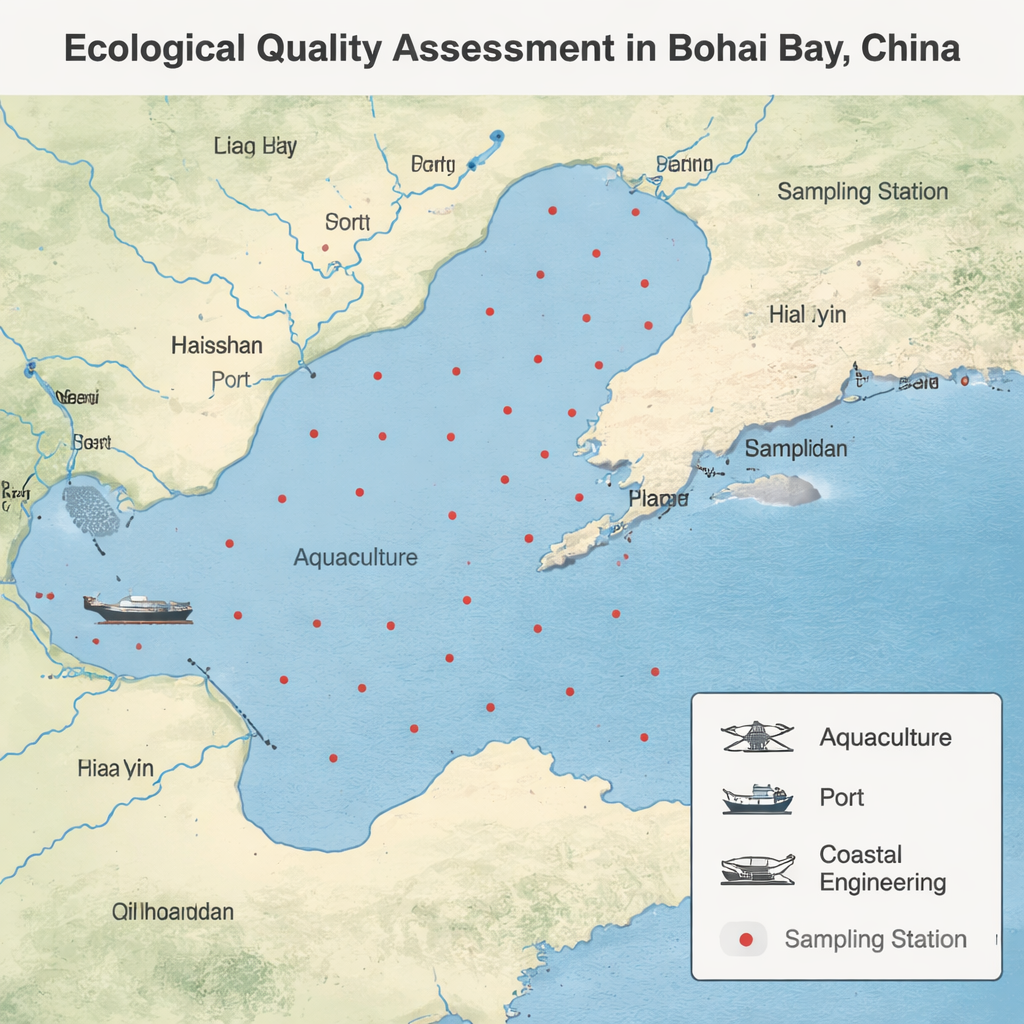
Rather than relying only on water samples, the researchers focused on animals living on and in the seabed—worms, clams, snails, and other bottom-dwellers collectively called benthic macrofauna. These creatures move slowly, live for months to years, and cannot easily escape bad conditions, so their communities remember the bay’s history of stress. The team carried out coordinated summer surveys from 2019 to 2023 at up to 32 stations spread from polluted nearshore zones to cleaner offshore waters. At each site they collected seafloor animals, measured water quality, and analyzed sediments, then used three standard indices to score ecological quality: a diversity index (Shannon–Wiener H′), a pollution-tolerance index (AMBI), and a combined index (M‑AMBI) that blends richness, diversity, and tolerance information.
Signs of Recovery, but Not Everywhere
Across the five years, all three indices told a broadly encouraging story. The share of stations classed as slightly disturbed or undisturbed rose from about four-fifths in 2019 to nearly all sites by 2023. Stations rated in good or high ecological status climbed from just over half to more than three quarters. Diversity scores fluctuated from year to year but trended upward, with 2023 showing the healthiest communities. Particularly striking was the disappearance, after 2019, of stations ranked as heavily disturbed or in outright bad condition. These patterns line up in time with the government’s Comprehensive Governance Campaign for the Bohai Sea, which tightened controls on land-based pollution, coastal construction, and aquaculture practices.
Persistent Hotspots Near Human Activity
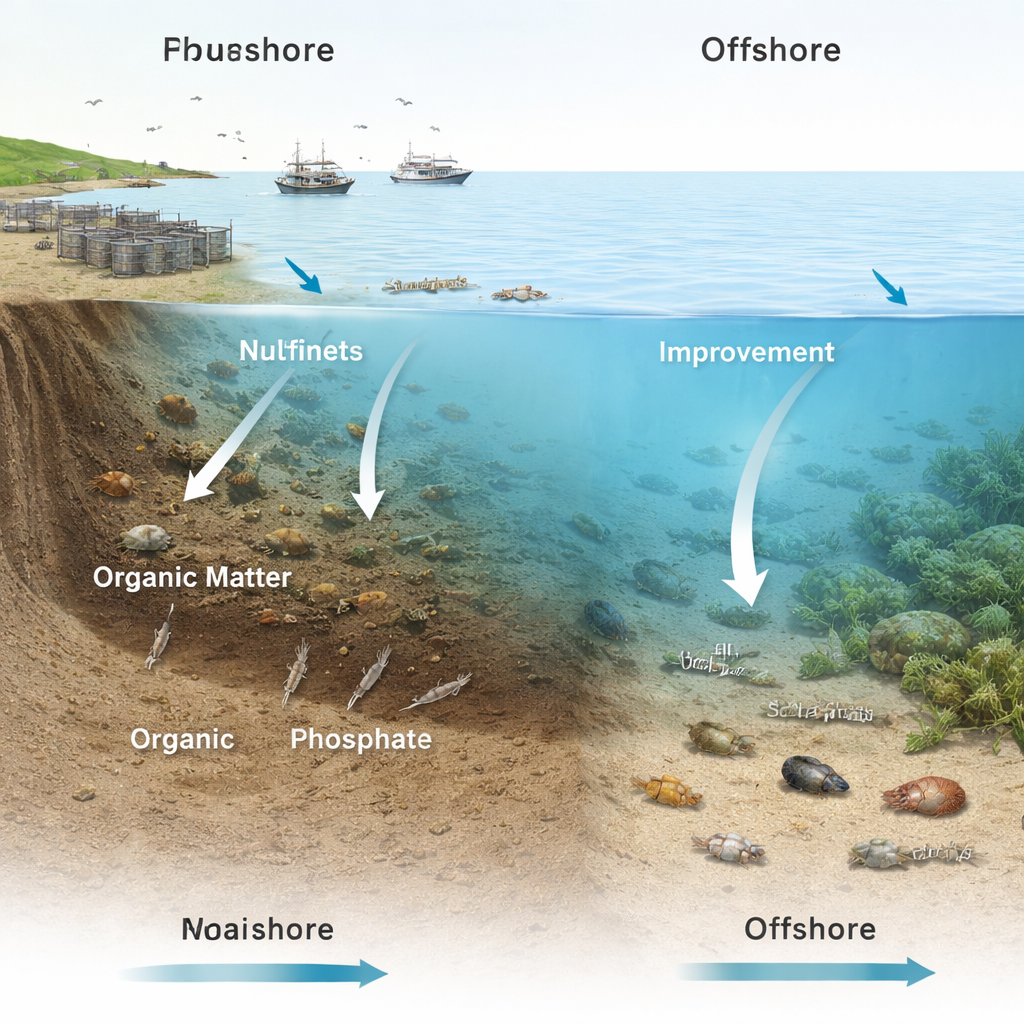
Despite the overall improvement, the seafloor’s recovery was patchy. A clear gradient emerged: offshore areas with better water exchange generally hosted diverse, balanced communities, while several nearshore pockets remained degraded. Problem stations clustered near intensive aquaculture zones, busy anchorages, and coastal engineering works. In those hotspots, the seafloor community shifted toward small, hardy worms known to thrive in polluted, low-oxygen mud, while more sensitive animals such as echinoderms were scarce. The more nuanced indices, H′ and especially M‑AMBI, were better at picking out these trouble spots than AMBI alone, which tended to bunch many sites into only slightly disturbed categories and thus underplayed moderate but meaningful damage.
What Drives Seafloor Health
To understand why some areas bounced back while others lagged, the authors linked their biological scores with measurements of the surrounding environment. Two factors stood out. First, sulfide in the sediment—a toxic by-product that builds up where organic waste rots without oxygen—was strongly tied to poor ecological quality. Where sulfide was high, overall abundance and diversity fell and pollution-tolerant species dominated. Second, moderate levels of phosphate, a key nutrient in the overlying water, were associated with healthier, more diverse communities, likely because they support plankton that eventually feed bottom-dwelling animals. But when nutrient inputs are excessive, the extra organic matter can fuel the very oxygen loss and sulfide buildup that smother seafloor life, especially beneath fish farms and in poorly flushed inlets.
What This Means for People and Policy
For non-specialists, the study’s bottom line is that Bohai Bay’s seafloor is measurably healthier today than it was before China’s recent cleanup efforts, demonstrating that strong environmental policies can reverse damage even in heavily used coastal seas. Yet the same analysis also shows that local, concentrated pressures—from aquaculture waste, shipping, and shoreline construction—continue to create pockets of stress that blunt wider gains. Keeping the bay’s recovery on track will require not only continued pollution control at the scale of the whole watershed, but also targeted actions in hotspots to reduce organic waste, manage sediment quality, and protect vulnerable habitats. In short, the bay is healing, but careful, site-specific management will be needed to ensure that its recovering seafloor communities can keep supporting fisheries, coastal economies, and biodiversity in the long run.
Citation: Zeng, R., Lu, W., Xu, Y. et al. Spatial and temporal variation of benthic ecological quality evaluation in the Bohai Bay (China) using benthic indices. Sci Rep 16, 6936 (2026). https://doi.org/10.1038/s41598-026-37766-7
Keywords: Bohai Bay, seafloor ecology, marine pollution, benthic communities, coastal restoration