Clear Sky Science · en
Multi-response optimization and machine learning-based prediction of straight-groove warm incremental sheet forming of AZ31 magnesium alloy
Shaping Lightweight Metals More Easily
From cars and airplanes to medical implants, manufacturers are eager to use lighter metals that can save fuel and improve performance. Magnesium alloys are especially attractive because they are both light and strong, but they are also stubborn to shape at room temperature and can crack easily. This study explores a smarter way to form parts from a common magnesium alloy, AZ31, by gently heating it and using data-driven methods— including machine learning—to find settings that are fast, energy-efficient, and less likely to damage the material.
How a Moving Tool Gently Carves a Metal Sheet
Instead of pressing a sheet of metal into a solid die in one big hit, incremental sheet forming uses a rounded tool that traces a path over the metal, pushing it a little deeper with each pass. In this work, the team focused on a straight-groove shape: a simple channel formed into 1 mm-thick AZ31 sheets. The sheet is clamped over a custom electric heating chamber so it can be warmed to 200–250 °C, and a computer-controlled (CNC) machine moves the tool step by step while a force sensor measures how hard the tool has to push and how long the process takes until the sheet finally fractures. 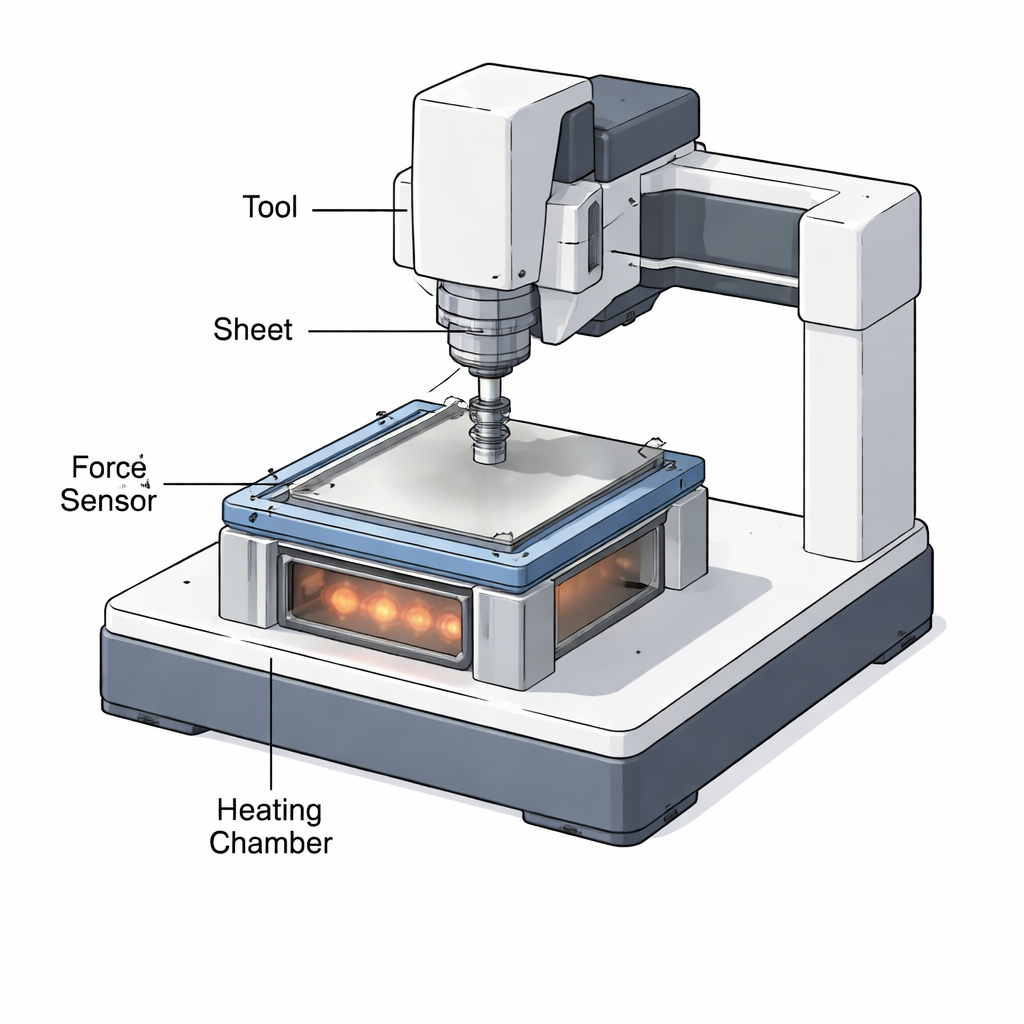
Turning Many Trials into One Best Recipe
Because four different settings—temperature, step-down depth per pass, spindle speed and feed rate—can all be adjusted, the researchers used a structured testing plan called a Taguchi design to run 27 carefully chosen experiments instead of trying every possible combination. They then applied a ranking method known as TOPSIS that combines two goals at once: keeping forming forces low (to reduce wear and energy use) and keeping forming times short (to improve productivity). This method assigns each trial a single score, called a closeness coefficient, that tells how close it comes to the best imaginable outcome—low force and low time together.
Heat and Small Steps Do the Heavy Lifting
The analysis showed that two settings matter most: how hot the sheet is, and how deep each vertical step of the tool is. Warming the AZ31 sheet to around 250 °C makes its internal crystal structure more flexible, so it can stretch more easily and needs less force to shape. At the same time, using a smaller step-down per pass spreads the deformation out more gently, avoiding sharp local strains that slow the process and raise the force. Tool rotation speed and feed rate had only minor influence within the tested ranges. By combining the statistical rankings, the team predicted an even better set of conditions than any single experiment had used and then confirmed this prediction in a follow-up test, which slightly outperformed all earlier trials.
Teaching a Computer to Predict the Process
To move beyond trial-and-error, the researchers trained a machine-learning model called a Random Forest to predict forming time, forming force, and the TOPSIS performance score from the four process settings. Even with only 27 experimental data points, the model learned the patterns well enough to forecast force and time with high accuracy. It also independently highlighted temperature and step-down as the dominant levers, reinforcing the statistical findings. At the microscopic level, electron microscope images of fractured groove walls showed classic signs of ductile failure—deep dimples and tear ridges—indicating that, under warm conditions, the metal stretches extensively before it finally breaks. 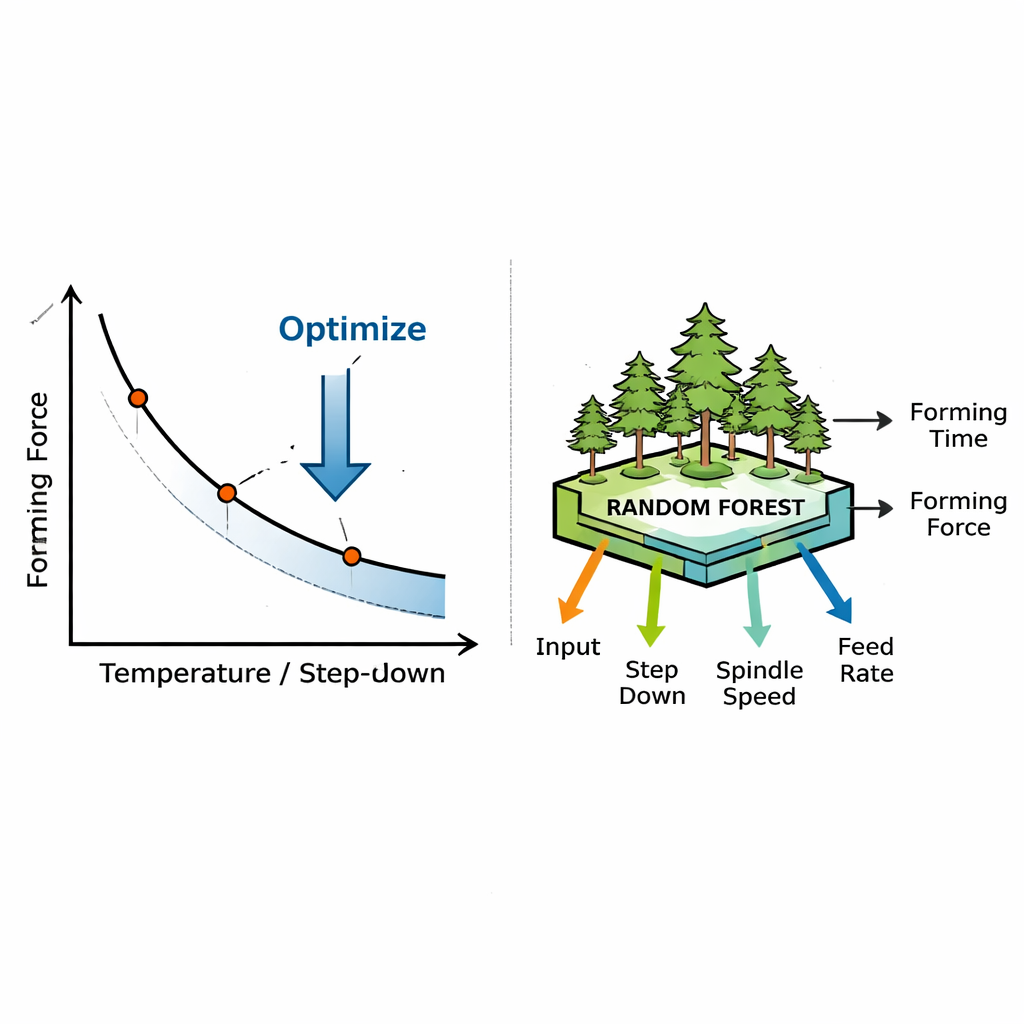
What This Means for Real-World Manufacturing
In everyday terms, this work shows how manufacturers can coax a difficult, lightweight metal into shape by combining controlled heating with careful adjustment of just a few key settings. The hybrid approach—mixing planned experiments, multi-criteria ranking, and machine learning—provides a practical recipe for choosing temperatures and step sizes that keep forces low and production times reasonable, without having to test every possibility on the shop floor. The same strategy could be extended to other alloys and shapes, helping factories design lighter parts more quickly, safely, and efficiently.
Citation: Khot, A.A., Magdum, R.A., Magdum, A.R. et al. Multi-response optimization and machine learning-based prediction of straight-groove warm incremental sheet forming of AZ31 magnesium alloy. Sci Rep 16, 6432 (2026). https://doi.org/10.1038/s41598-026-37761-y
Keywords: incremental sheet forming, magnesium alloy AZ31, warm forming, process optimization, machine learning in manufacturing