Clear Sky Science · en
Local/global visual processing impacts numerosity-magnitude conflict resolution
Why how we "see" numbers matters
When you glance at two plates of cookies and instantly know which plate has more, you are using a fast, intuitive sense of number. This “number sense” helps us navigate prices, crowds, or doses of medicine without doing exact calculations. But this gut feeling is not perfect: it can be tricked by how objects are arranged or how much space they occupy. This study asks a subtle question with big implications for how we learn and use math: does the way we visually scan a scene—focusing on tiny details versus the overall shape—change how well we can ignore these visual tricks and judge “how many”?

Looking at details versus the big picture
Psychologists often distinguish between two ways of seeing. Local processing is detail-focused: the eyes and mind zoom in on individual bits, like single leaves on a tree. Global processing is big-picture: we first see the whole forest, then the trees. Both styles are normal and useful, but people and situations can lean one way or the other. In number tasks that use displays of black dots, these two modes may highlight different cues. Dot size is a detail-level property tied to each dot, while the overall area occupied by the dots—their “footprint” on the screen—is a whole-scene property. When we compare which of two dot arrays has more items, these visual features can either support the correct answer or pull us toward a wrong one.
When visuals mislead our sense of number
To study this, the researchers worked with 54 adults who completed quick comparisons of dot arrays: on each trial they had to decide which of two circles held more dots. Sometimes the more numerous array also had larger dots or took up more space on the screen, making the correct choice visually obvious. Other times, the display was intentionally deceptive: the array with more dots had smaller dots or a tighter footprint, and so might look like “less” at a glance. These conflicts between actual number and visual appearance are known to slow people down and cause mistakes, revealing how strongly we rely on non-numerical cues, even when we think we are judging number alone.
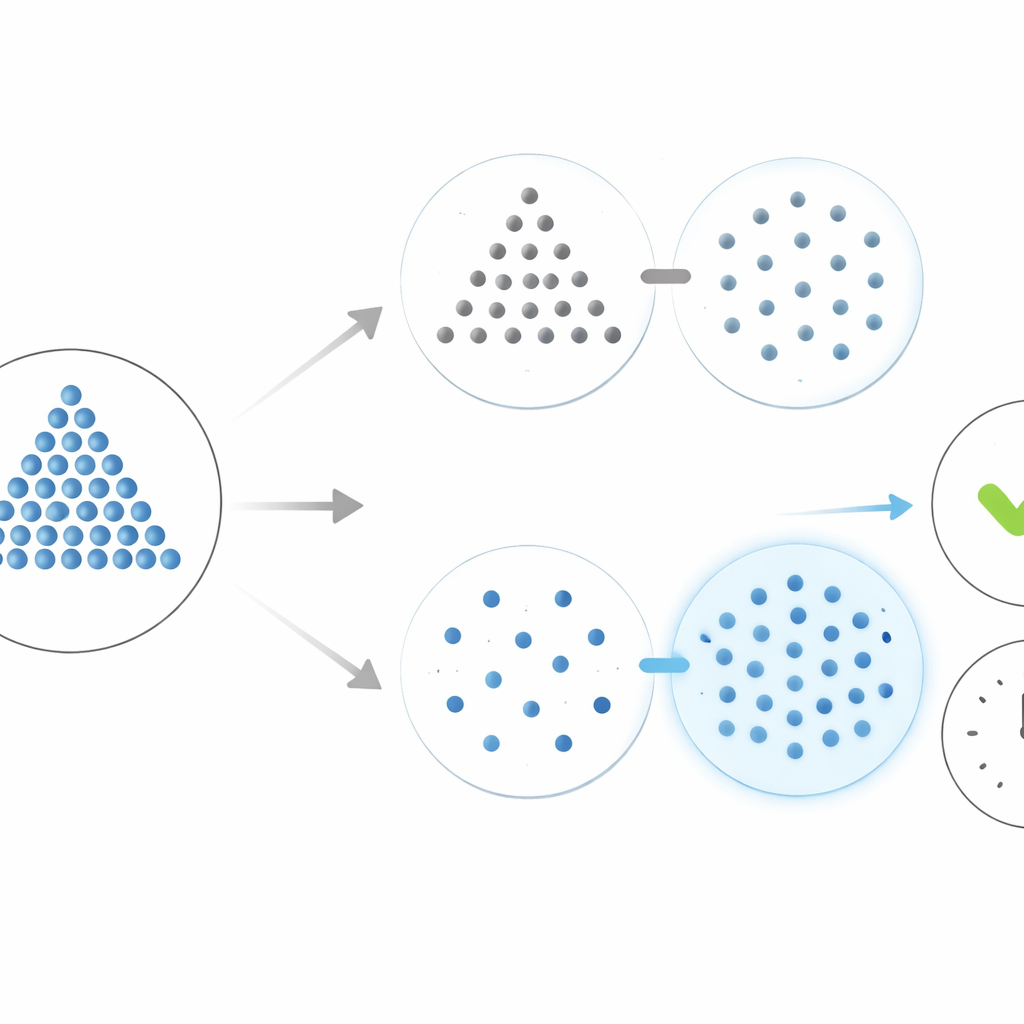
Gently nudging the brain toward details or wholes
Before some of the dot comparisons, participants briefly saw a “prime” image designed to push their attention toward either details or the whole shape. These primes were simple figures where small shapes formed a larger object. In the local condition, the important information was in the small, repeated shapes; in the global condition, it was in the overall outline. Participants had to quickly detect a target at the instructed level, which momentarily tuned their attention toward either local or global processing, before they moved on to judging the dots. A third, neutral condition involved just the dot comparisons, with no prime, providing a baseline for performance.
Detail focus helps ignore misleading space, not dot size
Across all conditions, people were slower and less accurate when number conflicted with the visual features of the arrays, confirming that our intuitive number sense is easily swayed by appearance. A key finding, however, was that local priming—momentarily shifting attention to fine details—changed how people dealt with these conflicts. It did not dramatically alter performance when the conflict involved dot size, where adults already showed little interference. But when number conflicted with the overall occupied area, focusing attention on details made participants faster on these tricky trials. In other words, encouraging a detail-oriented mode reduced the impact of the “big shape” of the dots, helping people rely more on number and less on misleading spatial spread.
What this means for everyday number sense
The results suggest that our ability to judge “how many” is not just about having a good internal sense of number. It also depends on where our visual attention goes: to small parts or to the whole scene. Briefly steering the brain toward a detail-focused mode made adults less vulnerable to one powerful source of visual bias. This hints that training or classroom strategies that shape how we look—when to zoom in on elements and when to step back—could support more robust numerical understanding. In simple terms, the study shows that how we look at the world can tilt the balance between being fooled by appearances and seeing the numbers that truly matter.
Citation: Chrétien, L., Poirel, N., Knops, A. et al. Local/global visual processing impacts numerosity-magnitude conflict resolution. Sci Rep 16, 9004 (2026). https://doi.org/10.1038/s41598-026-37755-w
Keywords: numerical cognition, visual attention, number sense, global local processing, dot comparison