Clear Sky Science · en
Transient modeling and performance evaluation of a solar-driven HDH desalination system with phase change material storage
Turning Sunlight into Drinking Water
For millions of people living in hot, dry regions, nearby seawater or salty groundwater is plentiful, but safe drinking water is not. This study explores a compact, solar-powered device that can turn salty water into fresh water without relying on the electric grid. By storing daytime heat in special "wax-like" materials, the system keeps making fresh water even after the sun goes down, offering a promising option for remote communities and off-grid homes.
How the Simple Two-Box System Works
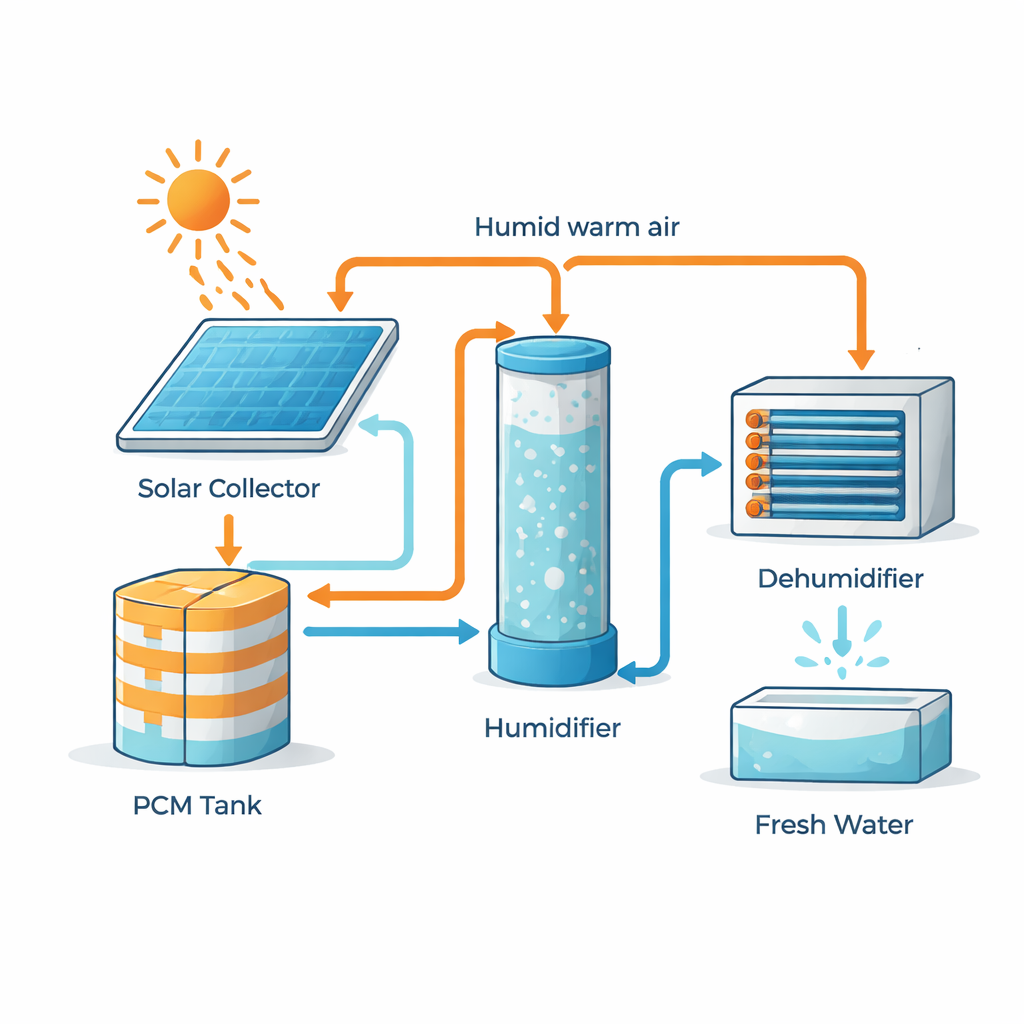
The desalination setup is built around two main boxes: a humidifier and a dehumidifier, linked to a flat solar water heater. In the humidifier, a fan blows air through a wet packed bed so the air picks up water vapor, just like warm air in a bathroom after a hot shower. This now humid, warm air moves into the dehumidifier, where it is cooled on metal surfaces so the vapor condenses into liquid droplets of fresh water. The salty water that supplied the vapor is heated in a rooftop-style solar collector and then recirculated, creating a closed loop that converts solar heat into clean water.
Storing Daylight Heat in Wax-Like Materials
A key twist in this design is the addition of phase change materials (PCMs) to the solar collector. These materials behave like special waxes that melt at chosen temperatures—here, around 45 °C and 60 °C. When they melt during the day, they soak up large amounts of heat without getting much hotter, and when they cool and solidify later, they release that heat slowly. The researchers embed several thin layers of PCM beneath the absorber plate of the solar collector, so the collector can keep feeding warm water to the humidifier even when sunlight starts to fade.
Following the System Through a Day
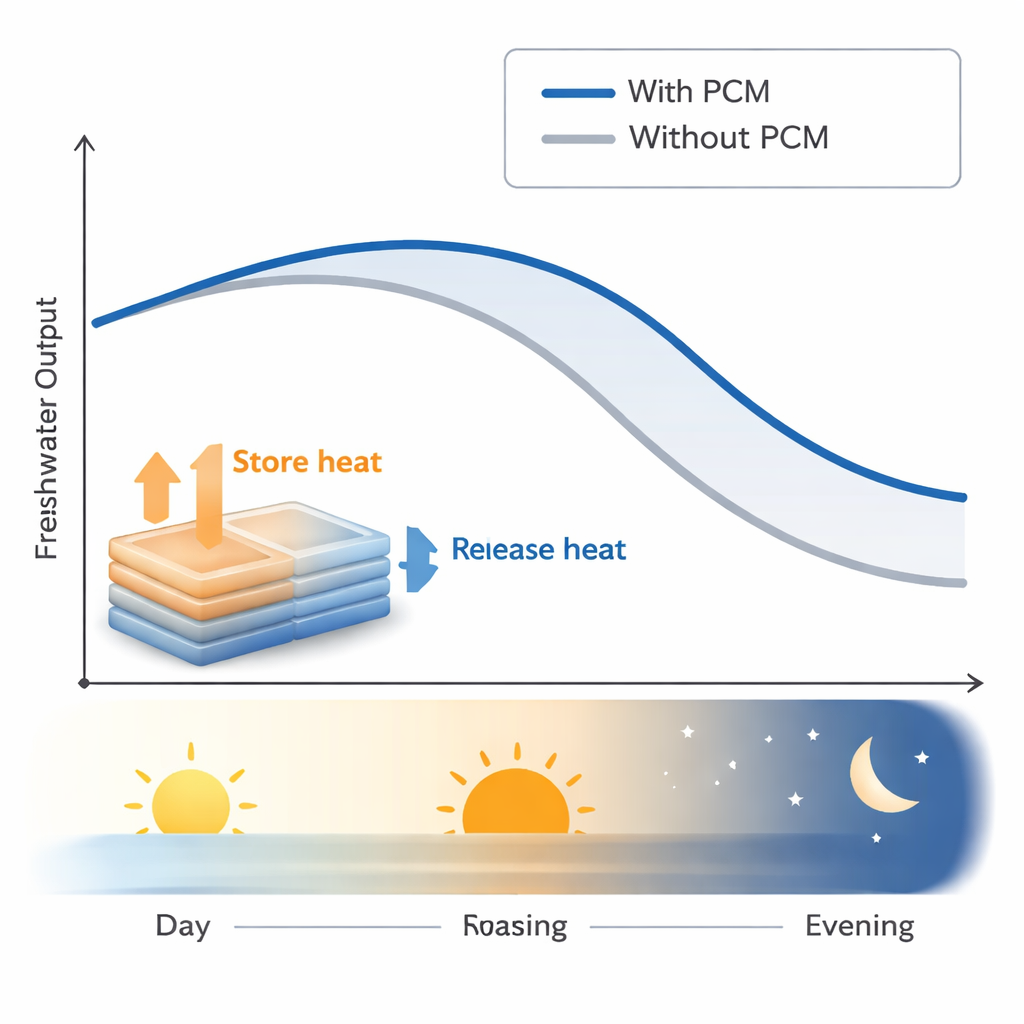
Using a detailed computer model, the authors followed how temperatures and water production change hour by hour. In the morning, when sunlight is still weak, the system produces about 2.1 liters of fresh water per hour. As the sun strengthens and the collector heats the water to around 45–55 °C, production rises to nearly 3.9 liters per hour. Without heat storage, output would then fall sharply in late afternoon as the collector cools. With PCMs in place, the stored heat flows back toward the water loop and air circuit, smoothing the temperature drop and delaying the point at which the system can no longer produce useful amounts of fresh water.
Why Evenings Matter More Than Peaks
The modeling shows that PCMs do not boost the mid-day peak in water production; that peak is already set by strong sunlight. Instead, the PCMs work like a thermal battery that stretches the operating hours. After about 3 p.m., systems without PCM quickly lose their driving temperature difference and shut down before sunset. In contrast, systems with PCM keep producing smaller but steady amounts of water into the early night. Over a full day, this extension raises total freshwater yield by about 10.5 percent. Two different PCMs with melting points of 45 °C and 60 °C perform similarly overall, but the lower-temperature material releases its heat more gradually, giving slightly more stable output in the evening.
What This Means for Thirsty Dry Regions
From a layperson’s perspective, the takeaway is straightforward: by adding an inexpensive heat-storing "wax" to a simple solar still based on humid air and condensation, you can keep making fresh water for hours after the sun starts to set. The study’s carefully validated model suggests that such a compact, low-temperature system could serve small communities far from power lines, turning abundant sunlight and salty water into a more reliable daily supply of drinking water. Future experiments and cost studies will be needed, but the concept points to a practical, low-tech way to make every hour of sunshine count for water security.
Citation: Mohammad, S.I., Jawad, M., Vasudevan, A. et al. Transient modeling and performance evaluation of a solar-driven HDH desalination system with phase change material storage. Sci Rep 16, 5745 (2026). https://doi.org/10.1038/s41598-026-37754-x
Keywords: solar desalination, freshwater scarcity, phase change materials, thermal energy storage, humidification dehumidification