Clear Sky Science · en
Using physical model test and numerical simulation for revealing the mechanism of stope collapse: a case study
Why underground cave-ins matter to all of us
Deep below ground, the metal ores that power our phones, cars, and clean-energy technologies are mined in vast man‑made caverns. If the rock roofs over these empty spaces suddenly collapse, the result can be deadly for miners and damaging for the environment and nearby communities. This study looks at how and why these collapses happen in a modern, backfilled underground mine, and how careful experiments and computer simulations can be used together to predict and prevent such disasters.
Hidden rooms beneath the surface
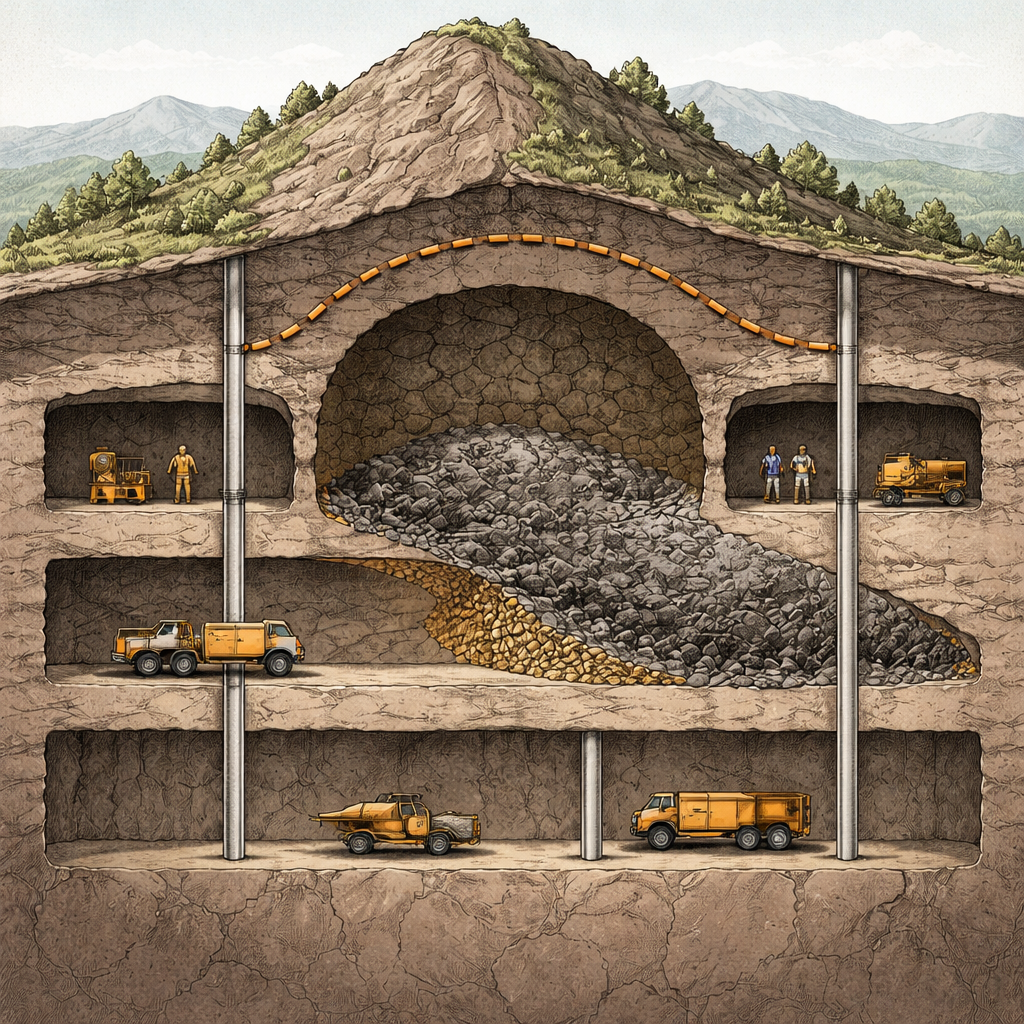
When miners extract ore, they leave behind hollowed‑out spaces called stopes or goafs. In many metal mines, these voids are later filled with waste rock and cement to help support the overlying rock. But when the fill is not strong enough, huge sections of the roof and surrounding rock can still give way. The authors focused on a Chinese metal mine where large areas had already been backfilled, yet the roof above one mined‑out zone collapsed. Their aim was to understand the chain of events that turned a seemingly stable underground room into a large, U‑shaped collapse zone that threatened nearby workings.
Building a mini mine in the lab
To probe this problem safely, the researchers built a large physical model of the mine using mixtures of sand, barite, cement, and plaster to mimic ore, backfill, and surrounding rock. They even invented a new grouting mold and step‑by‑step casting method so they could pour different types of “rock” and “fill” in neat, layered blocks—something that is surprisingly hard to do with heavy, slow‑flowing mortar. Once the model had hardened, they simulated mining to create a goaf and then gradually loaded the top to imitate the weight of overlying rock. High‑speed cameras, strain gauges, and vibration meters recorded how the model deformed and how shock waves spread when failure occurred.
Watching a collapse unfold
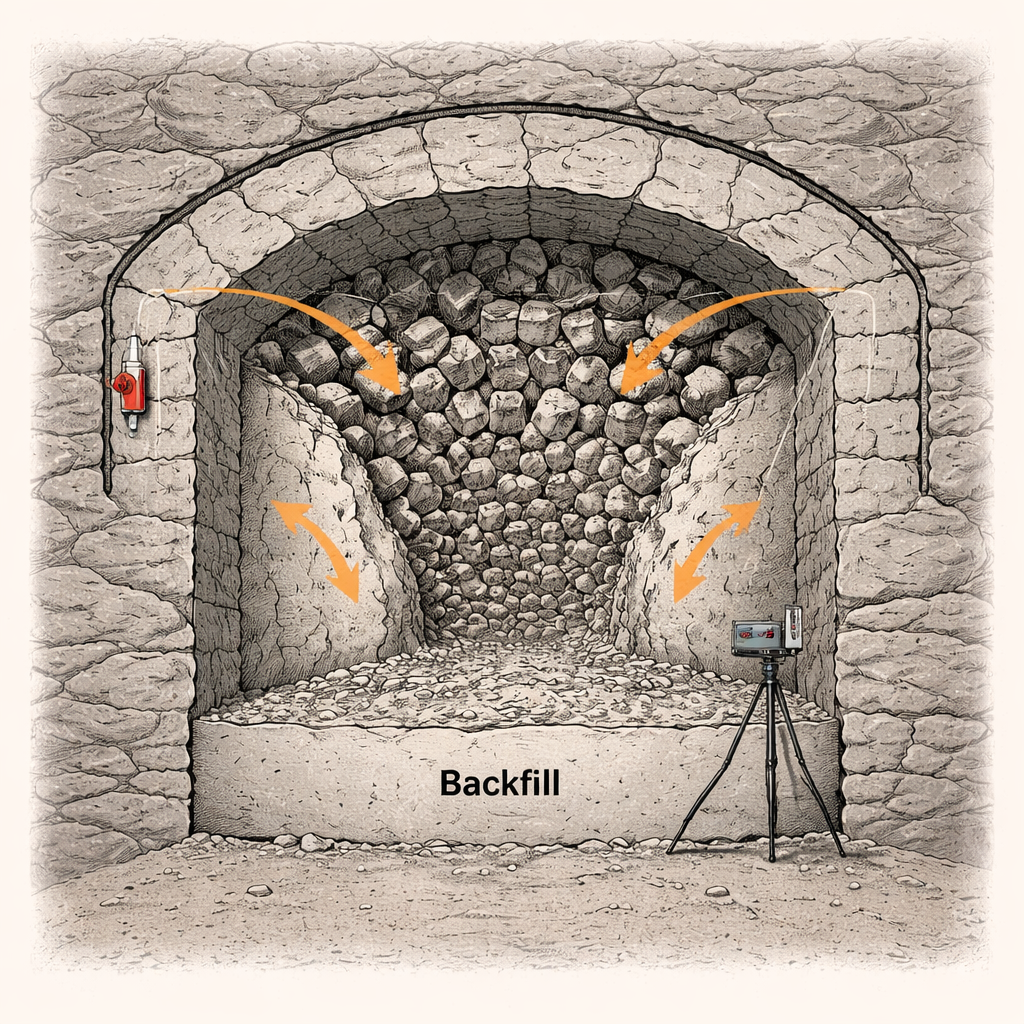
In the lab, the moment the large empty space was created, the roof slab did not gently sag; it failed almost instantly. The thick ore roof dropped as a relatively intact block, slamming into the floor and sending strong vibration waves through the surrounding material. Soon after, the side walls slid inward toward the center, squeezing the backfill and broken rock. By the time the system reached a new stable state, the collapsed zone had grown to about 72 meters in length and had a clear U‑shaped outline. Instruments placed near underground roadways in the model recorded higher vibration speeds on one side than the other, showing that local rock properties affect how collapse energy spreads through a mine.
Simulating rock failure in three dimensions
To check whether their scale model really captured what happens underground, the team turned to advanced numerical simulation using 3DEC software. They built a three‑dimensional digital version of the mine with realistic rock and fill properties and applied gravity and in‑situ stresses. The virtual mine behaved much like the physical one: the greatest movement occurred at the roof, the side walls slid toward the opening, and a U‑shaped failure zone developed around the goaf. The simulations also showed abrupt transitions from stable rock to rapidly sliding rock, and pinpointed where shear strain—an indicator of imminent slipping—spiked just before collapse. This close match between lab and computer gave the researchers confidence in their understanding of the failure process.
From theory to safer mining practice
Beyond simply describing what they saw, the authors used classic rock mechanics to derive a formula that links rock strength, friction, and tunnel shape to the thickness of a “pressure arch” above an underground opening. This arch is the zone of rock that carries the load after excavation; as it grows and then breaks, it guides how a U‑shaped collapse develops. Combining this theory with their experiments and simulations, they mapped out the likely slip lines and dangerous zones around the real mine’s collapsed stope. They then designed a targeted grouting scheme: drill from stable areas into the damaged zone and inject cement‑based slurry to glue loose blocks together. Field tests showed that this reinforcement improved rock quality and allowed five nearby stopes to be mined more safely.
What this means for people and mines
For non‑specialists, the message is straightforward: underground caverns do not fail at random. Their collapse follows recognizable patterns that can be measured, modeled, and controlled. By combining scaled‑down physical models, three‑dimensional computer simulations, and a simple arch‑thickness formula, this study provides mine operators with a practical toolkit for spotting high‑risk areas and reinforcing them before disaster strikes. The approach helps protect miners’ lives, reduces the chance of surface subsidence, and supports more reliable access to the metals on which modern society depends.
Citation: Zhang, R., Xie, C. & Chen, J. Using physical model test and numerical simulation for revealing the mechanism of stope collapse: a case study. Sci Rep 16, 6596 (2026). https://doi.org/10.1038/s41598-026-37753-y
Keywords: underground mining, rock collapse, backfill, numerical simulation, grouting reinforcement