Clear Sky Science · en
Validation of SocialBit as a smartwatch algorithm for social interaction detection in a clinical population
Why Counting Conversations Matters
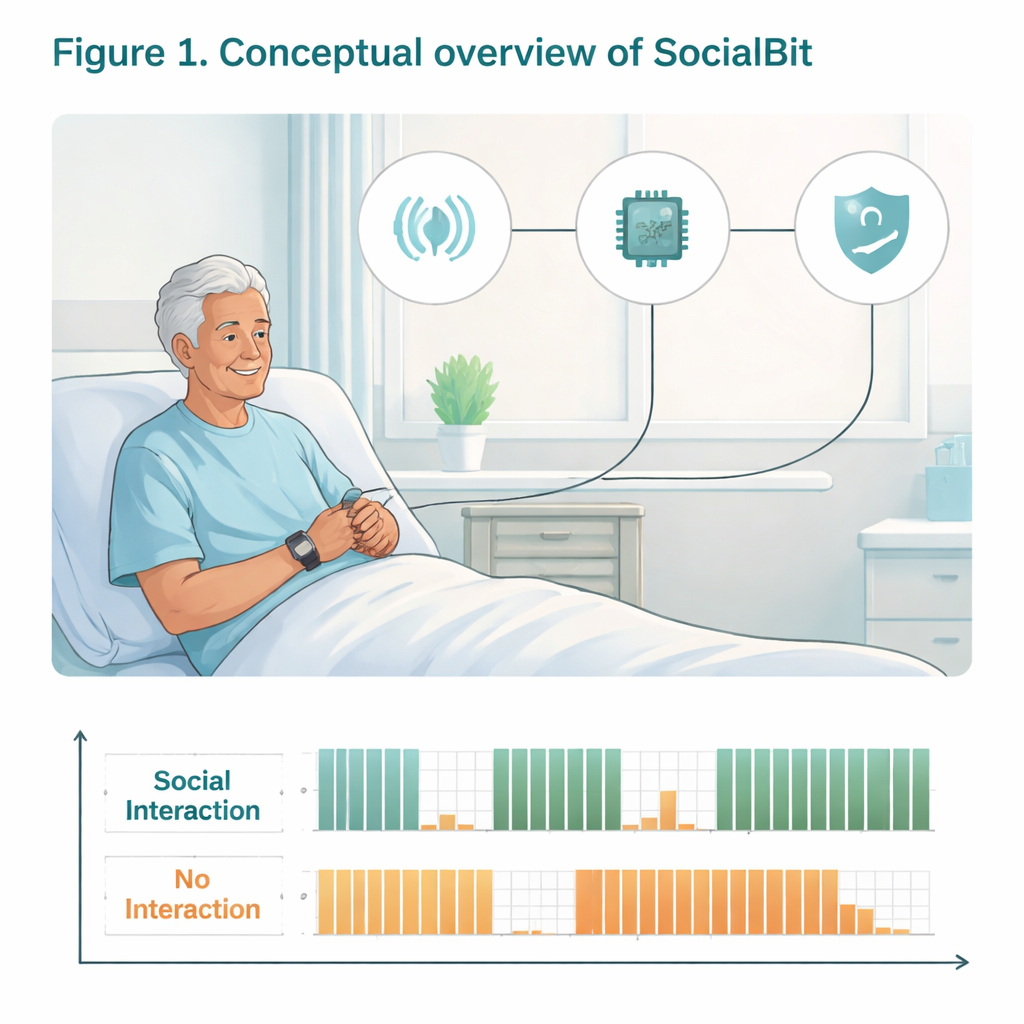
After a major illness such as stroke, small everyday moments—like chatting with a nurse or joking with family—can quietly shape recovery. Social ties are known to protect brain health and even lengthen life, yet doctors rarely have a reliable way to measure how socially engaged a patient actually is during the day. This study introduces SocialBit, a smartwatch-based system that listens for conversation in a privacy-conscious way and tests whether it can accurately track real-world social interaction in people hospitalized after a stroke.
A Smartwatch That Hears, Not Eavesdrops
SocialBit is a software algorithm that runs on an off-the-shelf smartwatch. Rather than recording conversations or analyzing the words people say, it uses brief snippets of ambient sound to capture patterns like volume, rhythm, and other acoustic features. From these, it decides whether a minute of time likely involved an interaction—defined simply as any sound made by or directed to the patient by another person, including fragmented or non‑verbal speech common after stroke. Because the system never stores raw audio or transcribed text, it is designed to preserve privacy while still giving clinicians a continuous readout of a patient’s social world.
Testing the Device in Real Hospital Life
To see if SocialBit works outside the lab, the researchers enrolled 153 adults hospitalized with ischemic stroke at two Boston hospitals. Patients wore the smartwatch during daytime hours for up to eight days, while trained observers watched secure live video and labeled each minute as social or not. This created nearly 89,000 minutes of human-coded data, of which about 14,000 minutes also had SocialBit readings. The patients varied widely: stroke severity ranged from very mild to severe, thinking and memory scores covered almost the full scale, and 24 participants had different forms of aphasia, a language disorder that often disrupts normal conversation. This diversity allowed the team to test whether the system held up even when speech was halting, slurred, or minimal.
How Well the Algorithm Performed
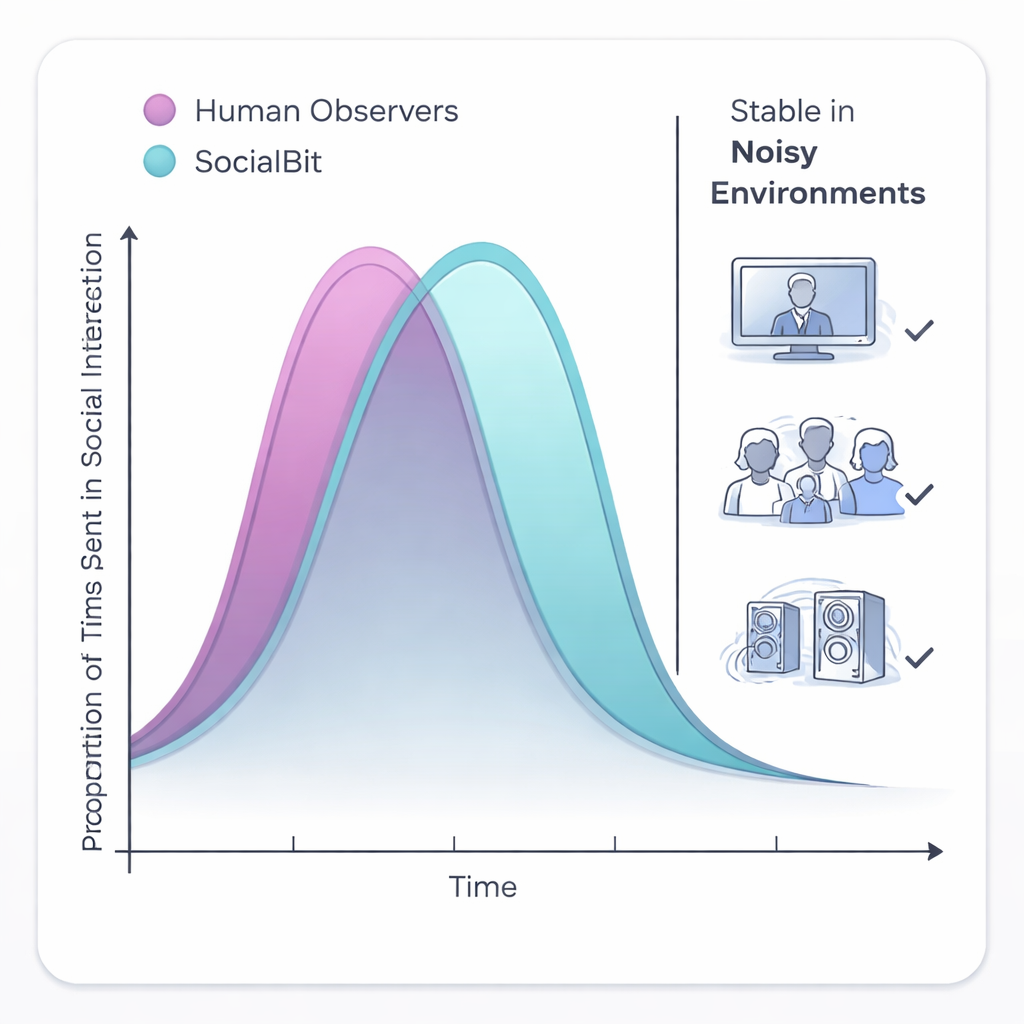
When SocialBit’s judgments were compared to the human coders’ minute-by-minute labels, the best-performing version of the algorithm correctly detected social interaction in about 87 percent of the minutes that truly contained it and correctly recognized non‑interaction 88 percent of the time. Statistically, this placed SocialBit ahead of existing general-purpose speech and conversation detectors. Importantly, its summary view of how much time patients spent interacting over the day closely matched the human estimates, even though the smartwatch only sampled one out of every five minutes to conserve battery life. Performance remained strong across many real-world challenges, including background television, side conversations in the room, phone and video calls, different hospital units, and two kinds of smartwatch hardware.
Including Patients Who Struggle to Speak
A key question was whether SocialBit would fail in people with aphasia, who may speak less or produce non‑standard speech. In this subgroup, the algorithm still performed well, with only a modest drop in accuracy compared with patients without language problems. The system also behaved in clinically sensible ways: patients with more severe strokes had fewer minutes of detected interaction, mirroring what the human coders observed. Each one‑point increase in stroke severity score was linked to roughly a one percent drop in the share of time spent interacting. This suggests that SocialBit is not just recognizing sound, but capturing a meaningful dimension of patients’ social lives.
What This Could Mean for Care
The authors argue that a tool like SocialBit could turn social interaction into a “vital sign” that can be tracked alongside blood pressure or heart rate. In research, it could provide an objective outcome for clinical trials that aim to improve quality of life or reduce isolation. In everyday practice, it could alert clinicians and caregivers when a patient is becoming less socially engaged, prompting earlier support or changes to the environment. While more work is needed to adapt the system for home use and to capture not just how often people interact but how meaningful those moments are, this study shows that a simple smartwatch can reliably measure a powerful yet previously invisible ingredient of recovery: human connection.
Citation: Dhand, A., Tate, S., Mack, C. et al. Validation of SocialBit as a smartwatch algorithm for social interaction detection in a clinical population. Sci Rep 16, 4529 (2026). https://doi.org/10.1038/s41598-026-37746-x
Keywords: stroke recovery, social interaction, smartwatch sensing, digital biomarker, aphasia