Clear Sky Science · en
Synergistic effects of nano SnO2 and TiO2 on the mechanical and antibacterial properties of HDPE
Stronger, Safer Everyday Plastics
From milk jugs to medical tubing, tough plastic called high‑density polyethylene (HDPE) quietly supports daily life. This study asks a simple but powerful question: can we make this common plastic both stronger and more hygienic by sprinkling in tiny mineral particles? By blending HDPE with nanometer‑scale tin oxide (SnO₂) and titanium dioxide (TiO₂), the researchers show how small changes in recipe can create plastic that resists breaking, blocks moisture and oxygen, and even fights harmful bacteria.
Tiny Additives with Big Impact
The team began by making very small grains—only about 30–50 billionths of a meter across—of tin oxide and titanium dioxide. At this scale, materials often behave differently than in bulk form. These nanoparticles were then mixed into melted HDPE and pressed into solid sheets. By carefully choosing how much of each oxide to add, the researchers could test whether the plastic became tougher or weaker, more flexible or more brittle, and whether it could slow the passage of water vapor and oxygen gas.
Finding the Sweet Spot for Strength
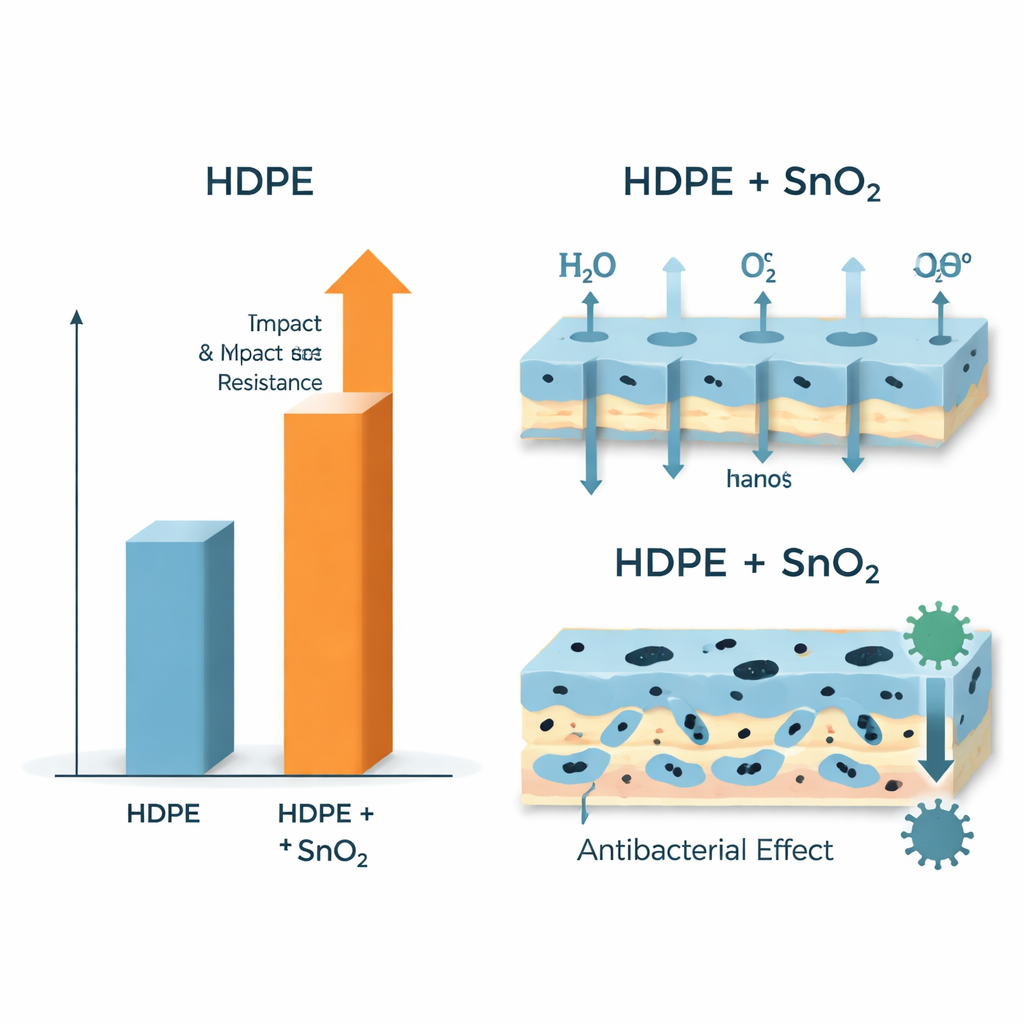
When tin oxide nanoparticles were blended into HDPE, the plastic’s mechanical performance improved dramatically—up to a point. With about 3 percent SnO₂ by weight, the material’s ability to absorb energy before breaking (its toughness) and its resistance to crack growth (fracture strength and impact strength) all increased compared with plain HDPE. The plastic could stretch more before snapping, yet remained reasonably stiff, indicating a good balance between strength and flexibility. At this loading, the tiny particles were well spread out, helping to redirect and blunt cracks rather than starting new ones. Pushing the SnO₂ content still higher, however, led some particles to clump, introducing weak spots that began to erode the gains.
When More Filler Becomes Too Much
Titanium dioxide told a cautionary counter‑story. A small dose—around 1 percent by weight—gave HDPE a modest boost in properties such as fracture strength and impact resistance. But when the amount climbed to 3 percent, performance dropped sharply. Instead of strengthening the plastic, the clustered TiO₂ nanoparticles acted like sand in concrete that has not mixed well, concentrating stress and making the material more brittle. This contrast with tin oxide highlights that not all nanoparticles behave the same in a given plastic, and that there is an optimal loading beyond which added filler can do more harm than good.
Better Barriers and Built‑In Germ Defense
Because the SnO₂‑filled HDPE looked especially promising, the authors cast it into thin films and measured how easily water vapor and oxygen could pass through. Compared with pure HDPE film, versions containing up to 2 percent nano‑SnO₂ showed a clear drop in both water and oxygen permeability. The nanoparticles forced gas molecules to take a longer, more winding route, slowing their progress through the plastic. The same films were then challenged with two troublesome bacteria: Escherichia coli and antibiotic‑resistant Staphylococcus aureus (MRSA). As the SnO₂ content increased, the films produced larger bacteria‑free zones and needed lower doses to completely halt growth, indicating strong, dose‑dependent antibacterial activity.
What This Means for Real‑World Uses
In plain terms, the study shows that adding carefully chosen, well‑dispersed nano‑tin oxide to HDPE can make a very common plastic tougher, better at keeping out air and moisture, and hostile to harmful microbes—all at relatively low additive levels. Titanium dioxide offers only modest benefits before it begins to undermine performance. For consumers and designers, this work points toward future plastic films and molded parts that last longer under stress and help keep food, medical devices, and contact surfaces cleaner, without radically changing existing manufacturing methods.
Citation: Syala, E., Elgharbawy, A.S., Abdellah Ali, S.F. et al. Synergistic effects of nano SnO2 and TiO2 on the mechanical and antibacterial properties of HDPE. Sci Rep 16, 7486 (2026). https://doi.org/10.1038/s41598-026-37745-y
Keywords: nanocomposite plastics, high density polyethylene, antibacterial packaging, tin oxide nanoparticles, barrier films