Clear Sky Science · en
An ancient Erysipelothrix rhusiopathiae genome recovered from 1400-year-old human remains in the Northern Caucasus
Ancient Clues From a Child’s Bones
In a mountain cemetery in the Northern Caucasus, the skeleton of a 10–11‑year‑old girl who died some 1,400 years ago has yielded an unexpected story. Her damaged spine looked, at first glance, like classic tuberculosis. But by reading microscopic traces of DNA preserved inside her teeth, scientists uncovered a different culprit: a little‑known animal‑borne bacterium that still infects people and livestock today. This work shows how ancient DNA can rewrite diagnoses from the distant past and illuminate the long history of modern diseases.
Life and Death in an Early Medieval Herding Community
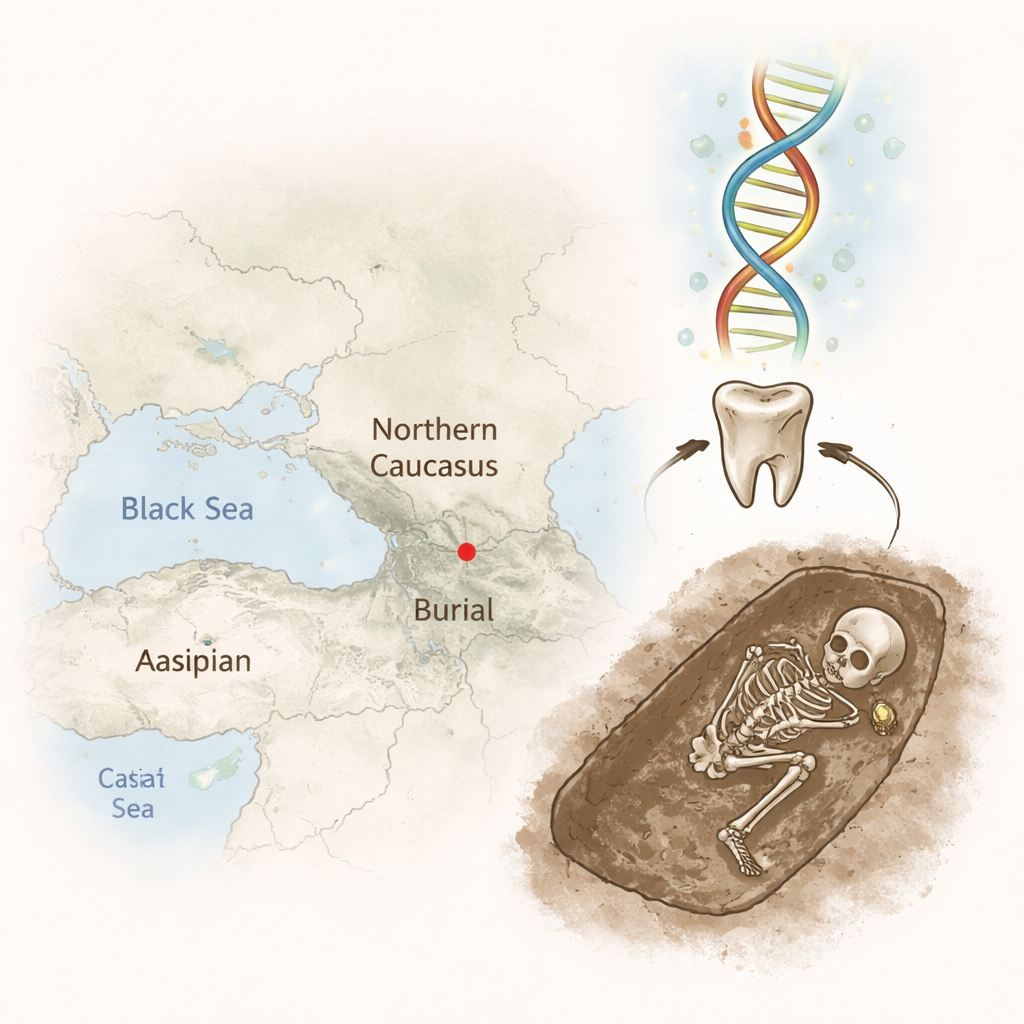
The girl, known to archaeologists as Sk213, was buried in a simple grave near today’s village of Zayukovo in the North Caucasus. Her people, the Alans, were farming and herding communities who kept cattle, sheep, goats, horses, and pigs. Radiocarbon dating placed her death between 574 and 668 AD. Grave goods were sparse: just a single bronze earring. That, along with the rough pit burial, suggests she came from a low social class, likely helping with everyday tasks that brought her into close contact with animals and their products.
Bones That Looked Like Tuberculosis
Careful study of Sk213’s skeleton revealed dramatic disease in the middle of her spine and nearby ribs. Several thoracic vertebrae showed areas where bone had been eaten away, others were misshapen or partly destroyed, and fine layers of new bone coated the inside of multiple ribs. To specialists, this pattern strongly resembles spinal tuberculosis, a chronic infection that slowly erodes bone and can ultimately cripple or kill. On that basis, an initial paleopathological diagnosis pointed toward tuberculosis, a well‑known scourge of past populations.
DNA Surprises Inside Ancient Teeth
To test that diagnosis, the team drilled into two of the girl’s teeth and extracted powder from the inner pulp, a tissue richly supplied with blood during life and an excellent trap for blood‑borne microbes. Using high‑throughput sequencing, they catalogued all DNA fragments present and compared them to modern databases. Surprisingly, they found virtually no genetic traces of the tuberculosis bacteria. Instead, a large number of sequences matched Erysipelothrix rhusiopathiae, a bacterium that today causes a disease called erysipeloid in humans and swine erysipelas in pigs and wild boars.
Additional tests confirmed that the bacterial DNA was truly ancient: the fragments were very short and carried chemical damage patterns typical of centuries‑old material. The same strain appeared independently in both teeth, indicating that this microbe had circulated in the girl’s bloodstream while she was alive, rather than being a later contaminant from soil. In modern patients, finding this bacterium in the blood is associated with a serious, sometimes fatal, systemic infection.
A Long‑Lived Lineage Linking Humans and Hogs
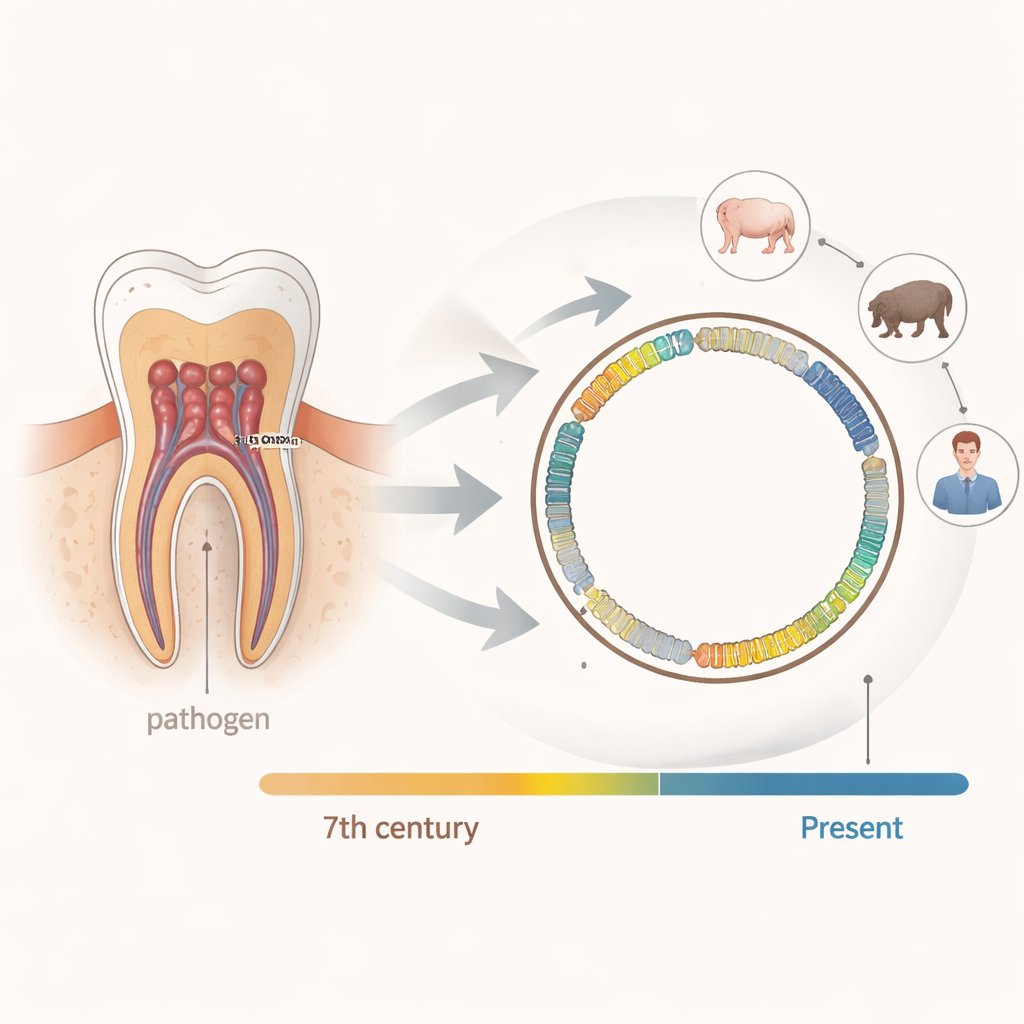
Using the ancient DNA fragments, researchers reconstructed a nearly complete bacterial genome, which they named ERA_01. They then compared ERA_01 to more than 500 modern genomes from the same bacterial group, many isolated from pigs and wild boars around the world. ERA_01 fell squarely within a major branch that today dominates in Europe and Asia. Its closest known relatives are recent strains from wild boars in Sweden and farm pigs in Europe, suggesting that this disease lineage has been circulating in animals—and occasionally spilling over into humans—for at least 1,400 years.
Genetically, ERA_01 carried most of the same genes that make modern strains virulent, including a key surface protein that helps the bacterium stick to host tissues and avoid being eaten by immune cells. It also bore genetic signs of resistance to vancomycin, a powerful antibiotic, showing that this trait long predates modern drug use. Differences in a cluster of genes that define “serotypes” hint that the ancient strain may have been typical of those found in wild animals, consistent with infection from contact with hunted or herded boars or pigs.
Rethinking Old Diseases With New Tools
Sk213’s damaged spine probably still reflects a severe, long‑lasting infection, and tuberculosis or related bacteria may have been present as well. But the abundance of E. rhusiopathiae DNA in her teeth, combined with modern clinical reports of this microbe attacking bones and vertebrae, makes it likely that erysipeloid—alone or in combination with other infections—played a major role in her illness and early death. More broadly, this study demonstrates how ancient DNA can reveal hidden players in past disease and shows that some animal‑borne pathogens troubling farmers and abattoir workers today have been shadowing human herding societies since at least the early Middle Ages.
Citation: Kritsky, A.A., Berezina, N.Y., Ivanova, A.O. et al. An ancient Erysipelothrix rhusiopathiae genome recovered from 1400-year-old human remains in the Northern Caucasus. Sci Rep 16, 7097 (2026). https://doi.org/10.1038/s41598-026-37742-1
Keywords: ancient DNA, zoonotic disease, erysipeloid, paleopathology, medieval Caucasus