Clear Sky Science · en
Therapeutic potential of targeting MASTL in lung adenocarcinoma
Why this lung cancer study matters
Lung adenocarcinoma is the most common form of lung cancer and a leading cause of cancer deaths worldwide. Many patients either do not respond to today’s targeted drugs and immunotherapies, or their tumors come back. This study focuses on a lesser-known enzyme called MASTL and asks a practical question: could shutting it down both slow tumor growth and make the immune system more effective against lung cancer?
A traffic controller gone rogue
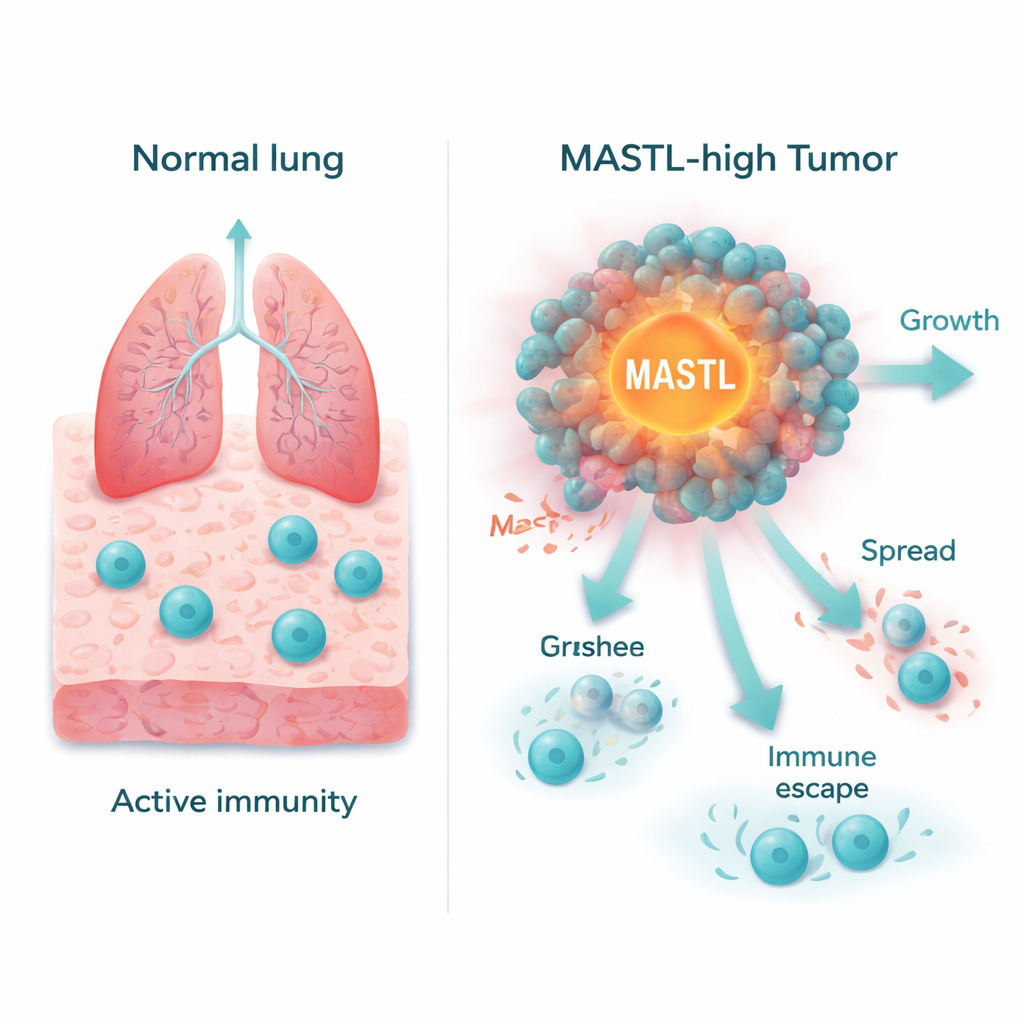
Inside every dividing cell, a tightly regulated control system decides when the cell should copy its DNA and split in two. MASTL is one of the key controllers of this process. By checking large cancer databases and patient samples, the researchers found that MASTL levels are much higher in lung adenocarcinoma tissue than in normal lung. Patients whose tumors had more MASTL tended to live for a shorter time, even when the cancer was caught at an early stage. Using statistical models that also accounted for tumor stage and other clinical factors, they showed that MASTL on its own can help predict how a patient will do.
How MASTL reshapes cancer cell behavior
To understand what high MASTL actually does, the team examined thousands of genes that change alongside it. Tumors with more MASTL showed strong activation of programs that drive cell division, DNA copying, and survival under stress. Several well-known growth and survival pathways, including those involving p53, MYC, mTOR, WNT and HIPPO, were closely linked to an activated form of MASTL that carries a chemical tag at a specific site (called S370). The researchers also identified a set of partner proteins that work with MASTL during cell division. Together, these findings portray MASTL as a central hub that helps lung cancer cells multiply faster, maintain their DNA despite damage, and gain more aggressive features.
Silencing the tumor’s alarm to the immune system
Cancer does not grow in isolation: it constantly interacts with immune cells in its surroundings. The study shows that tumors rich in MASTL tend to have fewer helpful immune cells infiltrating them and lower overall immune activity. Markers for dendritic cells, which normally present tumor signals and help activate T cells, were especially reduced. Patterns of immune helper cells (known as Th1 and Th2 cells) were also skewed in ways associated with a less effective anti-tumor response. When the authors analyzed data predicting response to immune checkpoint drugs, patients with low MASTL expression were more likely to benefit, while those with high MASTL had signs of immune evasion and poorer predicted outcomes. This suggests that MASTL may help tumors hide from, or blunt, the body’s natural defenses.
Testing a MASTL-blocking drug in the lab and in mice
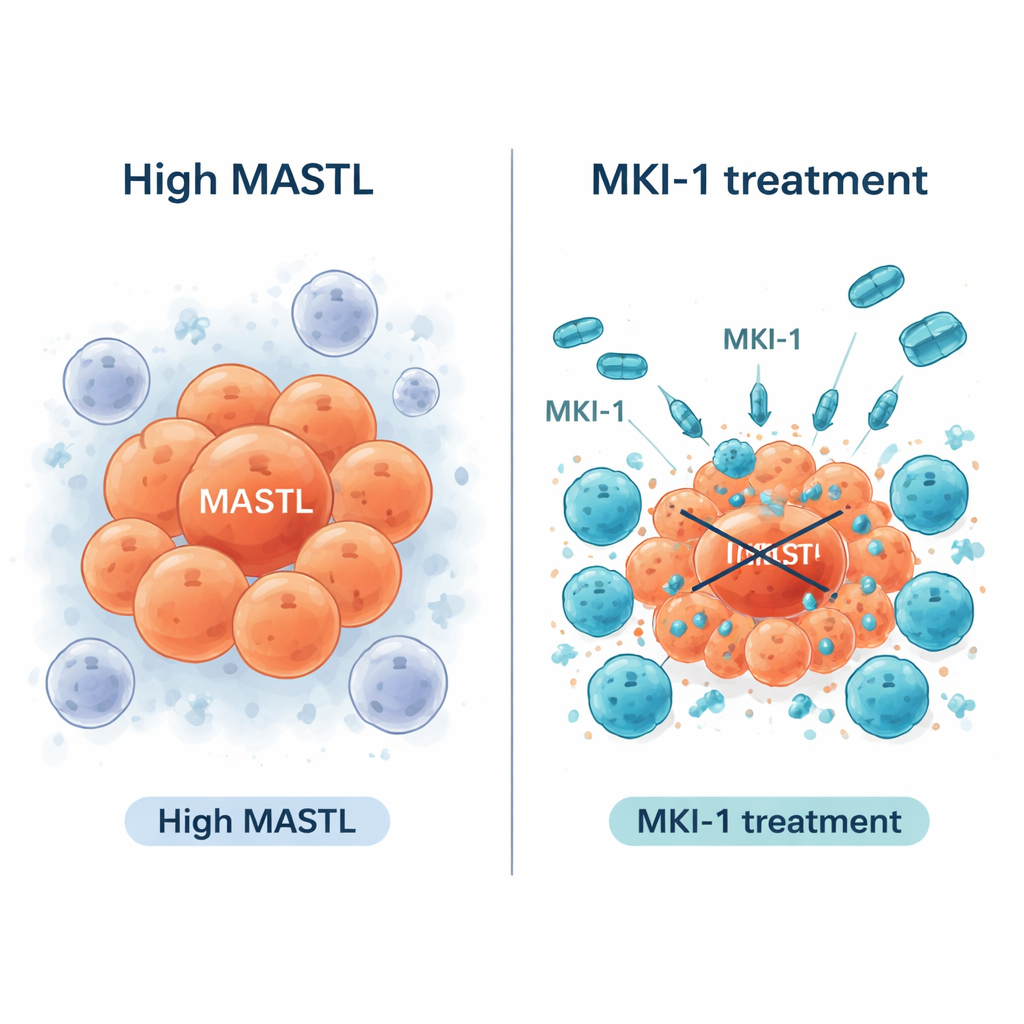
To move beyond computer analyses, the researchers used a small-molecule drug called MKI-1 that blocks MASTL activity. In lung adenocarcinoma cell lines grown in dishes, MKI-1 slowed cell growth, pushed cells into a stalled phase of the cell cycle, and triggered programmed cell death. It also reduced the cells’ ability to form colonies, migrate, and grow as free-floating spheres—behaviors associated with stem-like, highly metastatic cancer cells that resist treatment. In mice implanted with human lung adenocarcinoma cells, regular dosing with MKI-1 meaningfully shrank tumors compared with untreated animals, without causing obvious weight loss or toxicity. These experiments show that targeting MASTL can weaken tumor growth and aggressive traits in living systems.
What this could mean for future treatment
Taken together, this work positions MASTL as both a warning sign and a potential weak point in lung adenocarcinoma. High levels of MASTL flag tumors that are more likely to grow quickly, spread, and resist immune attack. At the same time, the success of the MKI-1 drug in cells and mice suggests that medicines aimed at MASTL could one day complement existing therapies—by directly slowing cancer cell division and by helping restore a more active anti-tumor immune environment. While further studies and clinical trials are needed, the findings open a new line of attack against one of the deadliest cancers.
Citation: Liu, J., Li, J., Luo, J. et al. Therapeutic potential of targeting MASTL in lung adenocarcinoma. Sci Rep 16, 6998 (2026). https://doi.org/10.1038/s41598-026-37735-0
Keywords: lung adenocarcinoma, MASTL, tumor microenvironment, immunotherapy, targeted therapy