Clear Sky Science · en
Entomological survey of sand fly vectors and molecular screening for Leishmania parasite in refugee camps in Ethiopia
Why tiny flies matter in crowded camps
In parts of East Africa, a microscopic parasite causes a deadly illness called visceral leishmaniasis, or kala-azar, spread by the bites of tiny sand flies. Refugee camps in Ethiopia host hundreds of thousands of people who may come from, or now live in, areas where this disease can flourish. This study set out to answer a basic but urgent question: what kinds of sand flies live in and around these camps, where do they prefer to rest and breed, and are they carrying the leishmaniasis parasite?
Taking a close look at camp surroundings
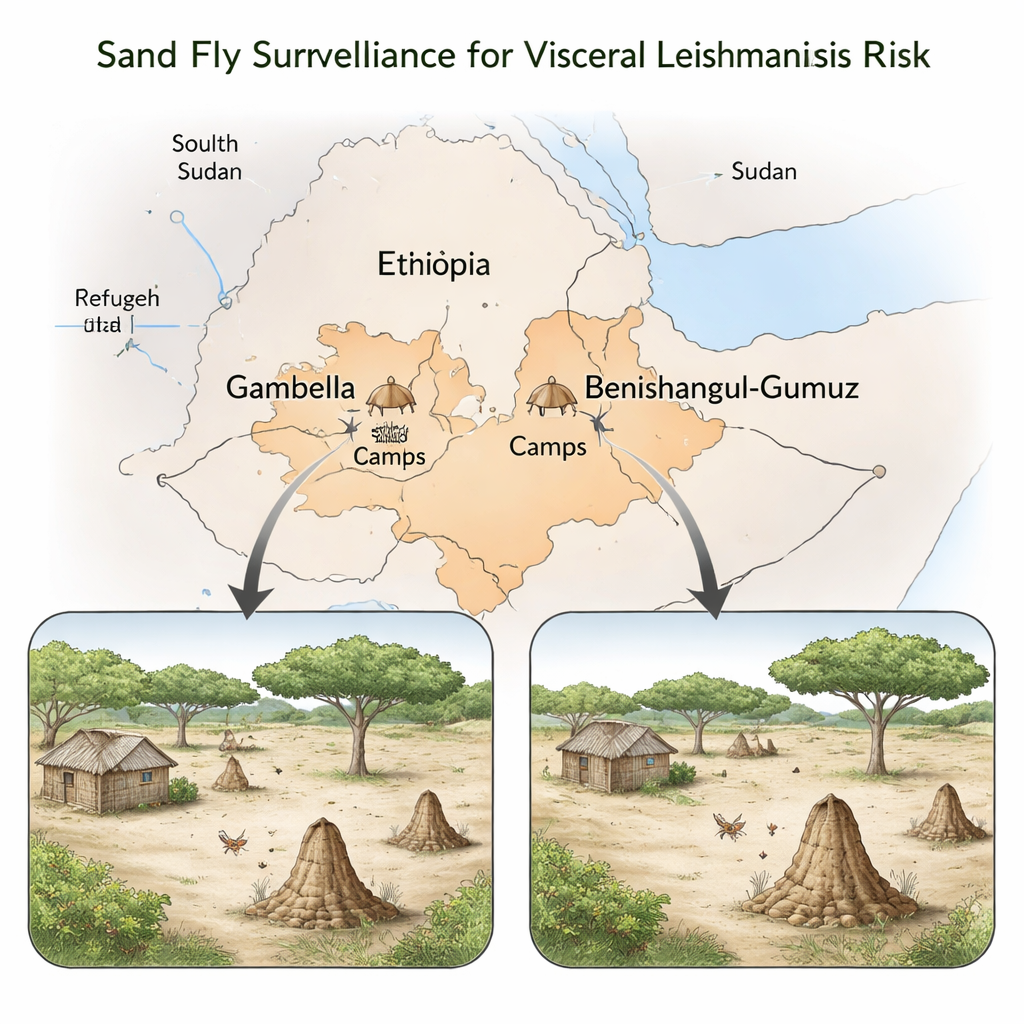
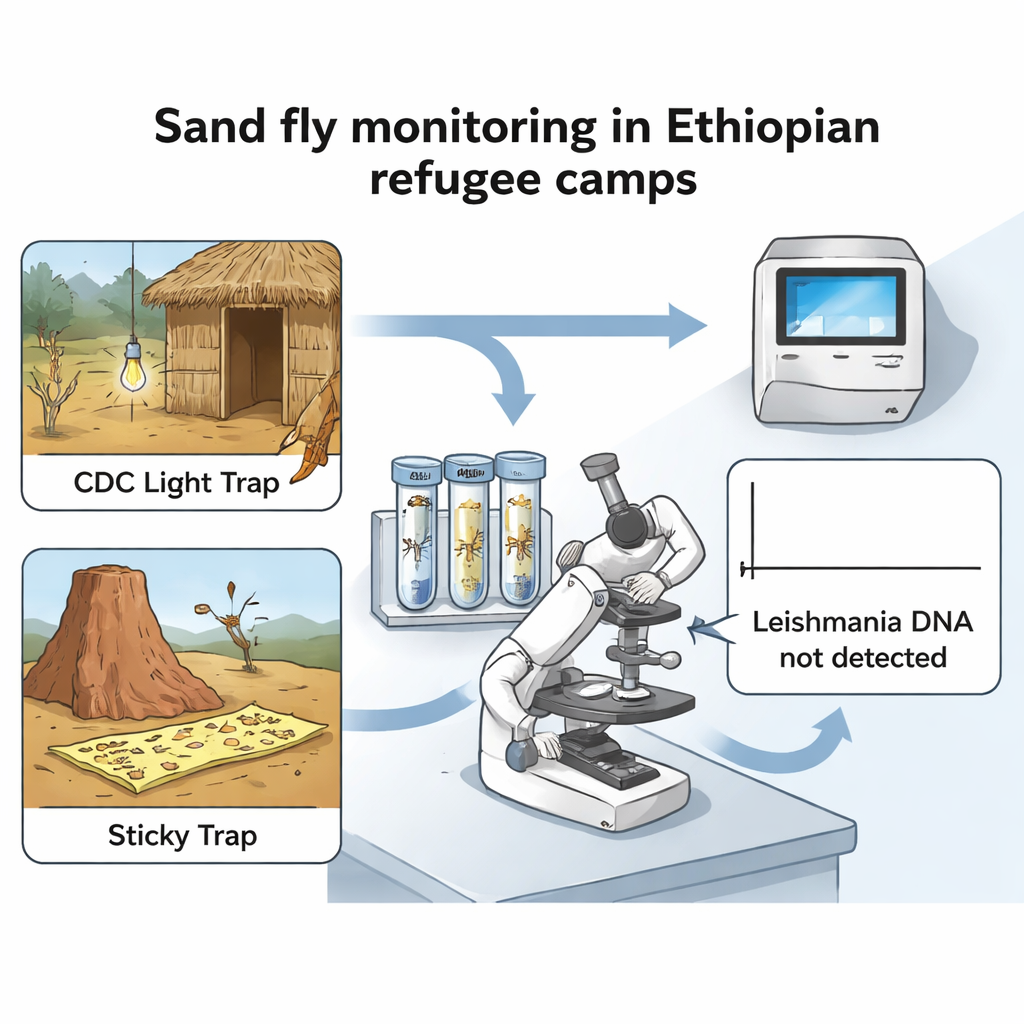
Researchers focused on four large refugee camps in two Ethiopian regions that border Sudan and South Sudan, both known for leishmaniasis outbreaks. These areas are hot, semi-arid landscapes of woodland, grassland and scattered termite mounds. The team set traps both inside homes and outside in yards, nearby vegetation and around termite hills. Using two main tools—a light trap that hangs near shelters at night and sticky sheets laid on the ground—they collected more than 2,000 adult sand flies during a short survey in 2025. Each fly was carefully examined under the microscope to identify its species, and females were preserved for later genetic testing.
Who are the local sand fly “neighbors”?
The survey revealed a surprisingly rich community of sand flies, dominated not by the classic disease-carrying species but by a group usually seen as less dangerous. Over 98% of the flies belonged to the genus Sergentomyia, with one species, Sergentomyia antennatus, making up more than half of all captures. Only 1.7% were from the genus Phlebotomus, the group typically responsible for spreading visceral leishmaniasis. In fact, just one Phlebotomus species—Phlebotomus rodhaini—was found, and in very low numbers. Different camps showed different mixtures of species: one site had all eight recorded species, while another had few flies and limited diversity, likely reflecting local differences in vegetation, soil and microclimate.
Outdoor life around termite mounds
Most sand flies were caught outdoors, with less than 3% found inside houses. This strongly suggests that the local sand fly populations prefer to rest and feed outside rather than on indoor walls. Termite mounds and nearby outdoor areas turned out to be major hotspots, harboring the highest sand fly densities, particularly of Sergentomyia species. Some species showed a clear fondness for termite hills in or near villages, while others favored mounds in more natural, wooded habitats. This pattern matters for control efforts: measures that focus only on spraying insecticide indoors are unlikely to reach the majority of flies that live and rest outside, especially around termite mounds.
Testing flies for hidden parasites
Finding sand flies is only half the story; the key public health question is whether they are carrying Leishmania parasites. To investigate this, the team tested female flies for parasite DNA using a very sensitive laboratory method called PCR, which can detect even tiny traces of genetic material. All individual Phlebotomus rodhaini females were tested separately, and hundreds of Sergentomyia females were tested in species-based pools. None of these tests showed any sign of Leishmania DNA. This suggests that, during the study period, transmission by sand flies in these camps was very low or absent, even though previous research has shown that many refugees carry the parasite silently without symptoms.
What this means for people in the camps
For now, the findings are cautiously reassuring: in these Ethiopian refugee camps, the main vectors of visceral leishmaniasis are rare, and the sand flies that were present did not show detectable infection with the parasite. At the same time, the study highlights important warning signs and priorities. Outdoor-resting flies and their strong association with termite mounds mean that control programs must look beyond indoor spraying and consider environmental management, such as reducing sand fly-friendly sites around homes. Because the survey covered only a short time window, the authors stress the need for repeated, long-term monitoring across seasons to catch any changes in sand fly populations or infection levels. These baseline data give health authorities a clearer picture of local risk and a foundation for protecting one of the world’s most vulnerable populations from a neglected but potentially deadly disease.
Citation: Belay, H., Erko, B., Belachew, M. et al. Entomological survey of sand fly vectors and molecular screening for Leishmania parasite in refugee camps in Ethiopia. Sci Rep 16, 6317 (2026). https://doi.org/10.1038/s41598-026-37733-2
Keywords: visceral leishmaniasis, sand flies, Ethiopia refugee camps, vector surveillance, termite mounds