Clear Sky Science · en
Ionization cross sections for collisions between fully stripped ions and ground state hydrogen atoms using the quasi-classical trajectory Monte Carlo method
Why smashing tiny particles matters for big energy goals
Designing future fusion reactors—devices that could one day provide almost limitless clean energy—requires knowing exactly what happens when fast, highly charged ions crash into ordinary hydrogen atoms. These microscopic encounters can either heat the fusion fuel or quietly sap energy from it. This paper explores those collisions in detail and tests a new way of calculating how often hydrogen atoms get stripped of their electrons, a key ingredient for predicting whether a fusion plasma will stay hot enough to work.
Clashing ions inside a fusion machine
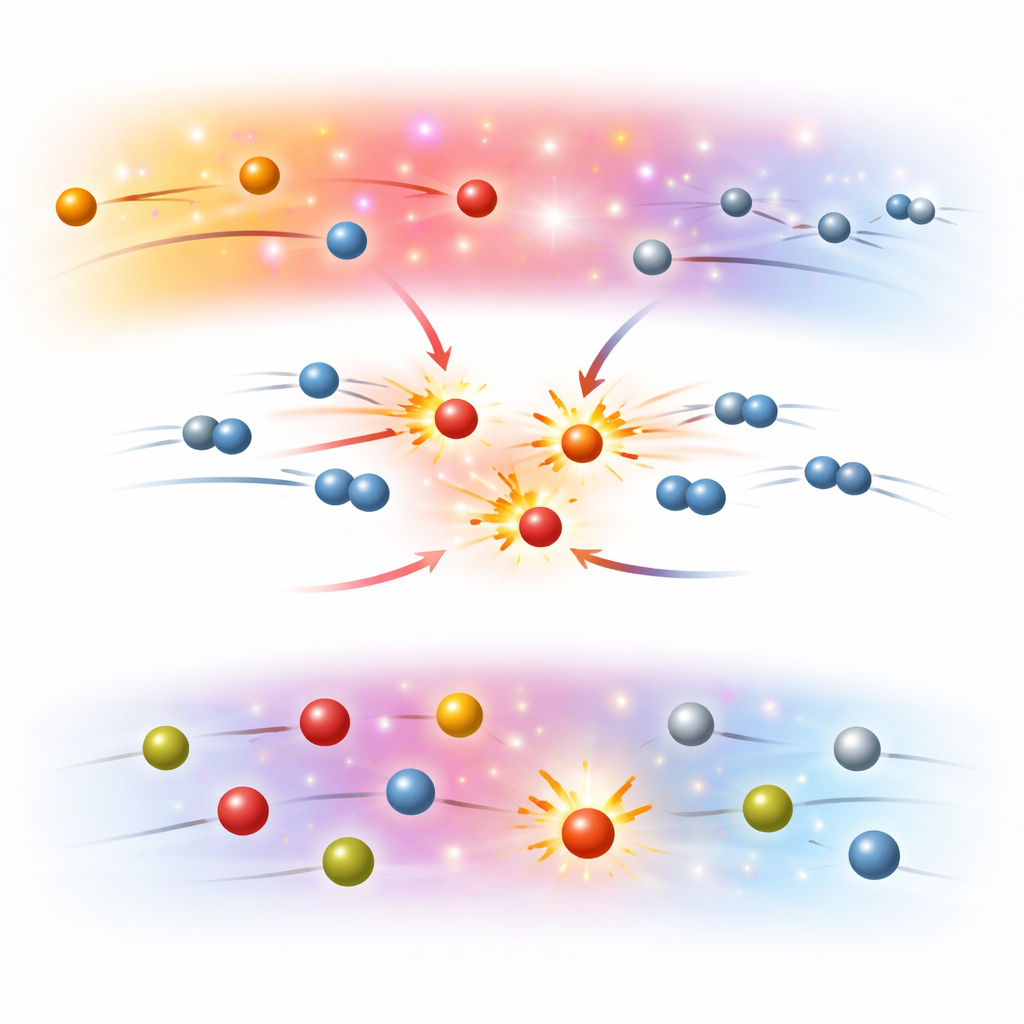
In modern experimental fusion reactors, the hot core of the plasma does not contain just the fuel ions. It also holds heavier “impurity” ions that have lost all their electrons, leaving bare atomic nuclei with strong electric charges. To heat the plasma, engineers fire in beams of fast neutral hydrogen atoms. As these neutral atoms plow through the cloud of bare ions, they can lose their single electron in violent encounters, a process called ionization. Each such event transfers energy and changes how the beam slows down, cools the plasma, or changes its composition. To model and control these effects, researchers need reliable numbers—ionization cross sections—that describe the probability of ionization at different beam energies and for different ion species.
Classical dice rolls with a quantum twist
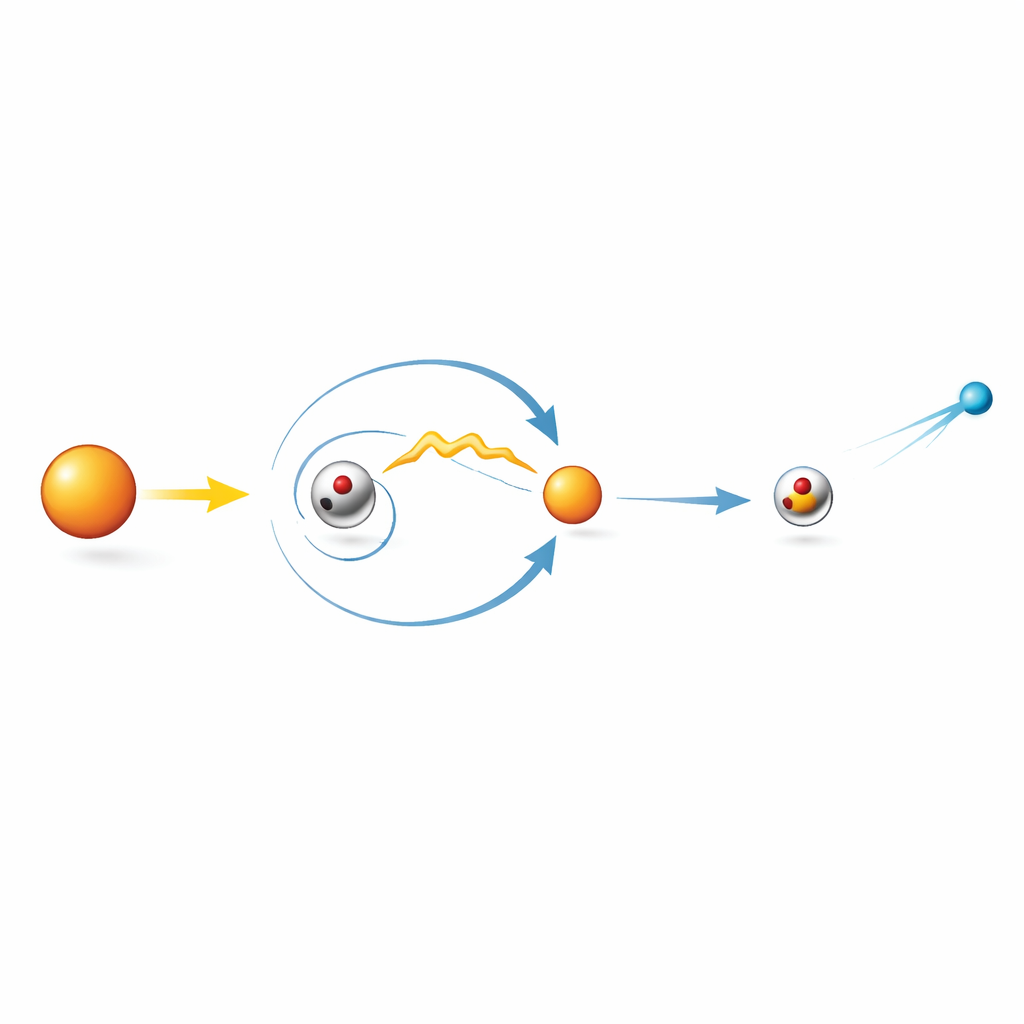
Because tracking these collisions exactly with full quantum theory is often too complex and time-consuming, scientists frequently turn to classical simulations. In the classical trajectory Monte Carlo (CTMC) method, the electron, hydrogen nucleus, and incoming ion are treated like tiny charged balls obeying Newton’s laws. The researchers launch millions of simulated collisions, each with slightly different initial conditions, and then count how many times the electron escapes. This approach is simple and flexible, but it misses crucial quantum behavior, especially at lower impact energies where the electron spends more time interacting with both centers and quantum effects become prominent. To bridge this gap, the authors use a quasi-classical version (QCTMC) that modifies the classical forces with an extra “Heisenberg-like” term designed to mimic the uncertainty principle and prevent unphysical collapse of the electron onto a nucleus.
Testing the new model across many projectiles
The team calculated ionization cross sections for bare ions ranging from hydrogen (H⁺) up to oxygen (O⁸⁺) colliding with ground-state hydrogen atoms over a wide energy span, from 10 to 1000 kiloelectronvolts per atomic mass unit. For each case, they ran five million simulated trajectories, both with the standard CTMC and with the QCTMC correction. They then compared their results with several sophisticated quantum-based methods and with laboratory measurements from previous experiments. Across all ions studied, the QCTMC cross sections were consistently higher than those from the purely classical CTMC, with the largest differences appearing at the lowest projectile energies, where quantum behavior is known to play a stronger role.
How a gentle extra push frees the electron
The key physical change introduced by the QCTMC model is an additional repulsive ingredient in the effective interaction between the electron and the nuclei. This extra term weakens the electron’s bond to the hydrogen nucleus, counteracting the purely attractive classical Coulomb pull. In practice, this makes it easier for the incoming ion to snatch or knock out the electron during the simulated collision. As a result, the calculated probability that the electron is lost—the ionization cross section—rises. When the authors compared these higher QCTMC values with detailed quantum calculations and with experimental data for all eight ion species, they found that the quasi-classical results closely tracked the more demanding approaches, particularly at low energies where the older classical model tended to underestimate ionization.
What this means for future fusion modeling
By adding a carefully designed quantum-inspired correction to a classical simulation, the authors show that it is possible to reproduce the accuracy of advanced quantum treatments while keeping the calculations relatively simple and efficient. For fusion researchers, this means more reliable ionization data for a range of impurity ions and beam energies, which can feed directly into models of how neutral beams heat and cool plasmas. In everyday terms, the study demonstrates that a modest upgrade to a widely used computational tool can provide a much clearer picture of how tiny charged bullets strip electrons from hydrogen, helping scientists better predict and optimize the behavior of future fusion reactors.
Citation: Ziaeian, I., Tőkési, K. Ionization cross sections for collisions between fully stripped ions and ground state hydrogen atoms using the quasi-classical trajectory Monte Carlo method. Sci Rep 16, 9370 (2026). https://doi.org/10.1038/s41598-026-37732-3
Keywords: fusion plasma, ionization collisions, Monte Carlo simulation, hydrogen beams, charged ions