Clear Sky Science · en
Comparative entropy analysis of 2D transition metal tetrahydroxyquinones via machine learning approaches
Why this new material and math matter
Modern technologies for cleaner energy and carbon capture depend on materials that can store, move, and transform molecules with great efficiency. This study looks at a promising class of ultra-thin porous materials called transition metal tetrahydroxyquinone frameworks (TM-THQ) and asks a simple but crucial question: can we predict their internal stability and behavior just from how their atoms are connected, using mathematics and machine learning instead of expensive lab work?
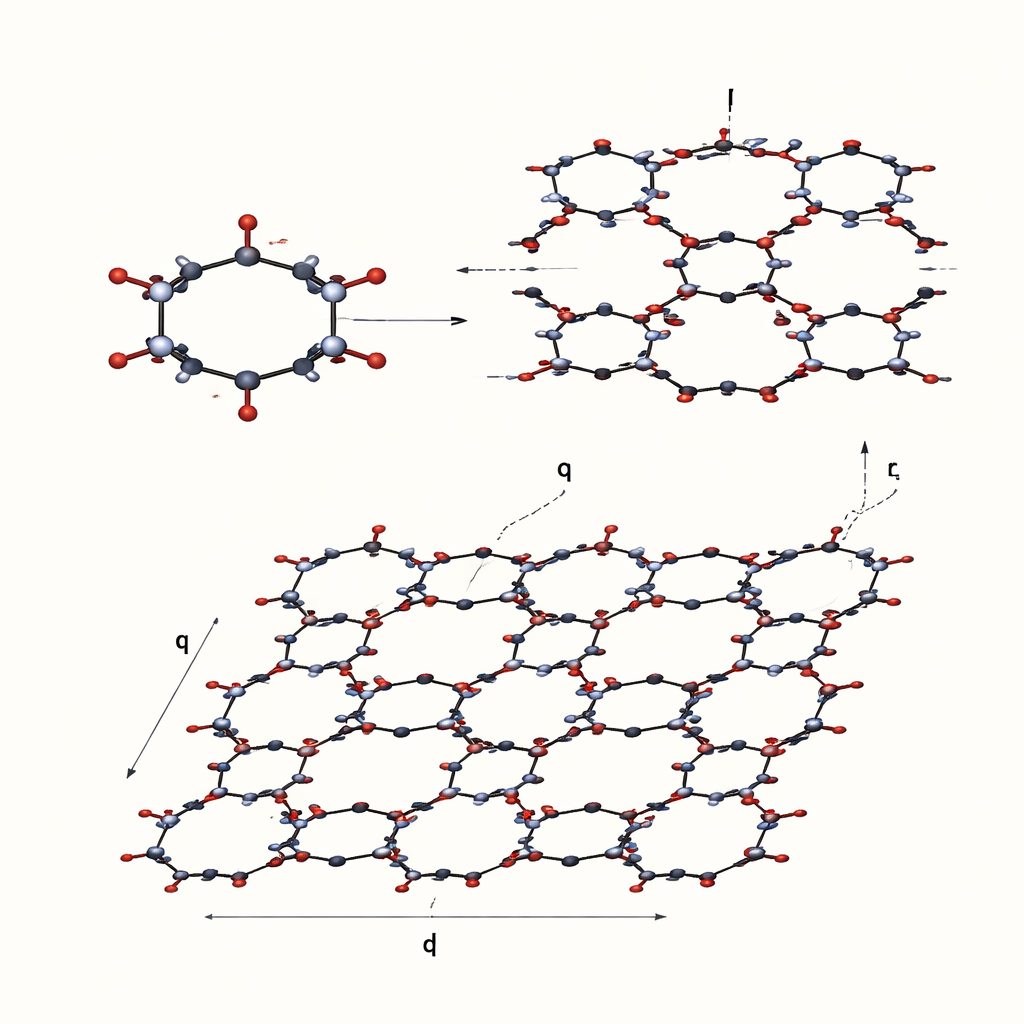
Turning molecules into networks
Rather than thinking of TM-THQ as a tangle of atoms, the authors treat it like a network: atoms become dots, and chemical bonds become lines joining them. This approach, known as chemical graph theory, allows researchers to describe the structure using numbers called topological indices that capture how crowded or sparse the connections are. TM-THQ is a two-dimensional metal–organic framework made of organic ligands and transition metal atoms arranged in a repeating, sheet-like pattern with regular holes. Each repeat unit contains carbon, oxygen, and metal centers in a flat, porous layout, and these units tile space in two directions, forming a large, ordered molecular net.
Measuring structure with simple numbers
To quantify the TM-THQ network, the team calculated several classic indices that chemists and mathematicians use to relate structure to properties such as boiling point or stability. These include Zagreb indices, which reflect how many bonds crowd around each atom; Randić indices, which highlight branching; and other measures that blend or compare the connectivity of neighboring atoms. Using symbolic and numerical tools in Python, they derived general formulas that express each index purely in terms of how many repeat units lie along the two directions of the sheet. As the sheet grows larger, all of these indices increase in regular ways, reflecting a more extended and interconnected framework.
From order and disorder to entropy
Knowing how atoms are connected is only part of the story; another key ingredient is how ordered or disordered the structure is overall. To capture this, the authors used Shannon entropy, a concept from information theory that measures randomness, and applied it to the same structural indices. For each index, they computed a corresponding entropy value that summarizes how evenly different types of connections are distributed throughout the TM-THQ network. The results show that as the framework becomes larger and more complex, these entropy values rise steadily, indicating greater structural diversity and subtle variation in how atoms interact across the sheet.
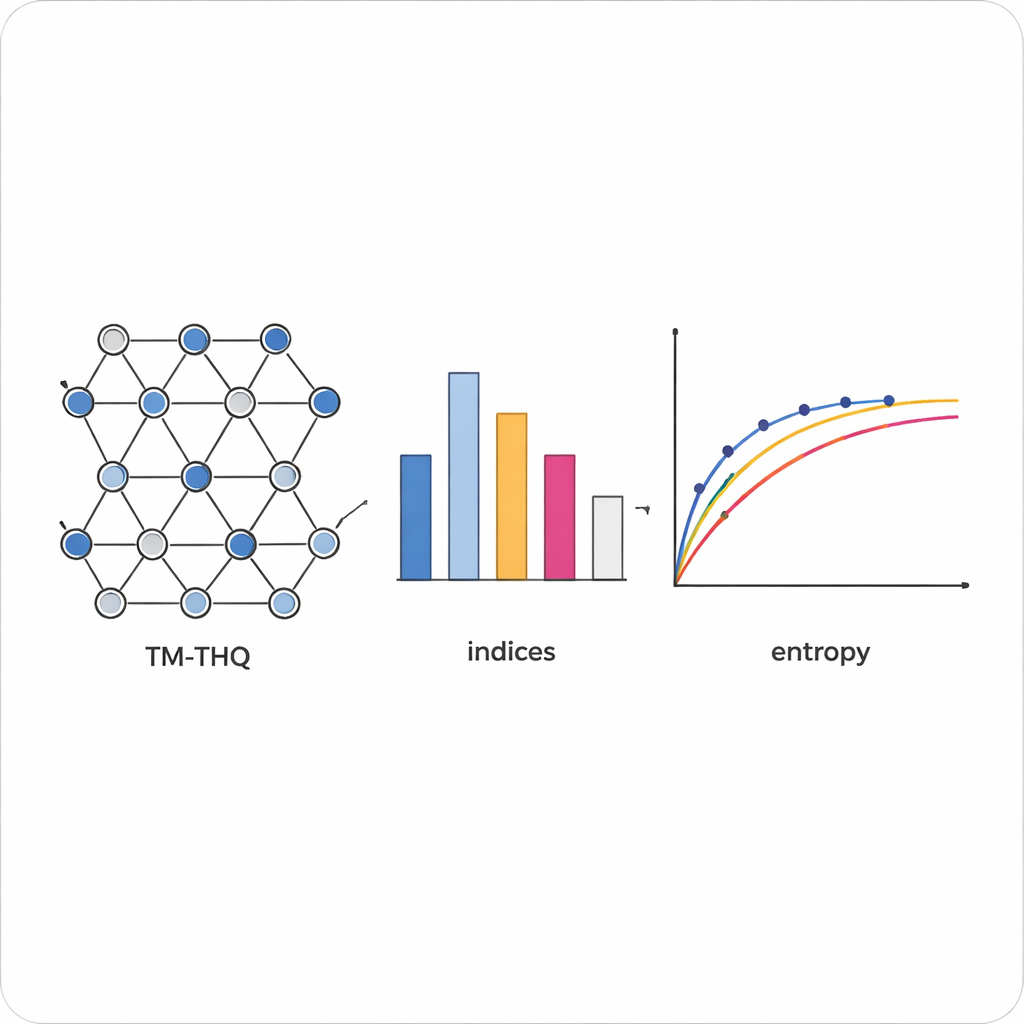
Letting machines learn the pattern
Rather than relying only on direct formulas, the authors also asked whether computers could learn to predict the entropy of TM-THQ purely from the index values. They tested three regression approaches: a simple logarithmic curve, and two popular machine learning methods—random forest and XGBoost—that combine many decision trees to capture complex patterns. Using Python-based models, they trained each method on data linking indices to entropy. Surprisingly, the humble logarithmic model performed best: it reproduced the entropy values almost perfectly, with tiny errors and a very tight match between predicted and actual numbers. XGBoost came close, while random forest lagged, especially for larger and more extreme cases.
What this means for future materials
For a non-specialist, the key message is that the intricate behavior of advanced porous materials like TM-THQ can be captured and predicted using relatively simple mathematics, without simulating every atom in detail. By turning molecular sheets into networks, summarizing them with compact numerical fingerprints, and then teaching straightforward models to link those fingerprints to measures of order and disorder, researchers can rapidly screen candidate materials on a computer. The findings suggest that TM-THQ has a tunable internal structure whose stability and complexity can be read off from these indices, helping guide its use in areas such as carbon dioxide conversion, catalysis, and energy storage while reducing trial-and-error in the lab.
Citation: Irfan, M., Bashir, N., Gaid, A.S.A. et al. Comparative entropy analysis of 2D transition metal tetrahydroxyquinones via machine learning approaches. Sci Rep 16, 6819 (2026). https://doi.org/10.1038/s41598-026-37731-4
Keywords: metal-organic frameworks, graph theory, entropy, machine learning, CO2 conversion