Clear Sky Science · en
Synergistic protective and regenerative effects of hyaluronic acid and polynucleotides against UVA-induced oxidative stress in dermal fibroblasts
Why this matters for your skin
Many people worry about wrinkles and loss of skin firmness as they age, and sunlight is one of the biggest culprits. This study explores how two substances already used in cosmetic treatments—hyaluronic acid and polynucleotides—might work together inside skin cells to better protect against sun-induced damage and even help the skin repair itself.
How deep sunlight harms your skin
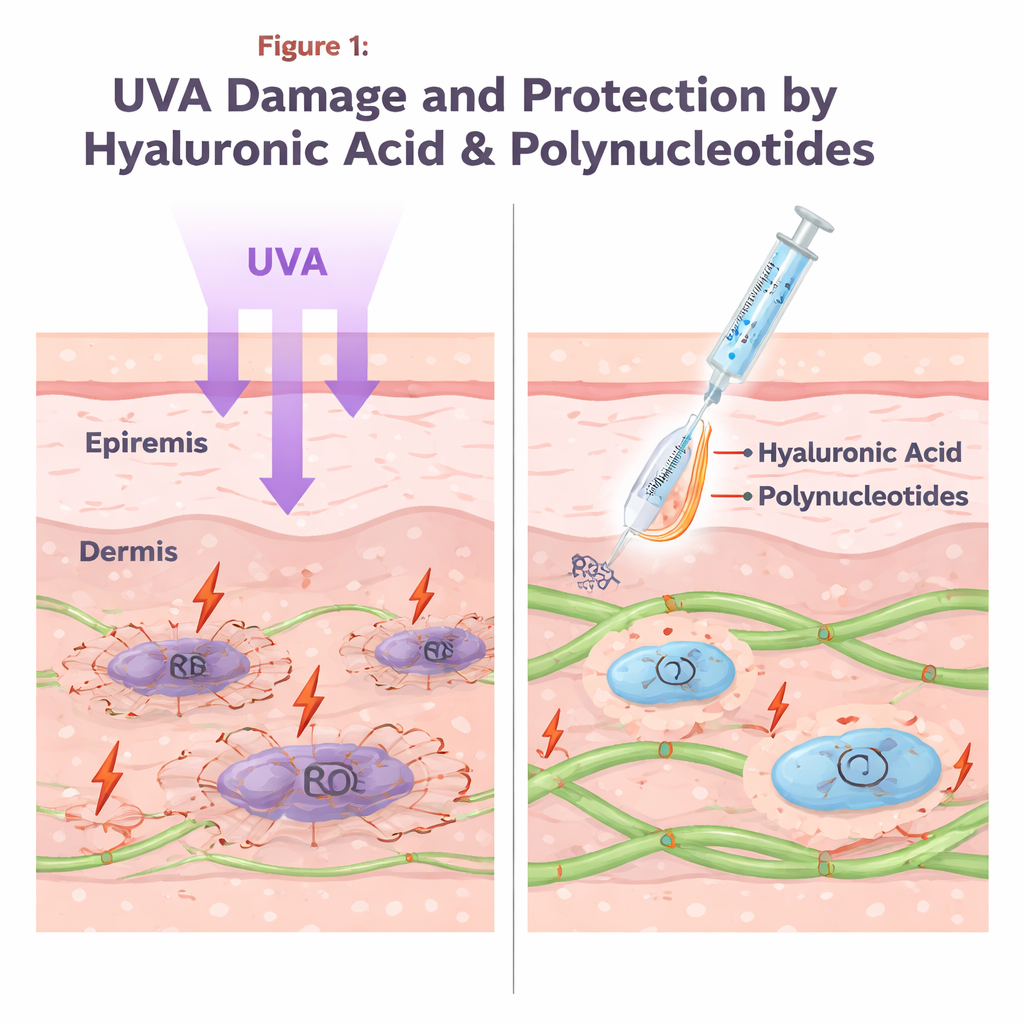
Sunlight contains different kinds of ultraviolet (UV) rays. While UVB mostly hits the surface, longer-wave UVA light penetrates deeper into the dermis, where support cells called fibroblasts live. These fibroblasts build and maintain the skin’s scaffolding, including collagen and fibronectin, which keep skin firm, smooth, and elastic. The authors show that when fibroblasts are exposed to strong UVA, they produce large amounts of reactive oxygen species—highly reactive molecules that damage DNA, proteins, and cell structures. As this oxidative stress builds up, fibroblasts lose vitality, their internal skeleton becomes disorganized, and they make less collagen and fibronectin. At the same time, inflammatory signals rise and natural antioxidant defenses weaken, creating a self-reinforcing loop that accelerates photoaging.
Two familiar ingredients with untapped potential
Hyaluronic acid is best known as the moisture-holding ingredient in fillers and skin “boosters,” but it also interacts with receptors on fibroblasts to support cell survival and matrix production. Polynucleotides are purified DNA fragments, often derived from salmon, already used in aesthetic medicine to promote tissue repair. Earlier research suggested that each can influence oxidative stress and inflammation, but their combined effect under UVA stress had not been carefully tested. The researchers reasoned that hyaluronic acid might mainly support the cell’s surroundings—hydration and structural stability—while polynucleotides might act more inside the cell, tuning metabolism and antioxidant pathways. If both routes converged on the same survival circuits, the two substances could work better together than alone.
Building a lab model of sun-damaged skin
To explore this idea, the team grew human dermal fibroblasts in dishes and exposed them to graded doses of UVA light. They found that a dose of 20 J/cm² reliably stressed the cells—reducing survival and disturbing cell shape—without killing them outright, mimicking serious but recoverable sun damage. They first checked that low to moderate doses of hyaluronic acid and polynucleotides were safe on their own and discovered that, while high doses became harmful, clinically relevant levels did not damage cells and even slightly boosted production of collagen-related genes. With this groundwork in place, they created a test scenario closer to real treatments: cells were pretreated with hyaluronic acid, polynucleotides, or both, then irradiated with UVA, and finally kept in medium containing the same substances to imitate ongoing therapy during recovery.
Stronger together: protection and regeneration
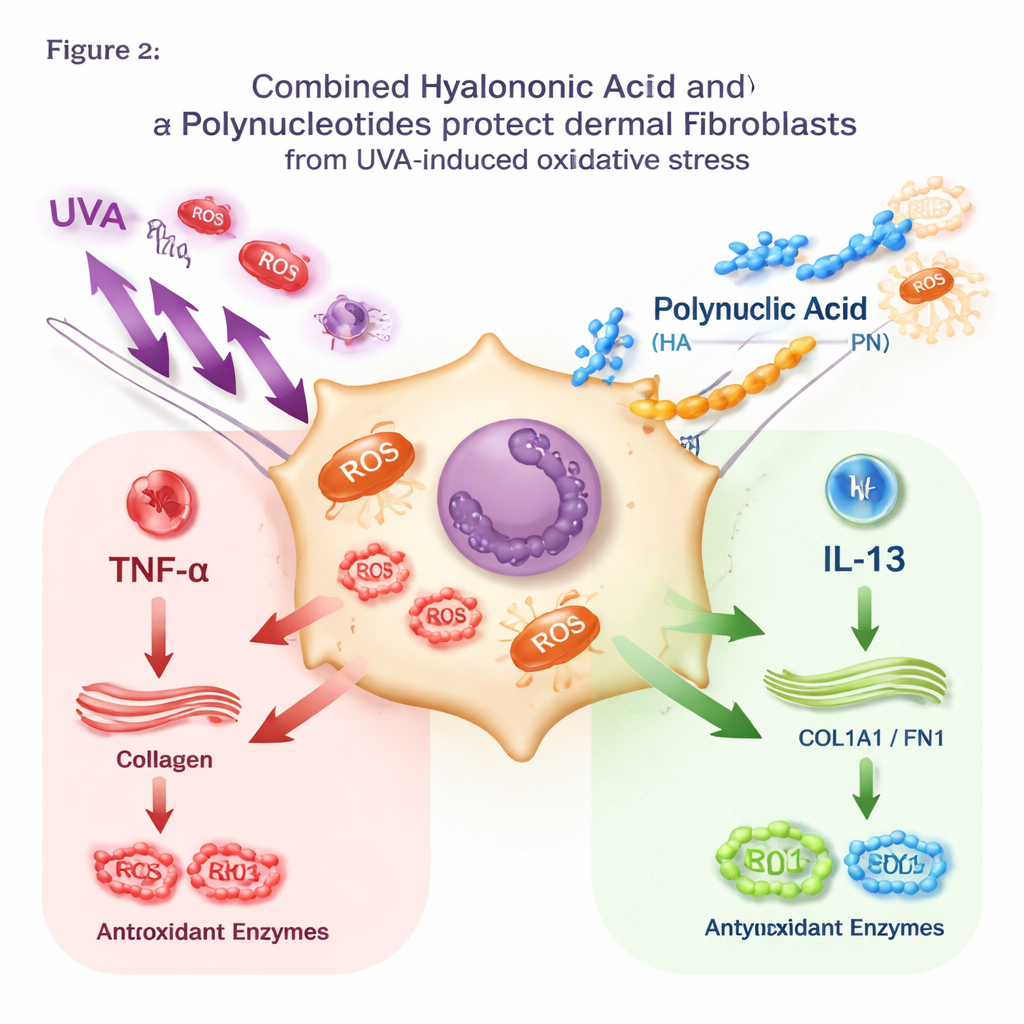
Under UVA alone, fibroblasts showed sharply lower survival and proliferation, higher levels of reactive oxygen species in both the general cell fluid and the mitochondria, and reduced activity of genes for collagen (COL1A1), fibronectin (FN1), and key antioxidant enzymes (GPX1 and SOD2). A pro-inflammatory signal, TNF-α, went up, while the anti-inflammatory cytokine IL-13 went down. Hyaluronic acid or polynucleotides by themselves softened these blows: they improved survival, partially restored healthy gene activity, and lowered reactive oxygen levels. However, when used together, the benefits were clearly greater than the sum of their parts. The combined treatment brought reactive oxygen levels close to those of unexposed cells, almost fully restored collagen and antioxidant gene expression, normalized inflammatory signals, and most notably, boosted the cells’ ability to invade through a membrane—an in vitro sign of regenerative activity and tissue rebuilding capacity.
What this could mean for future skin treatments
For non-specialists, the key message is that hyaluronic acid and polynucleotides do more than simply hydrate or “plump” the skin. In this study, they acted together inside and around dermal fibroblasts to reduce deep UVA damage, calm inflammation, and restart the skin’s own repair machinery. While these results come from cell cultures rather than living skin, they provide a mechanistic explanation for why combination products based on these two ingredients might offer stronger, longer-lasting protection and rejuvenation than either alone. In practical terms, this work supports the development of next-generation injectable fillers or topical systems that do double duty: shielding fibroblasts from oxidative stress while actively helping them rebuild the collagen-rich foundation that keeps skin looking healthy and resilient.
Citation: Tran, T.T.T., Heo, S.C., Lee, J.H. et al. Synergistic protective and regenerative effects of hyaluronic acid and polynucleotides against UVA-induced oxidative stress in dermal fibroblasts. Sci Rep 16, 6703 (2026). https://doi.org/10.1038/s41598-026-37730-5
Keywords: photoaging, hyaluronic acid, polynucleotides, oxidative stress, dermal fibroblasts