Clear Sky Science · en
Application of an IEW-CRITIC-CoCoSo method based on interval-valued T-spherical fuzzy for optimizing process parameters of 3D printed recycled polypropylene composites
From Pandemic Waste to Useful Parts
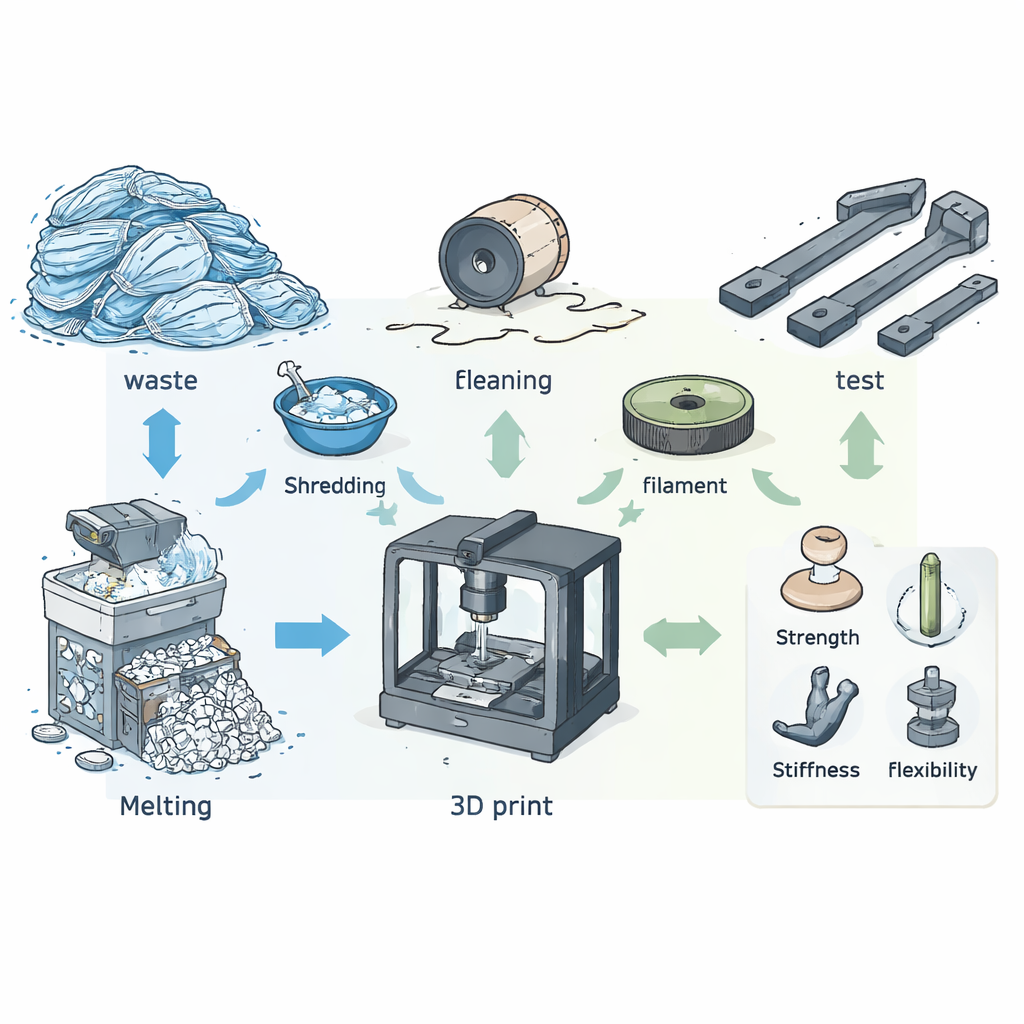
Billions of disposable masks and other polypropylene-based textiles have piled up as waste since the COVID-19 pandemic. This study explores how that trash can be turned into strong, reliable 3D-printed parts, and how to tune a printer so recycled plastic rivals fresh material. Using a new kind of smart decision-making math, the authors show how to squeeze the best mechanical performance out of glass-fiber–reinforced recycled polypropylene, helping close the loop on plastics while keeping 3D printing practical for engineering use.
Why Recycled Plastic Needs Smart Printing
Recycled polypropylene made from waste meltblown fabrics, such as mask layers, is attractive because it is cheap, light, and already widespread. But when used in standard fused deposition modeling (FDM) 3D printers, it suffers from weak bonding between layers and unstable shapes. Adding short glass fibers improves strength and stiffness, creating a composite called GF/RPP. Even then, the final quality still depends strongly on how the printer is set up: nozzle temperature, layer thickness, how full the part is on the inside (infill density), and the directions of the printed lines all push and pull on strength, stiffness, and stretchability in different ways. Finding one set of parameters that balances all three properties at once is far from obvious.
Designing the Material and the Tests
The researchers began by turning waste meltblown polypropylene into pellets and then into filament loaded with 30% glass fiber by weight. They confirmed that this composite melts and flows well below its degradation temperature, making it suitable for extrusion-based 3D printing. Using a commercial FDM printer, they printed standard dog-bone test pieces under nine different combinations of temperature (220, 240, 260 °C), layer thickness (0.1, 0.2, 0.3 mm), and infill density (60, 80, 100%), and repeated that set at three raster angles (0°, 45°, 90°). Each sample was pulled in tension to measure tensile strength, stiffness (tensile modulus), and elongation at break, capturing how strong, rigid, and ductile the parts were.
New Math to Balance Conflicting Goals
Because some settings that increase strength can reduce stretchability, the team used a multi-attribute decision-making (MADM) framework to weigh and combine all the results. They worked in a “fuzzy” setting, where each measurement is treated not as a single crisp value but as a range with degrees of belief, hesitation, and disbelief—better reflecting noisy experiments. Their interval-valued T-spherical fuzzy operator lets them merge data from different raster angles and mechanical properties while reducing the influence of odd outliers. To decide how important each property should be, they blended expert judgment with an objective measure of how much each property varies and conflicts with the others. Finally, they used a ranking procedure called CoCoSo to score and order the nine parameter sets, aiming for the best all-around mechanical behavior rather than just the highest single number.
What the Optimal Print Settings Look Like
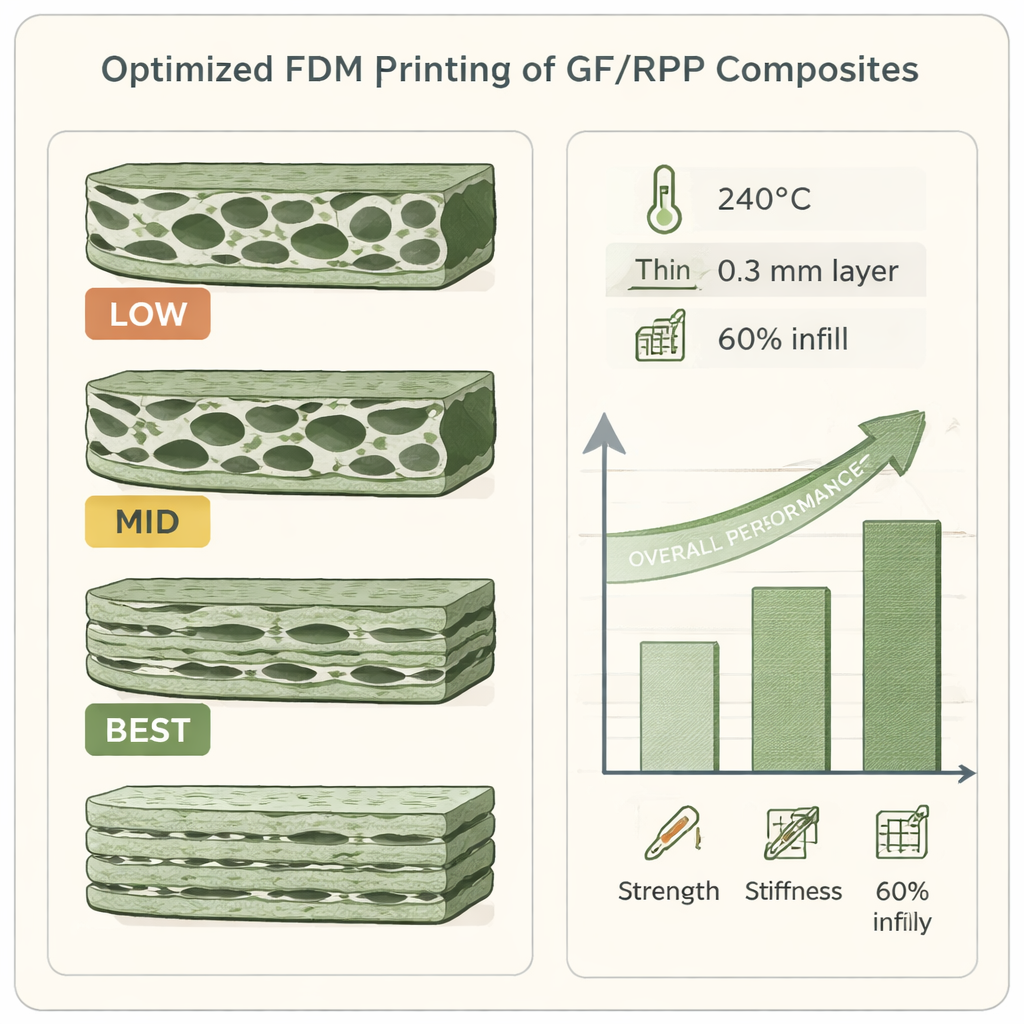
The combined analysis pointed clearly to one winning recipe: a printing temperature of 240 °C, a layer thickness of 0.3 mm, and 60% infill density. This combination, called scheme M6, delivered about 10.7% better overall mechanical performance than the other tested setups. At 240 °C, the material melts enough to fuse layers well without burning; thicker layers increase the contact area between layers and reduce internal voids; and a moderate infill density provides good support without introducing too much internal stress. Microscopy of fractured samples backed up the numbers: optimally printed parts showed dense, well-fused layers and glass fibers well anchored in the plastic, while poorer settings showed gaps, pulled-out fibers, and large voids that weaken the part.
What This Means for Greener 3D Printing
In simple terms, the study shows that with the right settings, recycled mask material reinforced with glass fibers can become a reliable feedstock for 3D printing structural parts. Instead of optimizing one property at a time, the authors’ fuzzy decision framework helps manufacturers tune printers for a balanced mix of strength, stiffness, and flexibility under uncertainty. Beyond this particular composite, the same mathematical toolkit could guide parameter selection for other recycled plastics and advanced materials, making it easier to design greener, high-performance 3D-printed products.
Citation: Zhao, S., Du, Y., Hao, Y. et al. Application of an IEW-CRITIC-CoCoSo method based on interval-valued T-spherical fuzzy for optimizing process parameters of 3D printed recycled polypropylene composites. Sci Rep 16, 6971 (2026). https://doi.org/10.1038/s41598-026-37726-1
Keywords: 3D printing, recycled polypropylene, glass fiber composites, process optimization, fuzzy decision-making