Clear Sky Science · en
Mechanochromic cholesteric liquid crystal devices for mechanical strain detection
Watching Cracks with Color
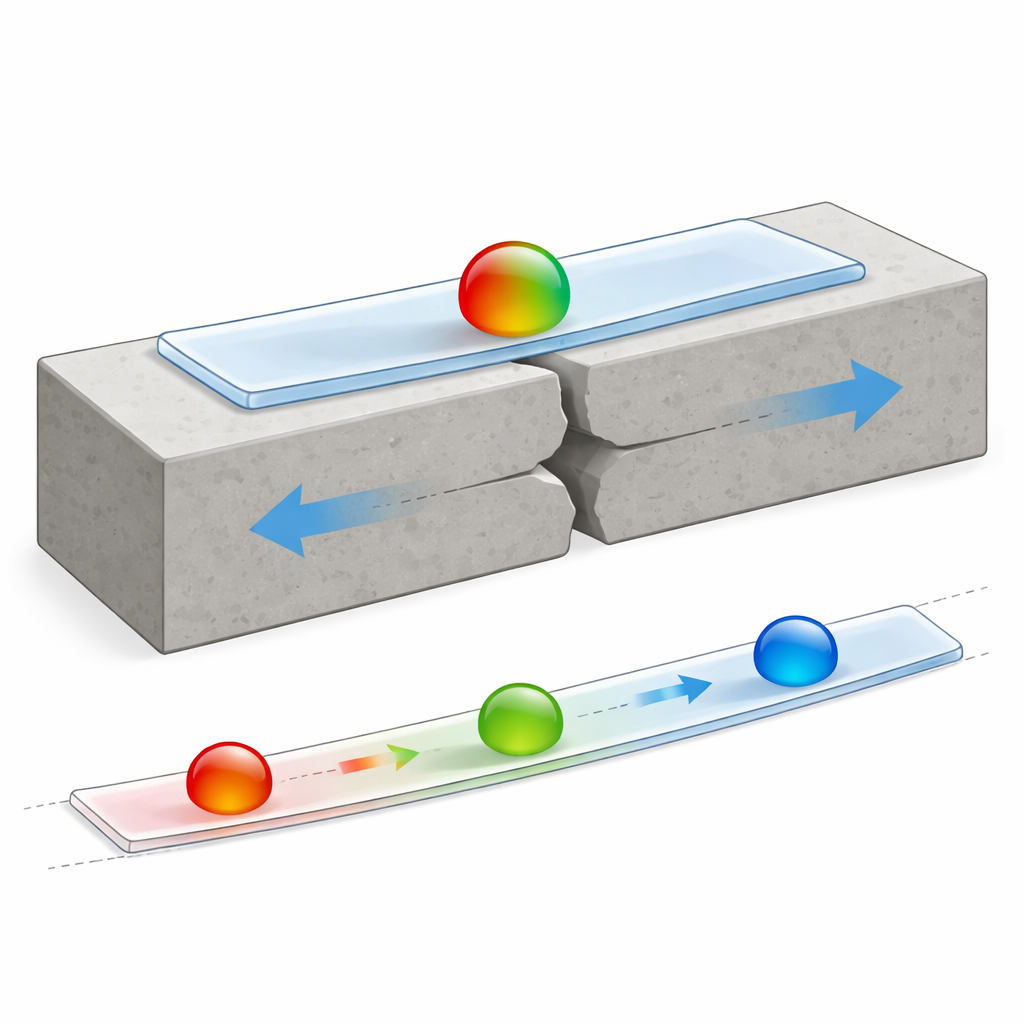
Bridges, tunnels and buildings slowly develop tiny cracks as they age and carry heavy loads. Spotting when those cracks start to grow dangerously is vital, but today it often requires power-hungry electronics or labor‑intensive inspections. This study explores a different idea: soft, colorful materials that change their reflected color when stretched or squeezed, turning invisible strain in concrete into an easy-to-see color signal.
Soft Matter that Acts Like a Warning Light
Traditional construction monitoring relies on rigid sensors and cables that can be costly to install and maintain. In contrast, soft materials such as polymers and gels can bend, stretch and respond to their surroundings in subtle ways. Among these, liquid crystals—best known from flat‑panel displays—are especially promising because they combine the flow of a liquid with some of the ordered structure of a solid. Certain liquid crystals, called cholesteric liquid crystals, naturally arrange themselves into a microscopic helical pattern that reflects only specific colors of light, much like a built‑in, tunable mirror.
How a Tiny Spiral Makes Color
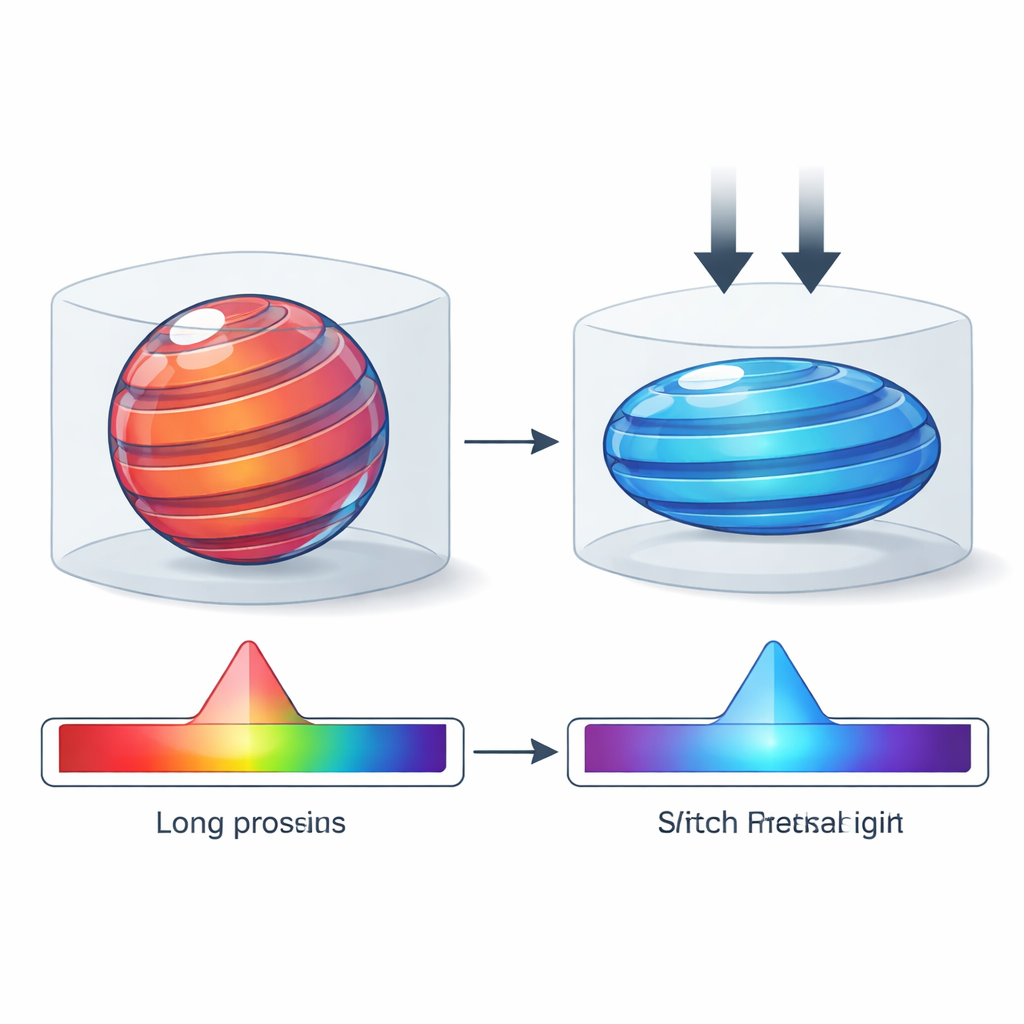
In a cholesteric liquid crystal, molecules twist in a regular helix. The distance over which the helix makes one full turn is called the pitch, and it decides what color of light is reflected. A longer pitch reflects redder light; a shorter pitch reflects bluer light. Because the pitch responds to changes in temperature, electric fields and, crucially for this work, mechanical deformation, these materials can act as “structural color” sensors. When the material is squeezed or stretched so that the helix tightens, the reflected color shifts toward blue; when it relaxes, it shifts back toward red.
Building Color‑Changing Beads for Concrete
The researchers created tiny three‑dimensional beads from a rubbery version of a cholesteric liquid crystal, known as a cholesteric liquid crystal elastomer. They first prepared a liquid precursor that could be crosslinked into an elastic solid, then formed droplets by letting the liquid fall, drop by drop, into a bath of silicone oil. As the solvent slowly evaporated, the droplets set into semi‑spherical beads with the desired internal helical structure. Several stirring methods were tested to control bead size and shape, but surprisingly, the simplest approach—letting the drops fall freely with no stirring—produced the most uniform beads and the clearest, most even color‑changing response.
Turning Beads into Practical Strain Sensors
To turn these colorful beads into usable devices, single beads were embedded in thin layers of a common silicone rubber (PDMS), similar to the clear sealants already used in many engineering applications. The team tuned the hardness of this silicone by changing the ratio of base polymer to curing agent, then stretched the silicone strips while monitoring how the bead’s reflected color changed. Freestanding beads, pressed directly, showed a strong shift from red toward blue as pressure increased, demonstrating that the internal helix was tightening as intended. When embedded in silicone, the beads still changed color under tension, but the strength and clarity of the signal depended strongly on how stiff the silicone layer was and how much stray light it transmitted.
What the Color Shifts Reveal
For the stiffest silicone samples, the embedded beads showed a clear and repeatable color shift toward shorter wavelengths as the strip was stretched, matching what has been reported in earlier studies on similar materials. The color changes persisted over a wide range of strain—up to about 170 percent extension—before the samples broke, indicating that the system can report on large deformations. Softer or more transparent silicone layers, however, tended to let through so much background light that the bead’s signature color became harder to distinguish, especially at higher strains. This highlighted how important the surrounding matrix is for transmitting mechanical forces and preserving a clean optical signal.
A Simple, Power‑Free Way to See Structural Strain
Overall, the work shows that cholesteric liquid crystal elastomer beads can act as compact, purely optical strain sensors that could be glued directly onto concrete surfaces. As a crack opens or widens, the local strain would stretch or compress the bead‑containing strip, causing a visible and reversible color shift across much of the visible spectrum. Because these devices need no wires, electronics or power supply, they could offer a low‑cost, easy‑to‑read way to identify where cracks are growing and how fast. Future efforts will focus on pairing the beads with more rigid, transparent host materials to make the color response even more sensitive to small, early‑stage deformations, improving the chances of catching structural problems before they become critical.
Citation: Sousa, F., Santos, J., Malta, J.F. et al. Mechanochromic cholesteric liquid crystal devices for mechanical strain detection. Sci Rep 16, 6298 (2026). https://doi.org/10.1038/s41598-026-37723-4
Keywords: liquid crystal sensors, mechanochromic materials, structural health monitoring, concrete crack detection, smart soft materials