Clear Sky Science · en
Multi-modal and multi-agent reinforcement learning framework for urban traffic flow prediction and signal control optimization
Why Smarter Traffic Lights Matter
Anyone who has sat through a string of red lights or crawled along a clogged downtown street has felt how inefficient city traffic can be. Beyond the frustration, idling cars waste fuel and pump greenhouse gases and pollutants into the air. This paper presents a new way to manage urban traffic that treats signals as a coordinated, learning network rather than fixed timers, with the goal of moving people faster while cutting congestion and emissions.
A City That Feels and Understands Its Traffic
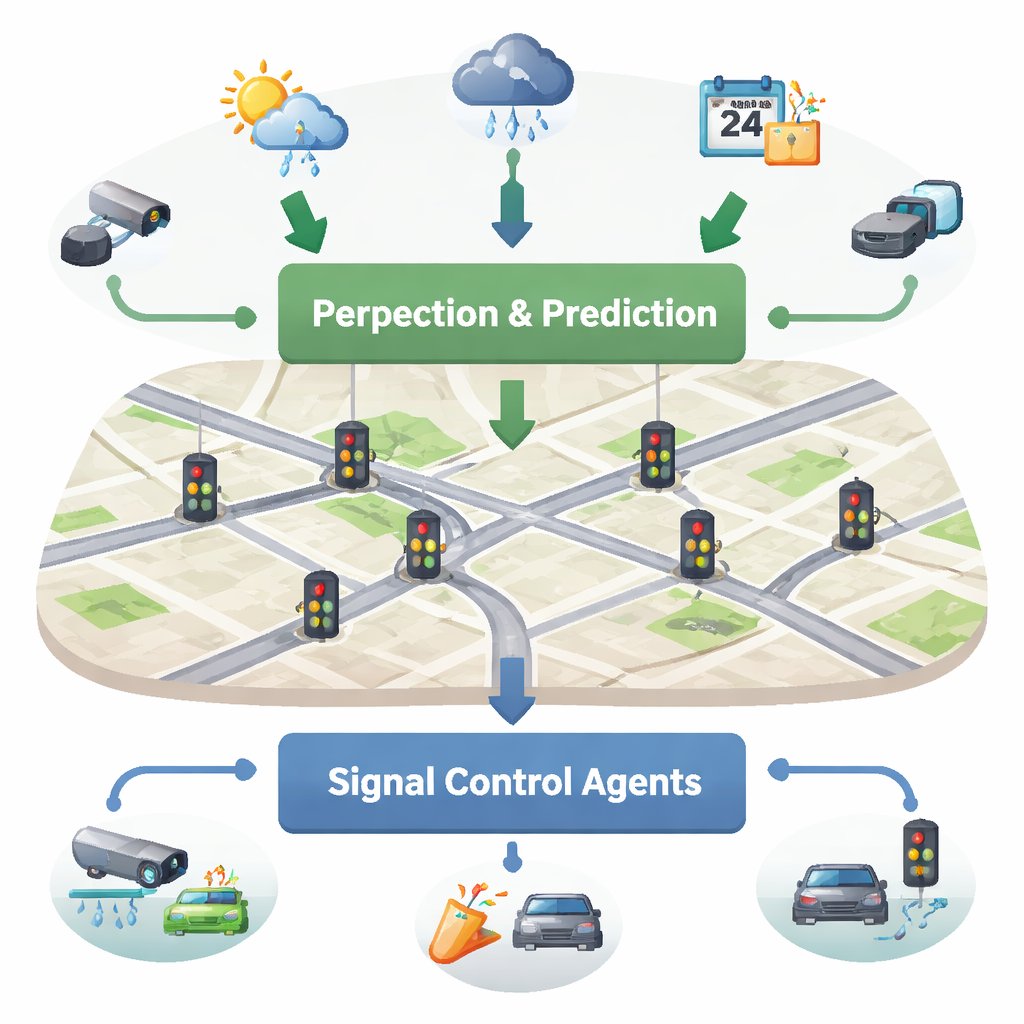
The researchers propose a system called MM-STMAP that gives a city a kind of digital nervous system. Instead of relying only on simple vehicle counts, it pulls in many kinds of data at once: traffic flow, speeds, weather conditions such as rain or fog, and special days like holidays. These diverse signals are cleaned, combined, and turned into a unified description of what is happening on the roads. By recognizing, for example, that a rainy holiday rush hour behaves differently from an ordinary weekday, the system can better anticipate how traffic will evolve in the next few minutes.
Seeing Patterns in Space and Time
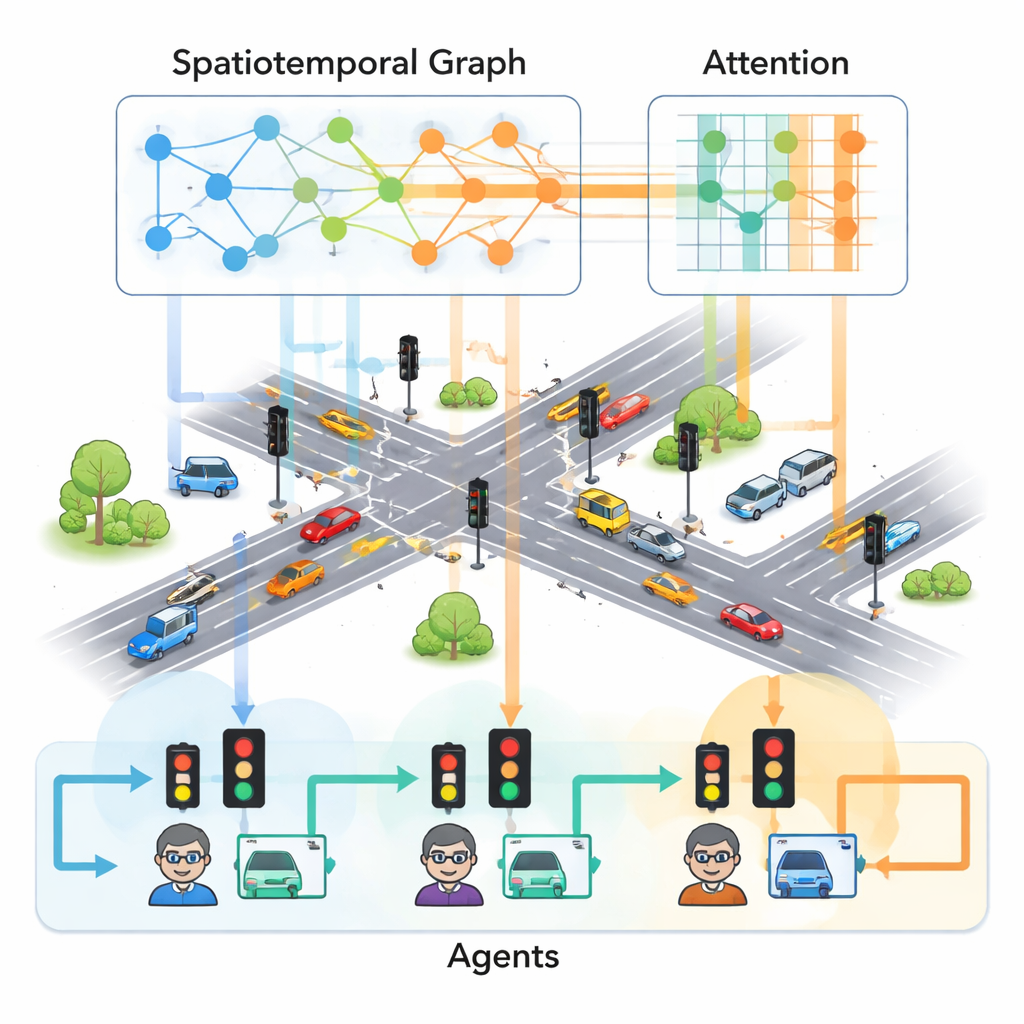
Traffic problems rarely sit at a single intersection; they ripple through a whole network of roads. MM-STMAP captures this by representing the city’s roads and intersections as a web of connected points, then learning how conditions spread across that web over time. It uses layered calculations that first look at how neighboring streets influence one another and then at how those influences change from one time step to the next. A specially designed “attention” mechanism allows the model to focus its computing power on the most relevant stretches of history—such as yesterday’s rush hour at the same time—without getting bogged down as data volumes grow. This makes it practical to process long-running sensor streams from large urban networks.
Traffic Lights That Learn Together
On top of this predictive engine, the authors build a learning-based control system for traffic signals. Each intersection is treated as an intelligent agent that can choose how long to hold green or red in different directions. These agents do not work in isolation: they share information about the broader traffic situation and are trained together so their individual decisions support smooth flow across the whole network. The learning process rewards patterns that increase the number of vehicles getting through, cut average waiting times, and reduce the stop-and-go behavior that wastes fuel, while penalizing configurations that create long queues and delays.
Putting the System to the Test
To see whether MM-STMAP offers real benefits, the team tested it on large, real-world data sets from the Los Angeles region. These data include tens of thousands of samples from highway and city sensors, along with realistic problems such as missing readings, noisy measurements, and irregular traffic patterns. Compared with several state-of-the-art forecasting models and with traditional signal control schemes—fixed schedules and locally reactive lights—the new approach produced more accurate short-term traffic predictions and more efficient signal timing. It reduced common error measures for forecasting by around a third relative to today’s best-performing fixed and actuated systems, and in simulations it cut average delays and the number of stops while pushing more vehicles through the network per hour.
What This Means for Everyday Drivers
In plain terms, MM-STMAP describes a future in which traffic lights cooperate and continually learn from experience, instead of blindly following hard-coded cycles. By anticipating where backups are about to form and adjusting signal timing across multiple intersections, the system can shorten travel times, smooth out stop-and-go traffic, and reduce unnecessary idling. While the approach still faces challenges—such as the need for reliable data and substantial computing power at city scale—it points toward smarter, cleaner urban mobility where our daily commutes are not only quicker but also gentler on the environment.
Citation: Wang, R., Zhang, J., Wang, X. et al. Multi-modal and multi-agent reinforcement learning framework for urban traffic flow prediction and signal control optimization. Sci Rep 16, 7612 (2026). https://doi.org/10.1038/s41598-026-37722-5
Keywords: urban traffic, traffic prediction, reinforcement learning, smart signals, intelligent transportation