Clear Sky Science · en
Lifetime MDMA use and associations with meaning in life in the context of childhood trauma
Finding Light After Early Hardship
Many people who endure painful experiences in childhood struggle later with questions like “What is the point of my life?” This study explores an unexpected angle on that struggle: whether having ever used the drug MDMA—best known on the club scene as ecstasy—relates to a stronger sense of meaning in life, especially for adults who carry the scars of childhood trauma. As MDMA-assisted psychotherapy edges closer to mainstream medicine for post-traumatic stress disorder (PTSD), understanding how this drug might influence a person’s deeper sense of purpose and coherence becomes more than a curiosity; it touches on how we recover and rebuild after hardship.
Why Childhood Wounds Matter
Childhood trauma—such as abuse, neglect, or chaotic homes—does not just leave emotional bruises; it can shake a person’s basic picture of what the world is like and where they fit in it. Earlier research shows that people who feel their lives are meaningful tend to have lower depression, anxiety, and risk of suicide. Yet trauma can erode that sense of meaning, making the world seem random, unfair, or empty. The authors focus on “meaning in life” as a psychological resource that helps people withstand and grow from adversity, asking whether MDMA use is linked to this resource in everyday, non-clinical settings.
Looking at Real-Life MDMA Users
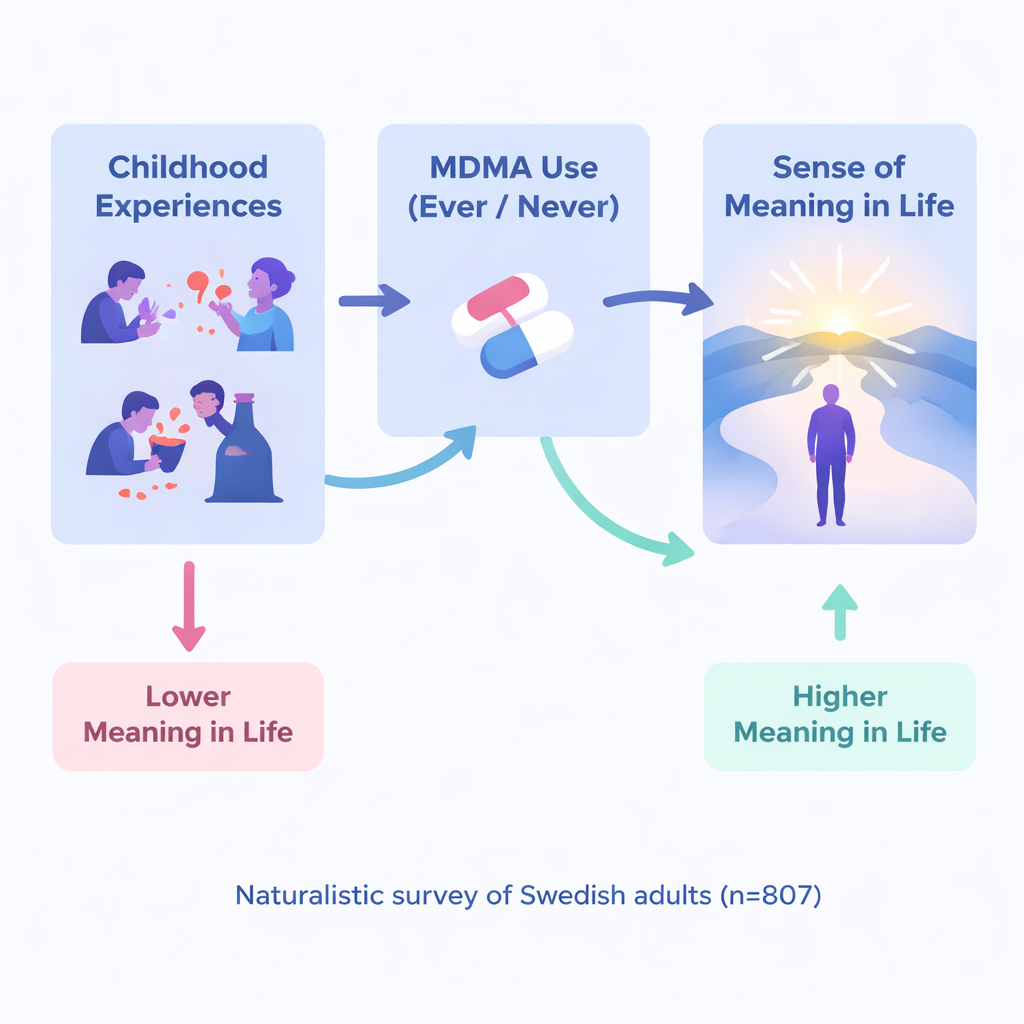
The researchers analyzed survey responses from 807 adults living in Sweden, most of them young and well-educated. Participants answered questions about their mental health, their history of drug and alcohol use, and whether they felt psychologically traumatized before age 17 (“No,” “Maybe,” or “Yes”). They also completed a standard questionnaire that measures how strongly they feel their lives are meaningful and purposeful. People were classified simply as having ever used MDMA or never used it; the study did not track dose, frequency, or whether the drug was taken in a party, therapeutic, or personal-growth context.
Trauma, Searching, and a Sense of Purpose
As expected, adults who reported childhood trauma tended to feel less meaning in life than those who did not. Those who said “Yes” or “Maybe” to being traumatized had lower scores on the “presence of meaning” scale. At the same time, trauma survivors often reported a stronger ongoing search for meaning, suggesting they were actively trying to make sense of what happened and to rebuild a workable story about their lives. The more severe the trauma, the more this restless search was linked to a weaker sense that life already felt meaningful—an indication of how unsettled their inner world could be.
Where MDMA Fits In
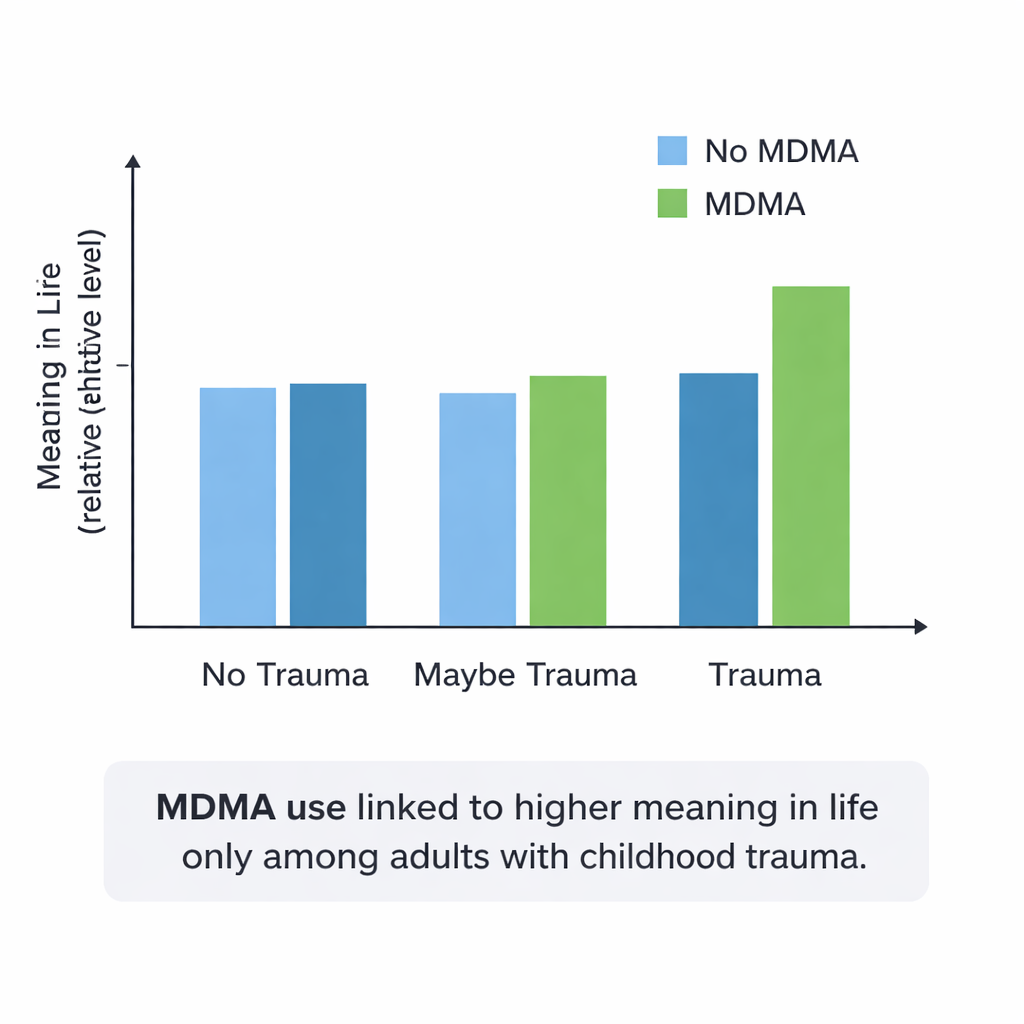
When the team first looked at the entire sample, having ever used MDMA was only weakly—and not quite statistically—linked to higher meaning in life. However, once they considered childhood trauma, a clearer pattern emerged. Among people without trauma, MDMA use did not make much difference. But among those who reported being traumatized as children, MDMA users showed noticeably higher levels of felt meaning in life than non-users, even after adjusting for age, gender, education, and use of other substances such as alcohol, cannabis, psychedelics, and opiates. Other drugs did not show this kind of positive link; in fact, lifetime alcohol and opiate use were associated with lower meaning in life overall.
What This Could Mean for Healing
The study cannot prove that MDMA caused anyone’s sense of purpose to grow—people who are already more resilient or more engaged in supportive communities may simply be more likely to try MDMA. Still, the specific pattern in trauma survivors echoes reports from clinical trials, where MDMA-assisted therapy appears to help people revisit painful memories with less fear, reconsider their beliefs about themselves, and experience deeper connection with others. The authors suggest that MDMA might, in some contexts, act as a catalyst for “meaning-making”—helping those with early wounds move from feeling shattered to building a more hopeful life story. They call for careful, long-term, and experimental studies to test whether MDMA-based treatments can safely and reliably strengthen meaning in life for people recovering from trauma.
Citation: Olofsson, M., Acar, K., Simonsson, O. et al. Lifetime MDMA use and associations with meaning in life in the context of childhood trauma. Sci Rep 16, 5617 (2026). https://doi.org/10.1038/s41598-026-37721-6
Keywords: MDMA, childhood trauma, meaning in life, post-traumatic stress, psychedelic therapy