Clear Sky Science · en
Miniaturized RF reconfigurable bandpass filter with dynamic wideband frequency and constant bandwidth tuning capability
Why tunable filters matter for everyday wireless life
Every time you stream a movie, make a phone call, or use Wi‑Fi, your device must pull out a narrow slice of radio waves from a crowded sea of signals. Doing this well requires filters that let only the desired frequencies pass while blocking everything else. Today’s networks need filters that can change their tuning on the fly as phones, base stations, satellites, and radar systems hop between channels. This paper introduces a tiny, tunable radio‑frequency filter that can slide across a wide range of frequencies while keeping its “window” width almost perfectly constant—an ability that can make future wireless systems more flexible, efficient, and compact.
A small circuit with a big job
The heart of the work is a compact bandpass filter, a circuit that passes signals within a chosen frequency band and rejects those above and below it. Unlike conventional filters, which are fixed once manufactured, this design can shift its center frequency across a broad span, from about 4.6 to 5.9 gigahertz, a region used by many Wi‑Fi, radar, and satellite services. Crucially, as the passband slides up and down in frequency, its absolute width—how many megahertz of spectrum are allowed through—can be kept nearly constant. That means a radio using this filter can maintain the same data rate and interference protection while switching channels, instead of having to redesign its signal processing for each new band. 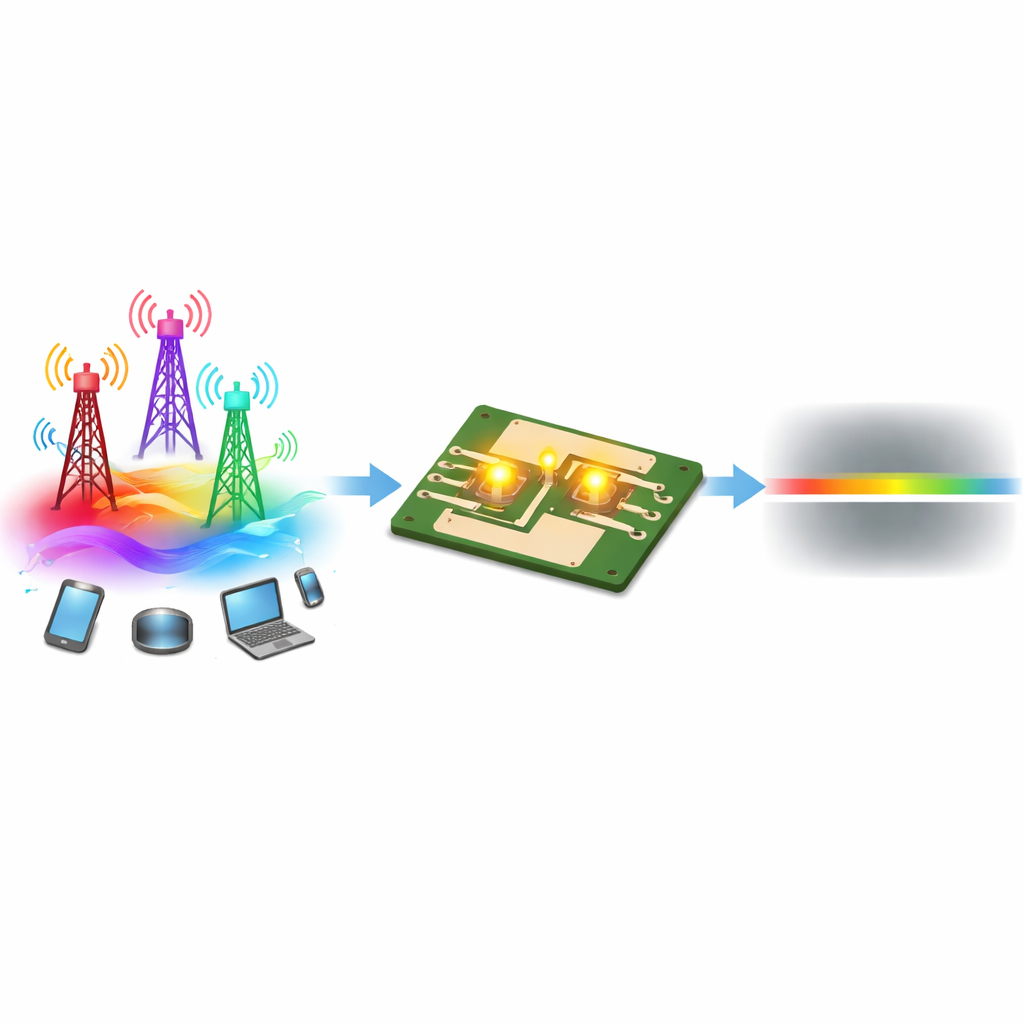
How the tunable filter is built
To achieve this agility, the authors build the filter on a high‑performance circuit board material using a structure called a multimode resonator. In simple terms, this is a carefully shaped metal pattern that naturally “rings” at certain radio frequencies, a little like a tuning fork for microwaves. Two such resonators are placed side by side with interlocking finger‑like sections that increase their interaction, sharpening the filter’s edges so that unwanted signals drop off quickly at the band boundaries. Two special diodes, known as varactors, are inserted at key points. When a small control voltage is applied, each varactor’s electrical “springiness” (capacitance) changes, which in turn shifts the resonant frequencies of the structure. By adjusting the two varactors separately, the lower and upper edges of the passband can be moved in a coordinated way so that the band’s center shifts while its width stays almost unchanged.
Peering under the hood of the design
To design and understand this behavior, the researchers use an analytical approach that splits the resonator’s behavior into two symmetric modes, similar to how one might analyze a vibrating object that can move in different patterns. This even‑odd mode treatment yields formulas that link geometry and varactor settings to the filter’s key frequencies. It explains how one varactor mainly controls the lower edge of the passband, while the other steers the upper edge. Simulations using professional electromagnetic software show that this arrangement can produce a strong, flat passband with low loss—around 0.8 decibels of signal reduction—while suppressing unwanted frequencies by more than 30 decibels just outside the band. The response remains clean and nearly distortion‑free in time, which is important for high‑speed digital communication. 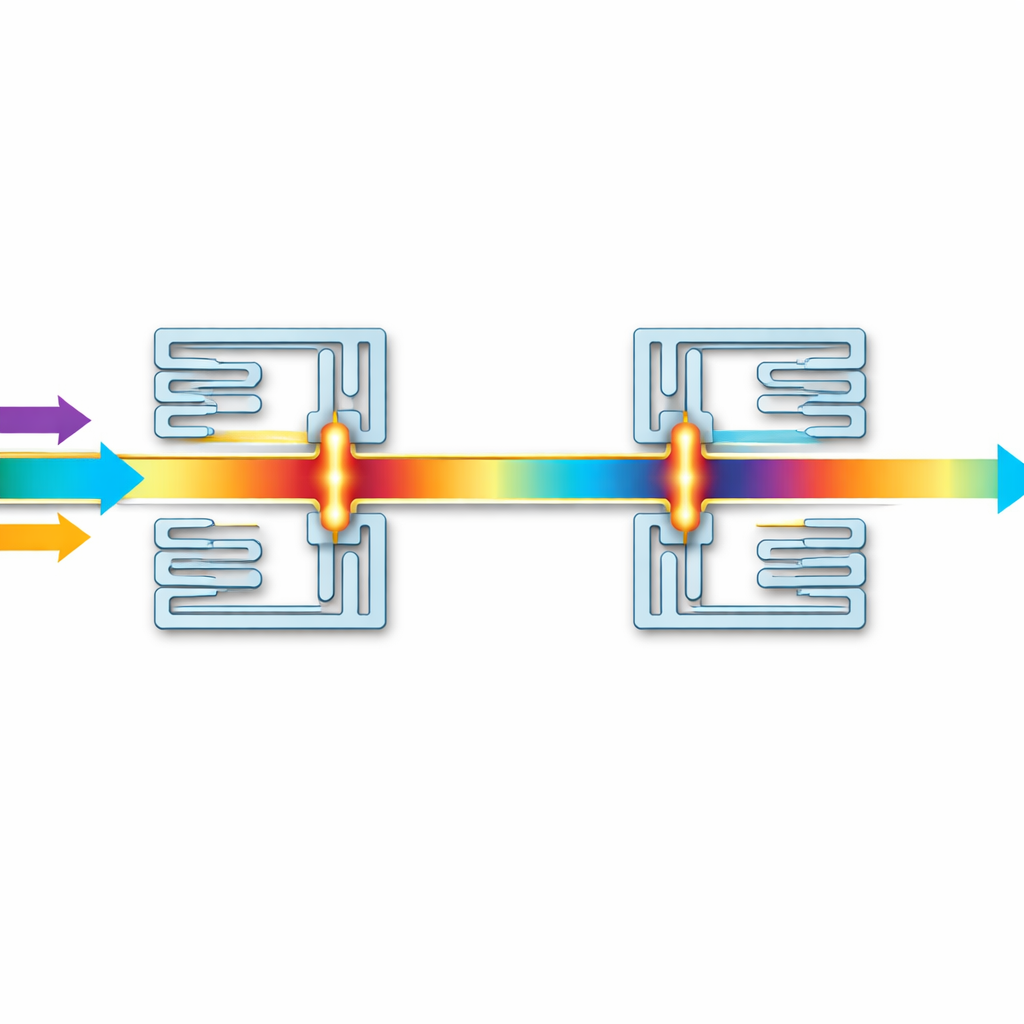
From theory to working hardware
The team then fabricates a prototype roughly the size of a fingernail and measures it with precision test equipment. The real‑world results closely match the simulations. The filter’s center frequency can be swept widely while keeping absolute bandwidths in the range of 400 to 2300 megahertz, and specific tests demonstrate center‑frequency shifts with fixed bandwidths of 1.0, 1.5, and 2.0 gigahertz. Across these operating conditions, the insertion loss stays under about 1 to 1.5 decibels, and reflections back toward the source remain low, indicating good matching and efficient power transfer. Although there are small deviations due to the non‑ideal behavior of packaged diodes and manufacturing tolerances, the overall performance compares favorably with other state‑of‑the‑art tunable filters, while using fewer tuning elements and occupying less area.
What this means for future wireless systems
In simple terms, the authors have built a tiny “smart gate” for radio waves that can slide up and down the dial without changing how wide it opens. That combination of wide tuning range, constant usable bandwidth, sharp rejection of neighboring channels, and low signal loss is exactly what emerging systems such as software‑defined radios, cognitive radios, and advanced radar need. Because the filter is compact, power‑efficient, and controlled with straightforward voltages, it is well suited for integration into next‑generation wireless front ends where hardware must adapt quickly to changing spectrum conditions. This work shows a practical path toward radios that can reuse spectrum more flexibly and handle growing data demands without sprawling, complex filter banks.
Citation: Sazid, M., Agrawal, N., Gautam, A.K. et al. Miniaturized RF reconfigurable bandpass filter with dynamic wideband frequency and constant bandwidth tuning capability. Sci Rep 16, 7858 (2026). https://doi.org/10.1038/s41598-026-37720-7
Keywords: reconfigurable bandpass filter, tunable RF front-end, constant bandwidth tuning, cognitive radio, microwave resonator design