Clear Sky Science · en
Differential effects of attentional focus on drop jump performance with implications for primary level coaches
Why Coaches’ Words Matter for Every Jump
What a coach tells an athlete to “think about” during a jump might seem like a small detail, but this study shows that these simple cues can measurably change how the body moves and absorbs force. By comparing different kinds of mental focus during a basic drop jump, the researchers reveal how low-cost, well-chosen instructions can help school and club coaches shape performance even when they lack expensive motion-capture labs or force plates.
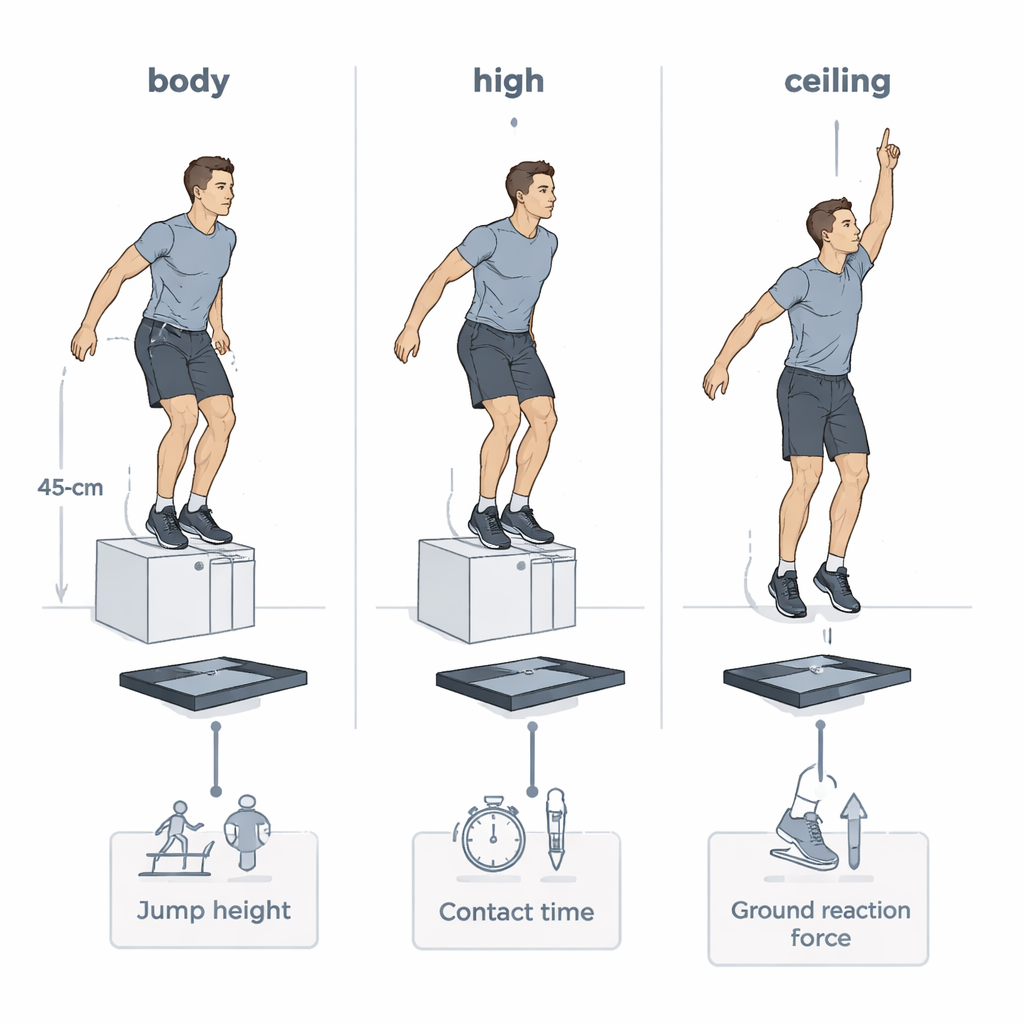
Three Ways to Pay Attention While Jumping
The study examined a common training drill called the drop jump: athletes step off a 45-centimeter box, land, and immediately spring back up. Twenty trained male athletes performed these jumps under three distinct types of attentional focus. In the internal focus condition, they were told to think about rapidly extending their hip and knee joints. In the proximal external focus condition, they focused on getting as high as possible off the ground. In the distal external focus condition, they aimed to jump as close as possible to the ceiling. A separate “normal jump” trial provided a reference, but the main comparisons were among the three specific focus types. Across all trials, athletes kept their hands on their hips to standardize technique.
Measuring Height, Speed, and Force
To understand how these mental instructions shaped performance, the researchers had athletes land on sensitive force platforms that captured ground reaction forces during each jump. From these data, they calculated jump height (how high the athlete rose), contact time (how long the feet stayed on the ground), leg stiffness (how “spring-like” the lower limbs behaved), and peak vertical ground reaction force (the maximum force between the body and the floor). They also looked at a combined measure called the reactive strength index, which relates how high an athlete jumps to how quickly they get off the ground. These numbers together describe whether a jump is more about being quick and stiff, or about producing large forces and higher flights.
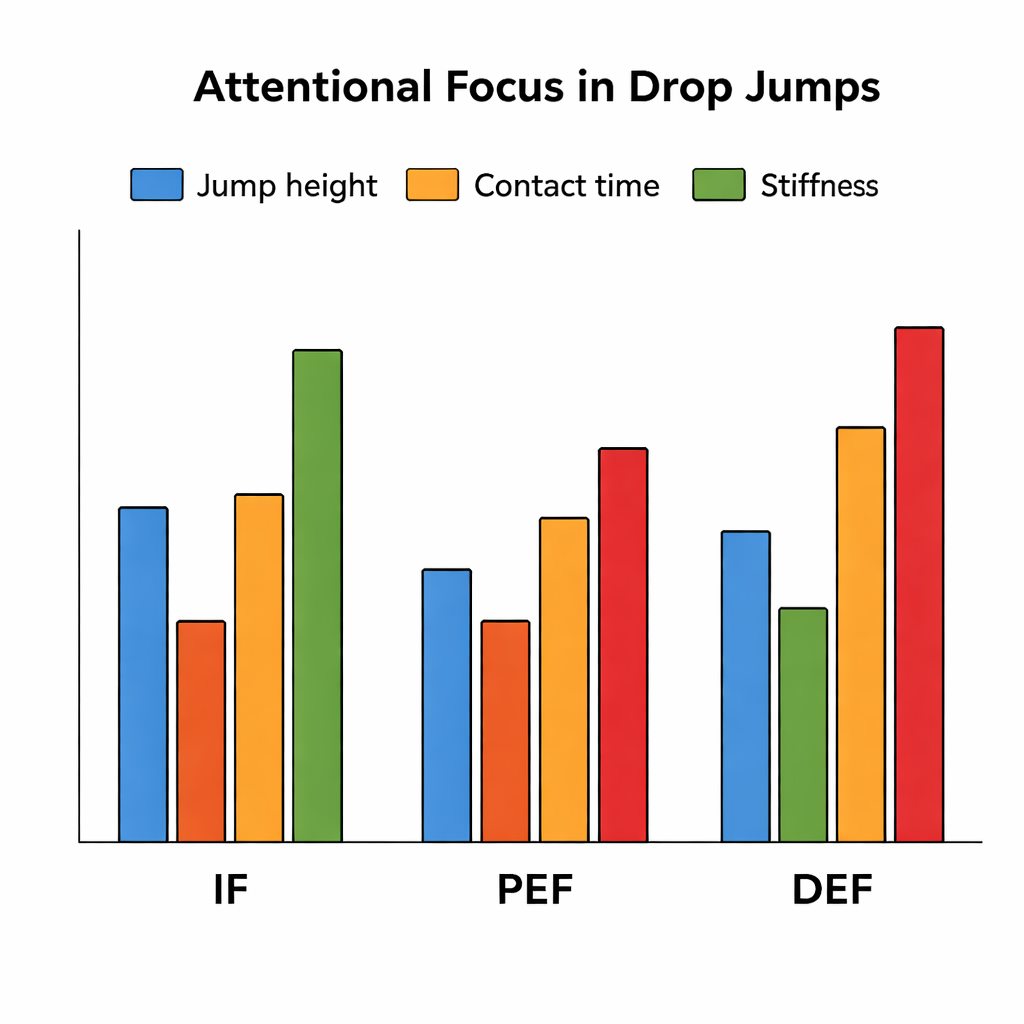
Different Cues, Different Jump Signatures
The three focus conditions produced clearly different “signatures.” When athletes aimed for the ceiling (distal external focus), they reached the greatest jump heights and produced the highest peak forces, but they also spent slightly longer on the ground. Focusing on jumping high off the ground (proximal external focus) led to similar, though slightly smaller, gains in height and force and a moderate increase in ground contact time. In contrast, thinking about body joints (internal focus) made athletes leave the ground more quickly and behave like stiffer springs, with shorter contact times and higher leg stiffness, but with lower jump heights and forces than the external-focus conditions. Interestingly, the overall reactive strength index did not differ significantly among the three focus types, suggesting that each strategy rearranged how height, time, stiffness, and force combined rather than simply making the jump “better” or “worse.”
Practical Takeaways for Grassroots Coaching
Because many primary-level and community coaches lack access to advanced measurement tools, the authors highlight attentional focus as a practical, no-cost lever to steer training. If the goal is to emphasize height and force—such as developing explosive power for jumping and rebounding—cues that direct attention outward, especially toward a distant target like the ceiling, seem most effective. If the goal is quicker ground contact and a stiffer, more rapid rebound—useful for rapid stretch–shortening actions—then internal cues about joint extension may be more suitable. Proximal external cues appear to offer a balanced option, boosting height and force without pushing them to extremes. The key message is that coaches can choose words that nudge athletes toward the mechanical profile that best fits their sport and training stage.
What This Means Beyond the Lab
In plain terms, this research shows that where athletes aim their attention can subtly tune whether a drop jump is higher and more forceful, or quicker and springier. Distal and proximal external focus cues help athletes jump higher and push harder against the ground, while internal focus cues favor faster contacts and greater leg stiffness. Because these changes arise from instructions alone, coaches working in schools or small clubs can apply them immediately, even without specialized technology. By matching simple phrases like “reach for the ceiling” or “extend your hips and knees fast” to specific training goals, they can shape jump performance in ways that are both targeted and accessible.
Citation: Zhang, J., Liu, L., Yang, X. et al. Differential effects of attentional focus on drop jump performance with implications for primary level coaches. Sci Rep 16, 7328 (2026). https://doi.org/10.1038/s41598-026-37718-1
Keywords: drop jump, attentional focus, coaching cues, plyometric training, sports performance