Clear Sky Science · en
SD-MAC protocol for wireless sensor network energy consumption
Why smarter sleep matters for tiny wireless devices
From farms and forests to factory floors and smart homes, tiny wireless sensors quietly measure temperature, vibration, pollution, and more. Most of these sensors run on small batteries that are difficult or costly to replace once deployed in large numbers. A big part of their energy budget is spent not on taking measurements, but on keeping their radios on and listening for messages. This paper presents a new way, called SD-MAC, for these sensors to "sleep" more intelligently, stretching battery life while still delivering data on time.
How today’s sensor networks waste precious power
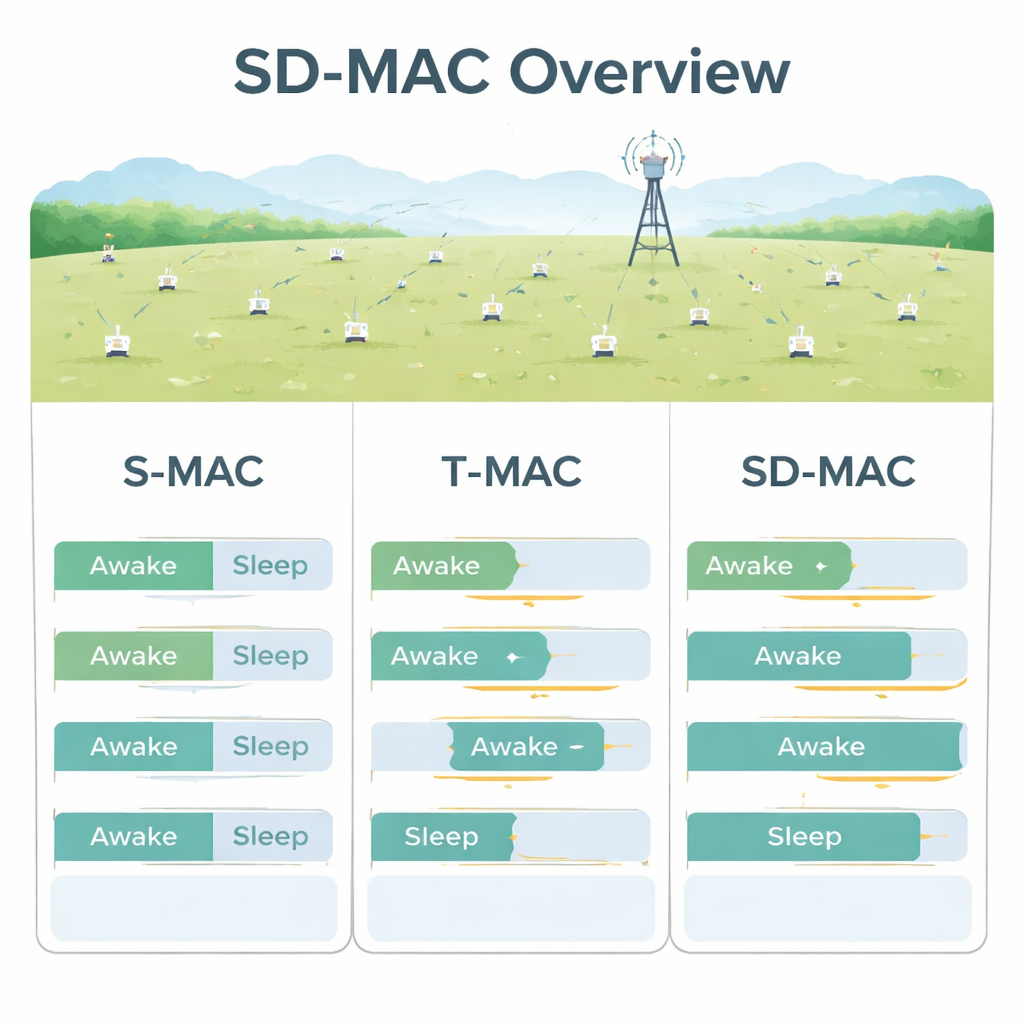
Wireless sensor networks rely on a shared radio channel where dozens of tiny devices take turns talking. To avoid chaos, the devices follow timing rules known as a MAC protocol, which decide when each node should be awake and when it can safely sleep. Early designs such as S-MAC use a rigid schedule: all nodes wake for a fixed listening window, then sleep for a fixed time. This works reasonably well, but it ignores how much traffic is actually present. When little is happening, nodes still wake up on schedule and waste energy listening to an empty channel. A later scheme, T-MAC, tried to fix this by letting nodes go back to sleep early if nothing is heard for a short timeout—but that brings its own problems.
When going to bed too early breaks the conversation
T-MAC saves more power than S-MAC by ending the awake period as soon as the channel seems quiet. However, this eagerness can cause an "early sleep" problem: one node may nod off just as a neighbor is about to speak, so messages are missed or delayed. This is especially harmful when traffic changes quickly, as in event-driven monitoring (for example, a sudden fire alarm) mixed with long quiet spells. The result is a tug-of-war between saving energy and keeping data flowing smoothly. Existing improvements from recent research—like organizing sensors into clusters or sharing fixed time slots—do help, but they still treat sleep schedules in a mostly static way and are not fully guided by real-time traffic measurements.
A traffic-aware sleep schedule that learns the rhythm
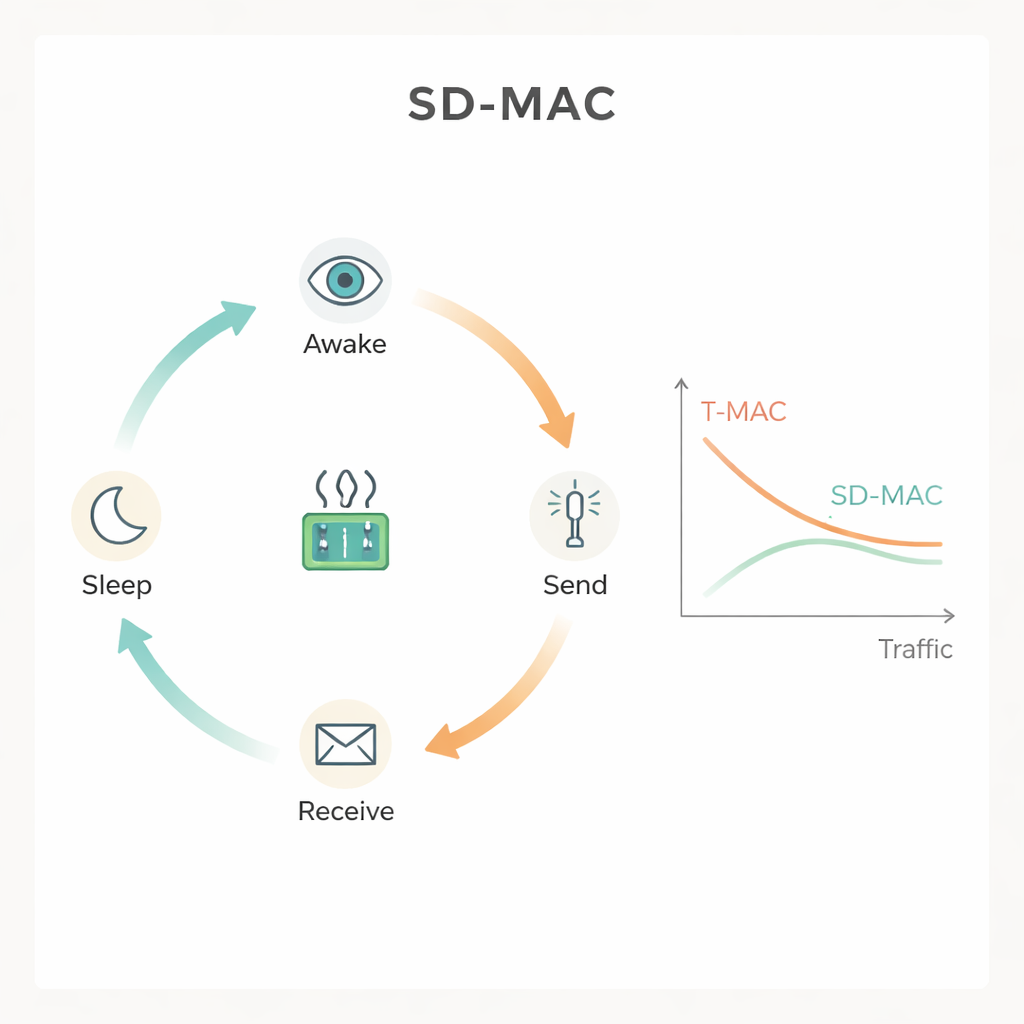
The SD-MAC protocol introduced in this work takes a different approach. Each sensor node keeps a lightweight count of how many messages it hears during a short listening window and converts that into a simple estimate of current traffic. Using two thresholds, the node classifies conditions as low, medium, or high traffic. Instead of changing sleep time unpredictably, SD-MAC keeps sleep intervals fixed and flexibly stretches or shrinks the awake period based on this traffic estimate. When the channel is quiet, nodes wake for a minimum time and then rest, greatly cutting idle listening. As traffic grows, the awake window expands so nodes stay active long enough to catch incoming packets and avoid early sleep. A simple probabilistic model, based on Markov chains, is used to analyze how often nodes are in each state—sleeping, listening, sending, or receiving—and how that translates into average energy use.
Putting the new scheme to the test
To see how well SD-MAC performs, the authors ran extensive computer simulations of a 50-node sensor network under different conditions: sparse reporting, moderate periodic traffic, and heavy bursts. They compared SD-MAC with classical S-MAC and T-MAC, as well as three newer research protocols that use clustering, shared time slots, or cooperative relays. Across these tests, SD-MAC consistently consumed the least energy, especially in low and medium traffic where savings of about 10% over T-MAC were observed. At the same time, it delivered a higher fraction of data packets to the central sink node, introduced less delay in accessing the radio channel, and extended the simulated network lifetime. Even when the radio link was imperfect, packets were longer, or more nodes were added, SD-MAC maintained its edge, largely because it avoids wasting energy on nodes that have nothing to send while keeping active those that do.
What this means for real-world sensor deployments
For non-specialists, the key takeaway is that simply teaching sensor nodes to listen to how busy their world is—and to adjust their waking hours accordingly—can make networks both thriftier and more reliable. Rather than hardwiring fixed sleep schedules or relying on crude timeouts, SD-MAC lets devices adapt smoothly to slow, steady reporting and sudden bursts of activity alike. This makes it attractive for real deployments, from environmental monitoring to industrial IoT, where changing conditions and long lifetimes are the norm. The authors suggest that future versions could integrate smarter traffic prediction and even machine learning, promising sensor networks that manage their own energy like a carefully budgeted household, stretching every battery as far as possible without missing important events.
Citation: Alhammad, S.M., Abbas, S., Elshewey, A.M. et al. SD-MAC protocol for wireless sensor network energy consumption. Sci Rep 16, 6452 (2026). https://doi.org/10.1038/s41598-026-37716-3
Keywords: wireless sensor networks, energy-efficient networking, duty cycling, MAC protocols, Internet of Things