Clear Sky Science · en
Exploring the impact of the innovative compound 3-(3-(4-hydroxy-2-oxo-2H-chromen-3-yl)-5-(pyridin-3-yl)-1H-pyrazol-1-yl) indolin-2-one on accelerating wound recovery
Why Faster Healing Matters
Almost everyone has experienced a cut that took longer to heal than expected, or has heard worrying stories about wounds that became infected and refused to close. As antibiotic resistance rises, doctors are searching for smarter dressings that not only protect damaged skin but also help it rebuild itself. This study presents a new laboratory-made compound, inspired by plant chemicals, that aims to do both: kill harmful germs and speed up the body’s own repair process.
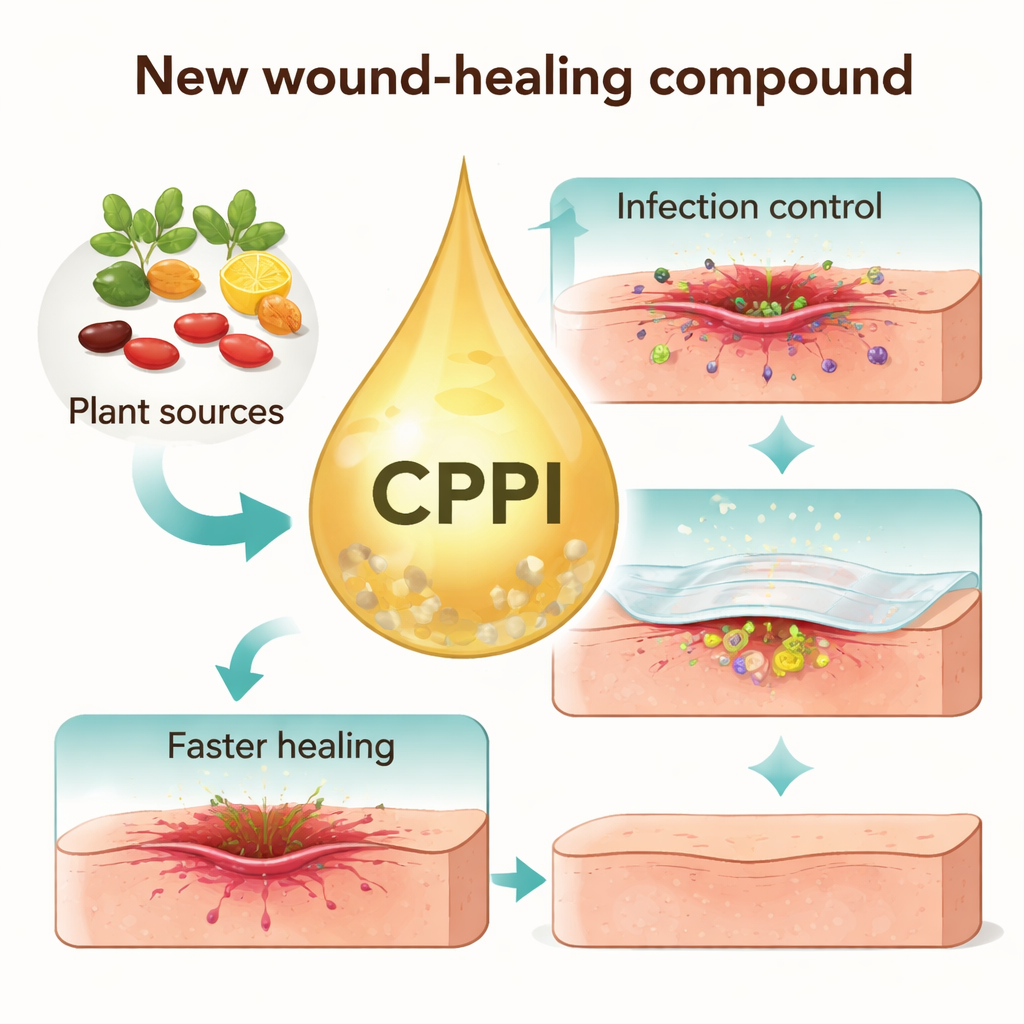
A New Helper Built from Plant-Inspired Pieces
The researchers focused on coumarin, a natural substance found in plants such as beans and some fruits, long known for its antibacterial and wound-healing potential. They designed a more complex molecule called CPPI by combining coumarin with three other ring-shaped building blocks that are common in modern medicines. These extra parts were chosen because they are known to interact well with bacterial enzymes and to influence inflammation and tissue growth. After carefully synthesizing CPPI in several chemical steps, the team used standard lab techniques to confirm that they had built exactly the structure they intended.
Fighting Off Dangerous Germs
Open wounds are ideal entry points for pathogens, especially strains of bacteria that no longer respond to many antibiotics. The scientists tested CPPI against several troublesome species, including methicillin-resistant Staphylococcus aureus (MRSA), Bacillus cereus, and carbapenem-resistant Pseudomonas aeruginosa. In petri dish experiments, CPPI stopped these bacteria from growing at lower doses than several commonly used antibiotics, although it was still less powerful than the very strong drug ciprofloxacin. It showed little effect on fungi such as Candida and Aspergillus, suggesting that its strength lies mainly in killing bacteria rather than acting as a broad antifungal agent.
Helping Skin Cells Close the Gap
Stopping infection is only half the battle; the skin must also rebuild itself. To see whether CPPI could support this process, the team used a “scratch” test with human skin fibroblast cells. They grew a flat layer of cells, scraped a narrow gap through the middle, and watched how quickly the cells crawled back to fill it. After 24 hours, dishes treated with CPPI had closed about 91 percent of the gap, compared with roughly 71 percent closure in untreated dishes. This result indicates that CPPI encourages the very cell movements that are essential for real wounds to knit together.
Speeding Healing in Living Skin
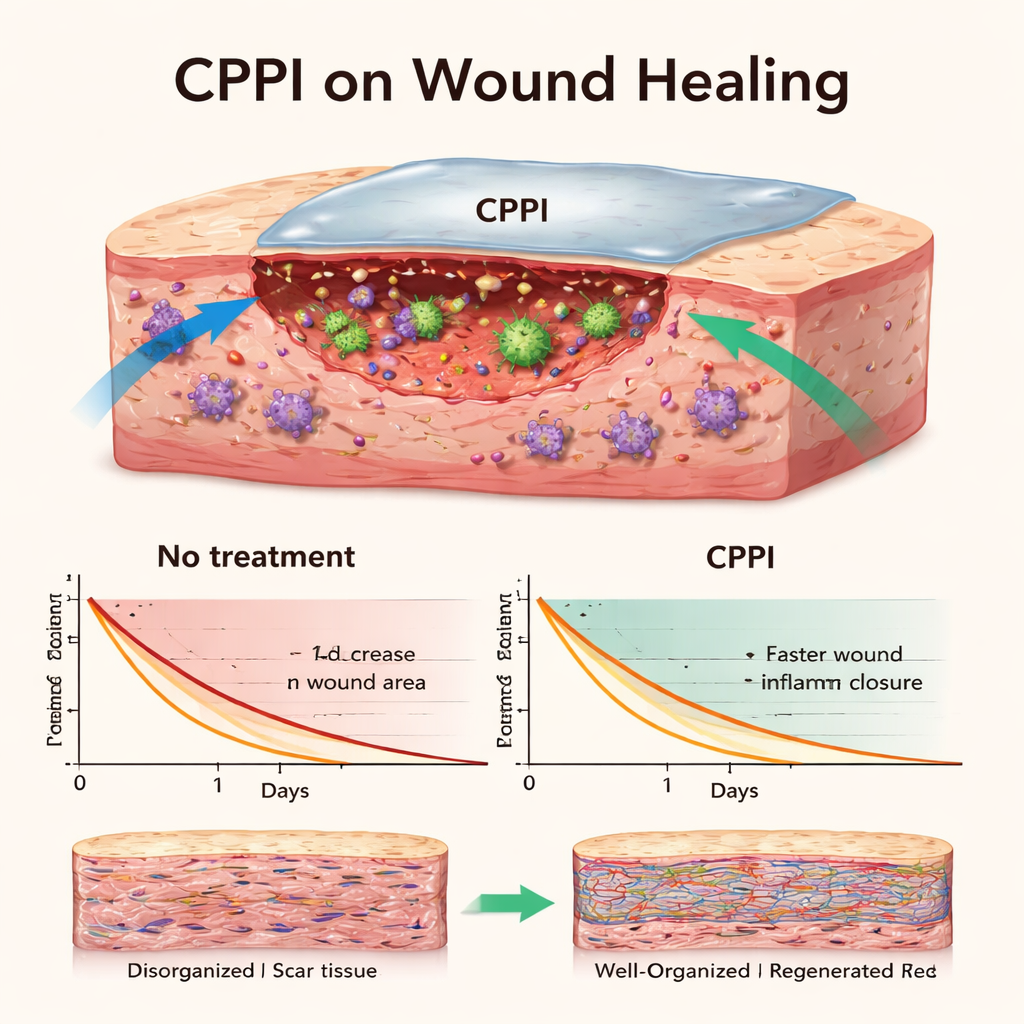
The most telling test came from experiments in rats. The researchers created small circular wounds on the animals’ backs, then left one group untreated and applied CPPI to the other group several times over two weeks. Photographs showed that by day 14 the untreated wounds remained noticeably open, while the CPPI-treated wounds were almost fully closed, with about 97 percent reduction in area. Under the microscope, untreated skin displayed heavy scarring, lingering inflammation, and poor regrowth of the outer layer. In contrast, CPPI-treated skin had a continuous new surface, thicker layers of regenerated tissue, and strong signals of vascular endothelial growth factor—a molecule associated with the growth of new blood vessels that nourish healing tissue.
Peeking Under the Molecular Hood
To understand why CPPI might be so effective, the team turned to computer simulations. They modeled how the compound fits into proteins involved in inflammation and tissue repair, particularly members of the MAP kinase family, which help control cell growth and stress responses. The virtual docking studies suggested that CPPI binds tightly and stably to one of these proteins, MAPK1, forming several chemical contacts that would be expected to alter its activity. Long, nanosecond-scale simulations indicated that the protein–compound complex remains stable without disrupting the overall protein structure, supporting the idea that CPPI could fine-tune signaling pathways that favor orderly wound healing.
What This Could Mean for Future Dressings
Taken together, the results suggest that CPPI could form the basis of next-generation wound dressings that both shield injuries from dangerous bacteria and actively encourage skin to repair itself more quickly and cleanly. While these findings are still at the experimental stage and far from clinical use in people, they point toward a promising strategy: building multi-tasking molecules, inspired by natural products, that combine antimicrobial strength with direct support for the body’s own healing machinery.
Citation: Sabt, A., Abdelmegeed, H., Abdel-Razik, AR.H. et al. Exploring the impact of the innovative compound 3-(3-(4-hydroxy-2-oxo-2H-chromen-3-yl)-5-(pyridin-3-yl)-1H-pyrazol-1-yl) indolin-2-one on accelerating wound recovery. Sci Rep 16, 7489 (2026). https://doi.org/10.1038/s41598-026-37714-5
Keywords: wound healing, antibacterial, coumarin, skin regeneration, drug design