Clear Sky Science · en
Distributed generation and shunt capacitor allocation in radial distribution power networks using a hybrid optimization approach
Keeping the Lights On More Efficiently
As our homes, offices, and factories plug in more devices and adopt electric vehicles and rooftop solar panels, the neighborhood wires that deliver electricity are being pushed to their limits. This paper explores how utilities can place small local power sources and simple electronic devices along their distribution lines so that less energy is wasted as heat, voltages stay within safe bounds, and operating costs fall—all without rebuilding the entire grid.
Small Power Plants in Your Neighborhood
Traditional electricity systems rely on a few large power plants sending energy over long distances. Today, however, many networks are turning into "smart" grids that welcome smaller sources of power, known as distributed generation, or DG. These might be solar farms, wind turbines, or compact gas units located closer to where people actually use electricity. Because they sit near homes and businesses, DG units can sharply cut the energy lost along power lines and improve the reliability of supply, especially in fast-growing regions.
Why Simple Capacitors Matter
Alongside these small generators, utilities can install shunt capacitors—relatively inexpensive devices that help balance the flow of power by supplying what engineers call "reactive" power. While that term sounds technical, the idea is simple: when many motors and appliances are running, they tug on the voltage, causing it to sag. Capacitors act a bit like shock absorbers, pushing back to keep voltages within a healthy band. Placed in the right spots, they reduce waste and help prevent flickering lights or equipment problems at the ends of long, heavily loaded lines. 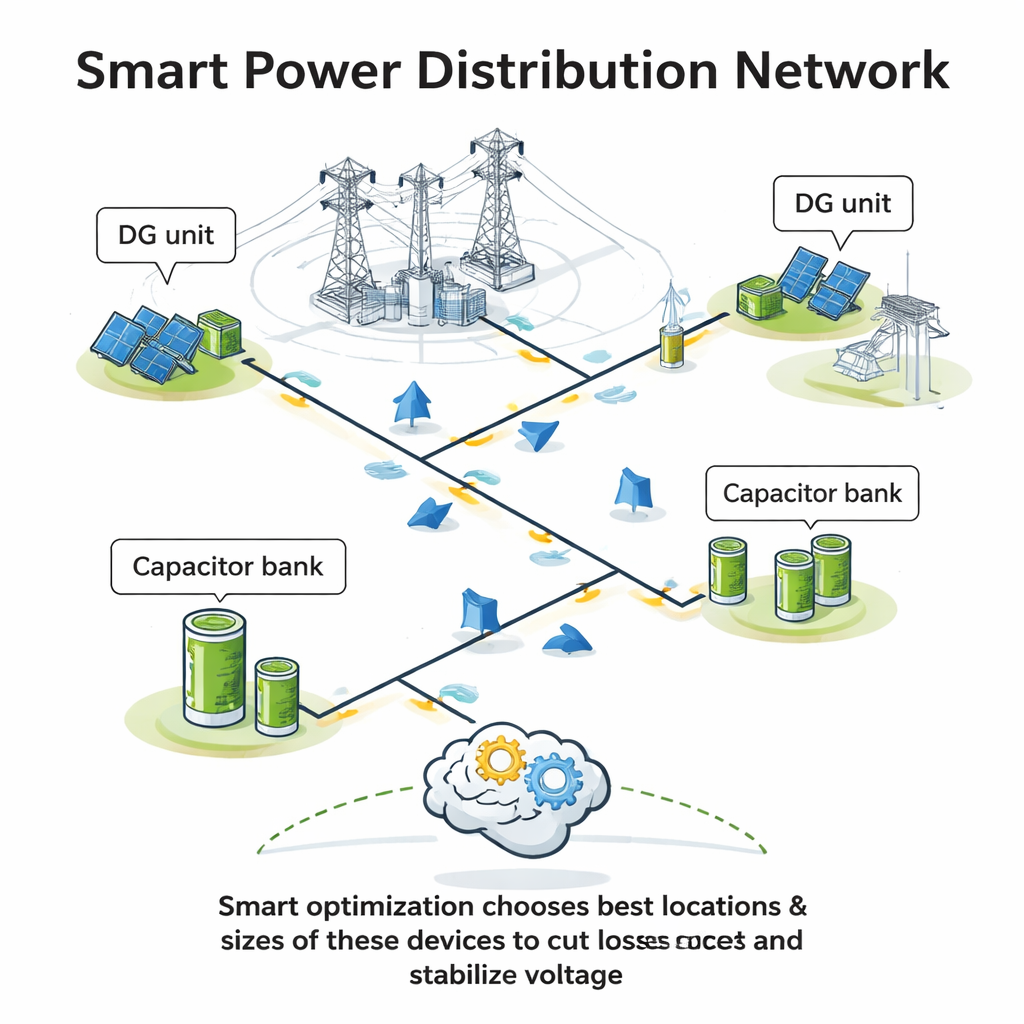
Nature-Inspired Search for Best Locations
Finding the best combination of DG locations, sizes, and capacitor placements in a real network is far too complex to try by hand. This study introduces a hybrid search method called the Hybrid Whale–Osprey Algorithm (HWOA), inspired by how whales and ospreys hunt. The "whale" part performs a broad, global search over many possible configurations, while the "osprey" part zooms in to finely polish promising candidates. By combining these two behaviors, the method avoids getting stuck in second-best solutions and can handle several goals at once: cutting power losses, keeping voltages close to their desired level, and limiting operating costs.
Testing on Realistic Network Models
The authors tested their hybrid approach on three widely used models of distribution systems, containing 33, 69, and 118 connection points, or buses. They compared cases with no added equipment, only DG units, only capacitors, and different combinations of both. When a single DG and a single capacitor were optimally placed in the 33-bus system, total active power loss fell by more than three-quarters, and the worst-case voltage rose from just over 90% of the target level to more than 97%. With two DGs and two capacitors, losses dropped by almost 90%. Similar patterns appeared in the 69-bus and much larger 118-bus networks: multiple, well-placed small generators and capacitors dramatically lowered losses and raised the minimum voltage, demonstrating that the method scales to complex grids.
Handling Uncertainty and Multiple Goals
Real power systems face constantly changing demand, so the team also stressed their method by increasing network loads well beyond their normal values. Even under this heavier and more uncertain operation, coordinated DG and capacitor placement using the hybrid algorithm kept voltages above critical thresholds while still delivering sizable loss reductions. In further tests, the method balanced several objectives at once—minimizing losses, limiting voltage swings, and reducing overall operating cost. It found solutions that trimmed losses by more than half and improved voltage quality, while keeping cost increases modest compared to less efficient layouts. 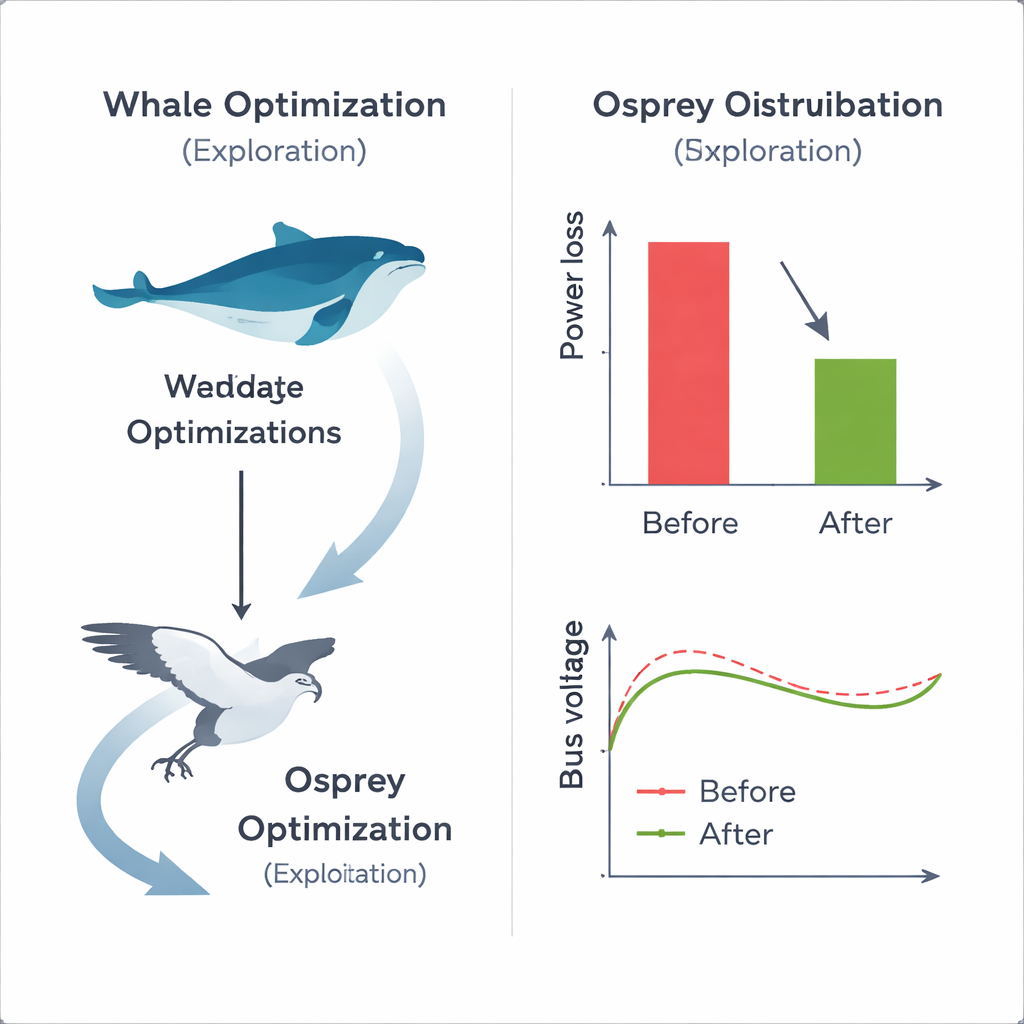
What This Means for the Future Grid
For non-specialists, the takeaway is straightforward: by combining many small power sources with simple support devices, and by using clever, nature-inspired software to decide where they should go, utilities can squeeze far more performance out of existing wires. The proposed hybrid Whale–Osprey method consistently outperformed several well-known optimization techniques, especially on large and difficult problems, and remained stable even when demand patterns were uncertain. Approaches like this can help modern power networks cut waste, keep voltages steady, and integrate more renewable energy, all while delaying costly infrastructure upgrades.
Citation: Sundar, R., Ashokaraju, D., Dharmaraj, T. et al. Distributed generation and shunt capacitor allocation in radial distribution power networks using a hybrid optimization approach. Sci Rep 16, 6299 (2026). https://doi.org/10.1038/s41598-026-37713-6
Keywords: smart grid, distributed generation, loss reduction, voltage control, metaheuristic optimization