Clear Sky Science · en
Machine learning assisted malaria detection using photonic crystal fibre optical sensors
Why this matters for everyday health
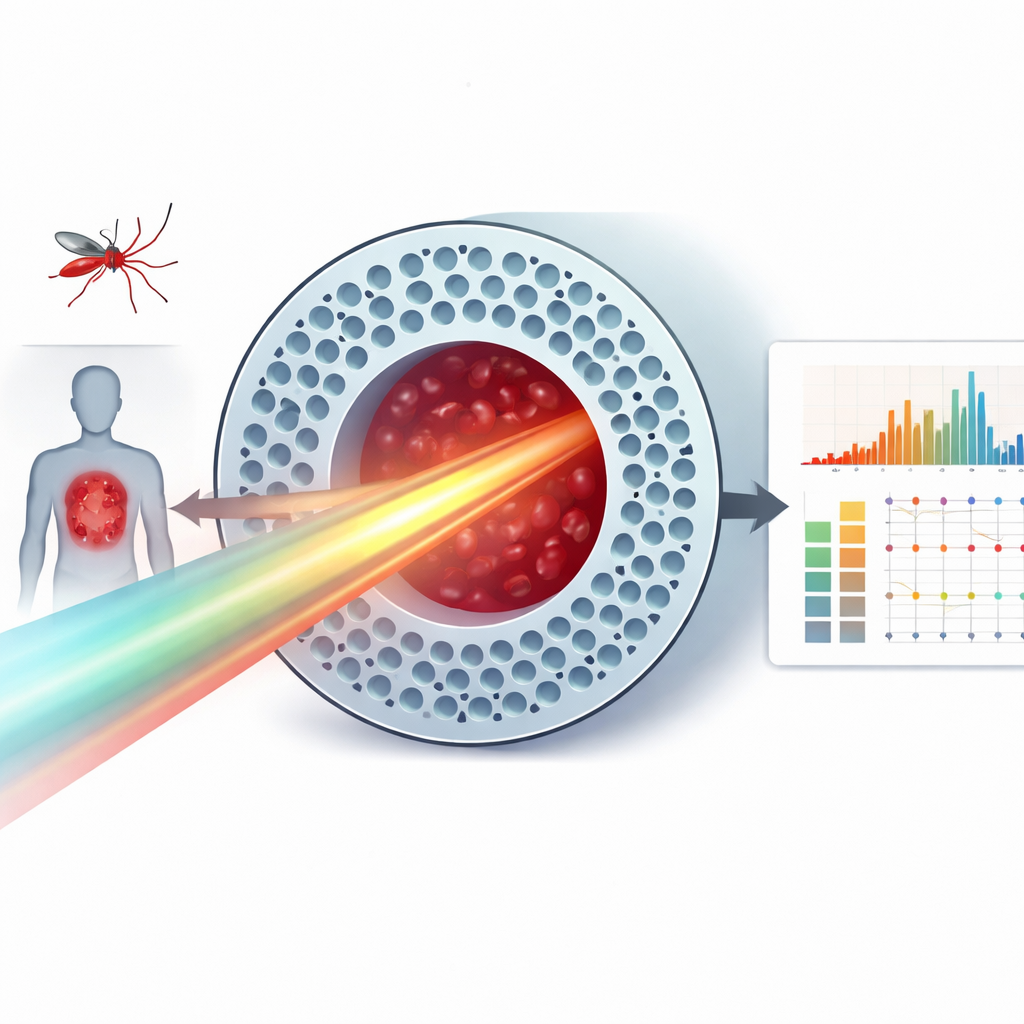
Malaria still kills hundreds of thousands of people each year, especially in tropical regions where access to fast, reliable testing can be limited. This paper describes a new way to spot malaria in blood using tiny light-guiding fibers and smart computer algorithms. Instead of relying on slow, microscope-based checks, the approach turns subtle changes in infected red blood cells into clear optical signals that machines can read, opening a path toward quick, portable, and highly sensitive diagnosis.
Seeing malaria through changes in blood
When malaria parasites invade the body, they settle inside red blood cells and pass through several stages called ring, trophozoite, and schizont. As they grow, they quietly reshape the cells from the inside, changing their structure and how they interact with light. Healthy red blood cells bend and slow light in a fairly uniform way, while infected cells become optically uneven. The authors use these tiny optical shifts as a fingerprint: by measuring how light behaves as it passes through blood, they can tell whether cells are healthy or at a particular stage of infection.
A tiny fiber as a smart test tube
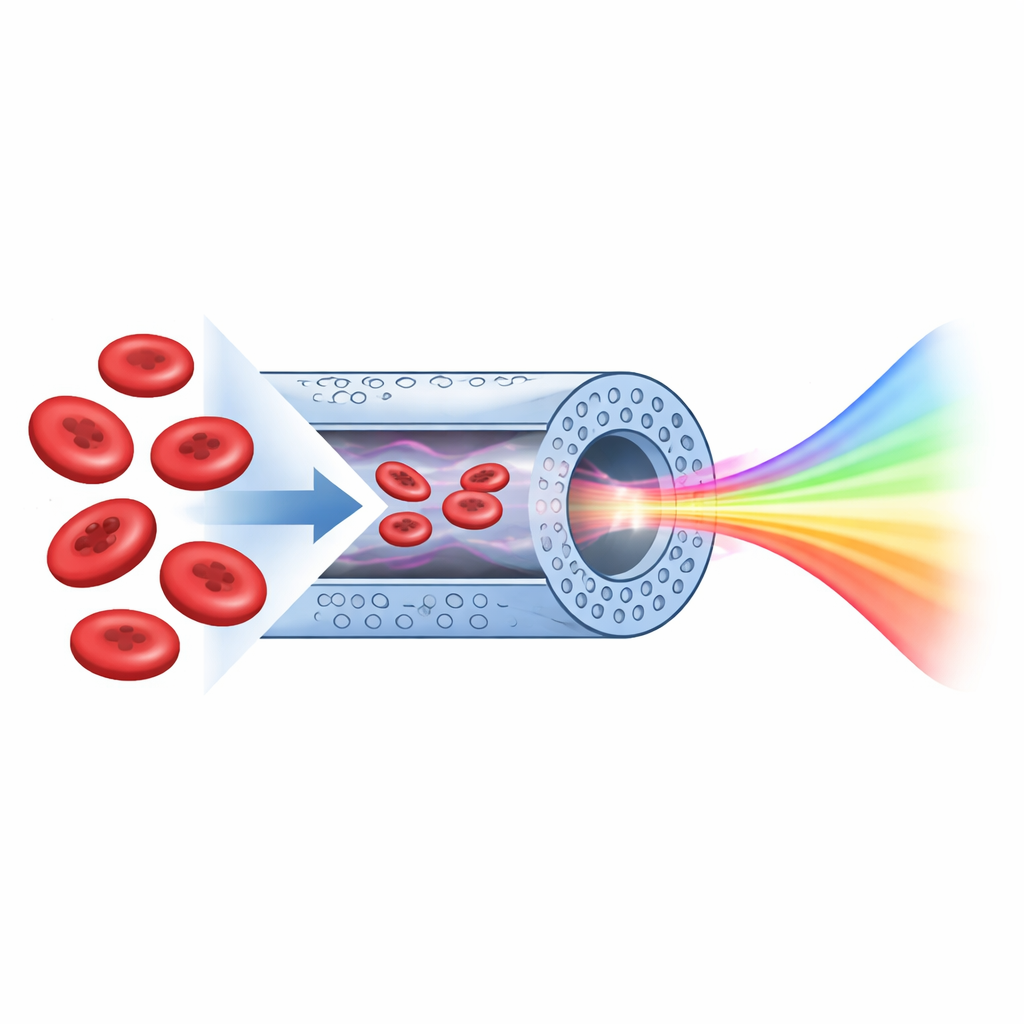
At the heart of the work is a special kind of optical fiber called a photonic crystal fiber. Unlike familiar glass fibers used for internet cables, this one has a hollow center surrounded by five rings of regularly spaced microscopic holes in a plastic known as Topas. Blood is introduced into the hollow core, where it directly interacts with a beam of light in the terahertz range, a part of the spectrum between microwaves and infrared. The carefully arranged holes around the core trap and steer this light with very little loss, forcing a strong interaction between the beam and the blood so that even slight changes in the cells are reflected in the transmitted signal.
Turning light shifts into clear disease signals
Using detailed computer simulations, the team shows how their fiber design converts differences in infected and healthy blood into shifts in the color (wavelength) of the light that makes it through. Across the key stages of malaria, the refractive index of red blood cells—that is, how strongly they bend light—changes only slightly, yet the fiber magnifies these shifts into easily detected movements of resonance peaks in the spectrum. The sensor achieves relative sensitivities above 95% for all stages, with particularly strong performance at a terahertz frequency of 2.2 trillion cycles per second. At the same time, the loss of light along the fiber remains extremely low, meaning the signal stays strong over useful distances and can be measured accurately with standard optical instruments.
Built for real-world use and robust design
The authors carefully tune the fiber’s geometry—such as the size and spacing of the air holes—to balance high sensitivity with mechanical strength and ease of fabrication. They also test how small manufacturing errors would affect performance and find that the sensor remains stable even when key dimensions vary by a few percent. The structure can be made using existing techniques and filled selectively with blood samples, making it practical for deployment outside sophisticated laboratories. Because it works without chemical labels or dyes, the method is well suited to repeat testing and could be adapted for other diseases that subtly alter blood’s optical properties.
Adding machine learning to sharpen diagnosis
Beyond the physical sensor, the paper outlines how modern machine learning can help interpret the rich but complex optical data the fiber produces. Methods such as meta-learning, convolutional neural networks, and recurrent networks can learn to distinguish patterns associated with different stages of infection, even when only small amounts of labeled data are available. This combination of sensitive optical hardware and adaptive data analysis opens the door to compact, portable systems that deliver rapid, automated malaria diagnoses at the patient’s side.
What this could mean for patients
In plain terms, the study shows that a carefully engineered hollow fiber can act like a smart straw: as blood flows through its center, the way light emerges reveals whether malaria parasites are present and how far the infection has progressed. Because the signals are strong, the design is robust, and the analysis can be automated with machine learning, this approach could underpin next-generation tests that are faster, more sensitive, and more accessible than traditional methods. If brought into practice, it could help doctors detect malaria earlier and more reliably, ultimately saving lives in the regions that need it most.
Citation: Abdullah-Al-Shafi, M., Sen, S. & Mubassera, M. Machine learning assisted malaria detection using photonic crystal fibre optical sensors. Sci Rep 16, 8320 (2026). https://doi.org/10.1038/s41598-026-37709-2
Keywords: malaria diagnostics, photonic crystal fiber, terahertz sensing, biosensor, machine learning