Clear Sky Science · en
Distinct changes in riparian sediment microbial communities with depth and time since dam removal
Why the Life Beneath Riverbanks Matters
When we think about dams, we usually picture changes we can see: widened streams, still ponds, or newly exposed channels after a dam is removed. But some of the biggest shifts happen out of sight, in the mud and sand of the riverbanks. This study peered several meters below the surface along small rivers in the U.S. mid-Atlantic to ask how the tiny organisms living there respond when long-standing milldams are built and, centuries later, torn down. Because these microbes help control the fate of nutrients like nitrogen and carbon, their hidden reshuffling can affect water quality, greenhouse gases, and the long-term success of river restoration projects. 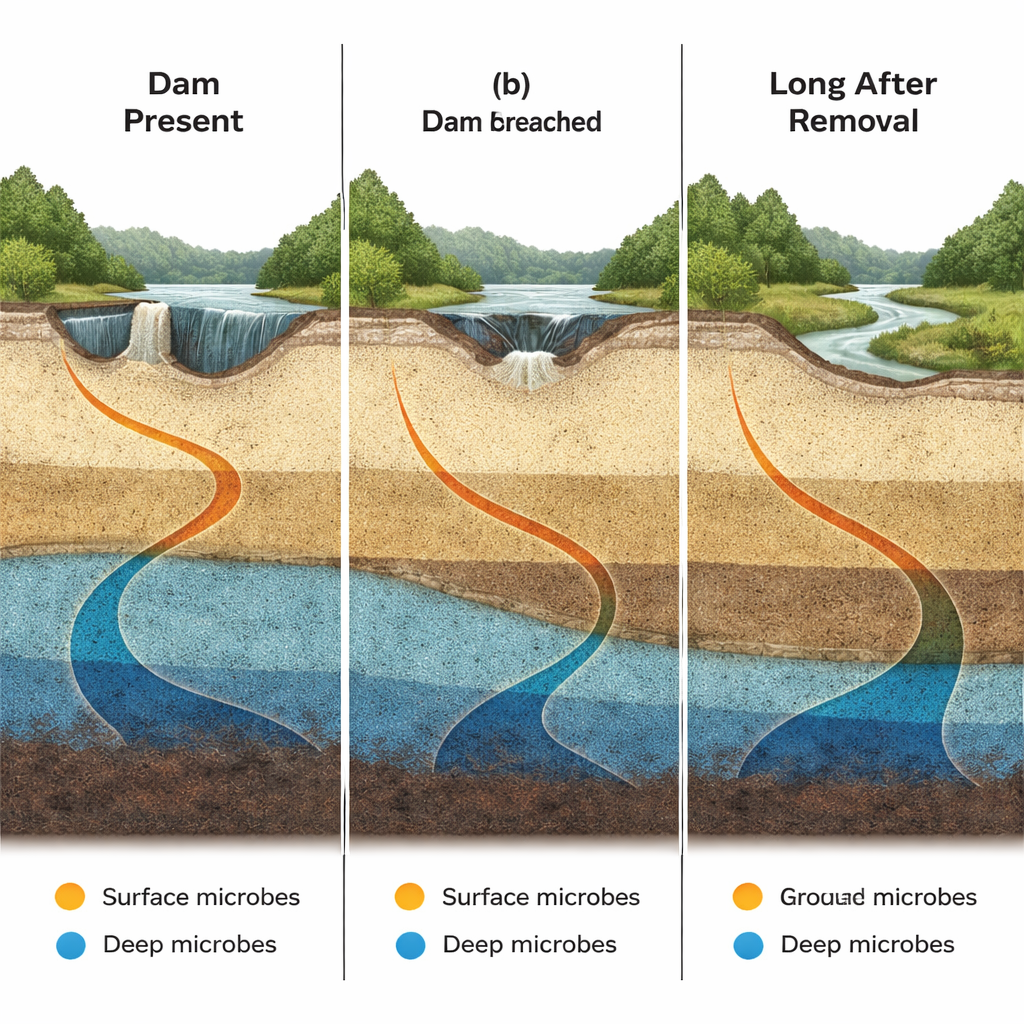
Layered Landscapes, Layered Microbes
The riverbanks upstream of old milldams are anything but simple piles of mud. Over thousands of years, natural wetlands built up organic-rich floodplain soils. In the last few centuries, European-style dams trapped huge amounts of eroded upland sediment on top of those ancient layers, creating thick terraces of "legacy" deposits. The result is a vertical stack: coarse gravels and buried wetland soils at the bottom, capped by finer silts and clays, and then newer sandy material near the surface. Each layer offers a distinct habitat, from damp, oxygen-poor depths to better-aerated upper zones. The researchers used DNA sequencing and other measurements at 12 dammed and formerly dammed sites to see how microbial communities sort themselves along this vertical maze.
Deep, Dark Zones Harbor Different Micro Life
Across all sites, total bacterial biomass generally declined with depth, but who was living where shifted in striking ways. Near the surface, communities were dominated by aerobic, fast-growing bacteria that thrive on fresher, more easily decomposed organic matter and can participate in nitrogen transformations that produce nitrate. Deeper down, especially below the groundwater level, anaerobic specialists took over. These included groups known to break down tougher, more resistant carbon compounds and others able to use iron and sulfur instead of oxygen to power their metabolisms. Buried organic-rich and iron-rich horizons, representing ancient wetland soils, hosted particularly distinctive assemblages. There, microbes linked to iron reduction and a nitrogen pathway that produces ammonium flourished, helping explain why those deep layers often contain high levels of dissolved iron and ammonium.
What Happens After a Dam Comes Down
Dam removal dramatically reshapes these hidden ecosystems. When a milldam is breached, the stream cuts down into its accumulated sediments and the former ponded terrace begins to drain and oxidize. In the years immediately following removal, the study found that microbial communities near the surface become more diverse and start to resemble those of ordinary, well-drained soils. Aerobic and nitrogen-cycling microbes become more common in upper and mid-depth layers, while some strictly anaerobic, iron- and sulfur-reducing groups shrink in abundance, particularly in the previously saturated middle and lower zones. Over a chronosequence spanning from newly breached sites to one with more than two centuries of drainage, the authors observed a shift away from the strongly anoxic, dam-influenced microbiome toward one characteristic of natural floodplains and uplands.
Depth, Water, and Chemistry Steer the Transition
These changes do not unfold uniformly from top to bottom. Groundwater level emerged as a key organizing force: above it, drier sediments with more oxygen and nitrate supported communities rich in surface-loving bacteria; below it, wetter, low-oxygen conditions favored anaerobes linked to iron cycling and the breakdown of old organic matter. Other soil properties—such as texture, pH, and the forms of iron present—also helped explain where different microbes thrived. Because some of these characteristics respond quickly to drainage while others change only slowly, the microbial makeover proceeds at different speeds with depth. The result is a complex but directional shift, as communities in surface and subsurface layers gradually converge on a new, more oxygenated steady state. 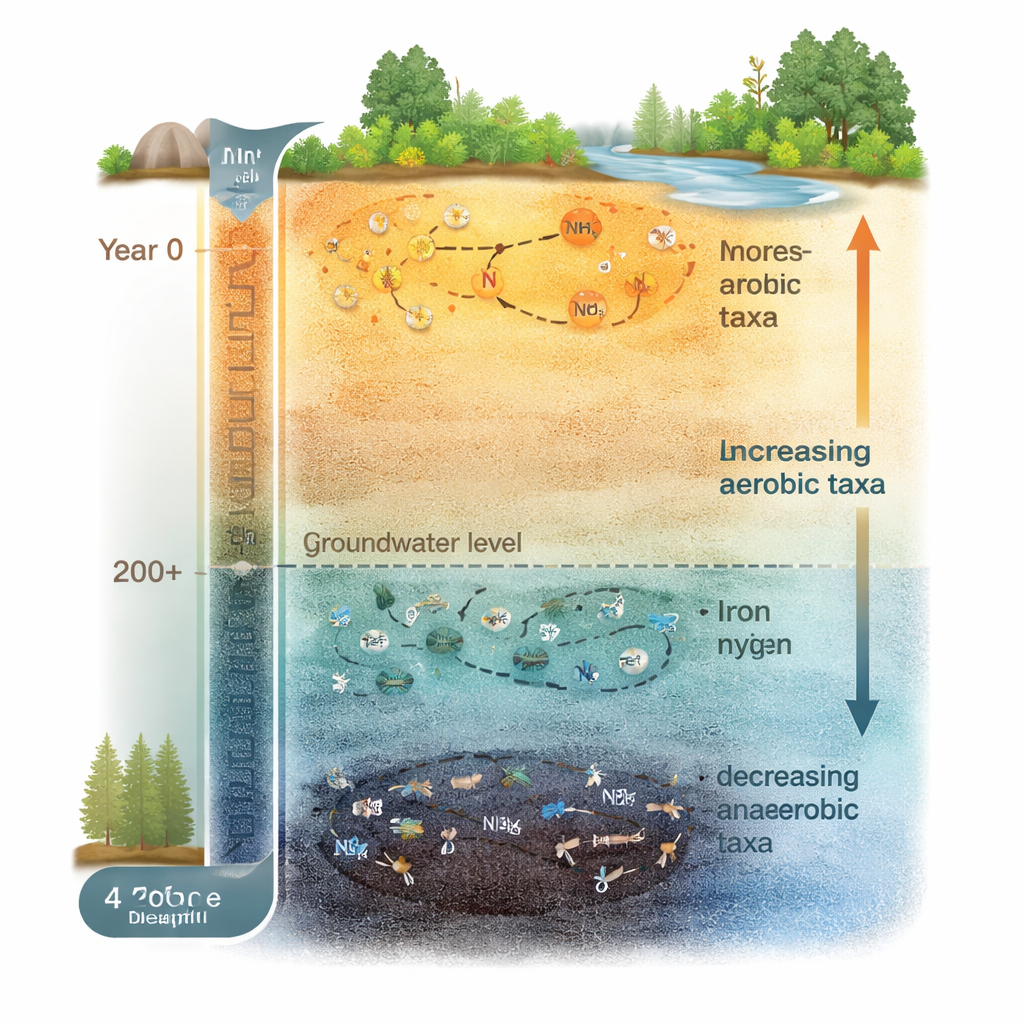
Implications for Cleaner Rivers and Recovery Timelines
For environmental managers weighing dam removal, this subterranean story carries practical lessons. Under intact dams, deep, waterlogged sediments can act as long-term sources of ammonium and dissolved iron, driven by anaerobic microbes that recycle nitrogen rather than removing it from the system. After removal, microbial communities reorganize, favoring organisms that convert ammonium to nitrate and, ultimately, forms that can be lost to the atmosphere, reducing the risk of downstream pollution. The study suggests that within about a decade, riparian microbes begin trending toward healthier, more natural configurations, though full recovery likely takes longer and varies by depth and site. By tracking how these microscopic engineers respond over time, we gain a powerful tool for predicting—and improving—the water quality outcomes of river restoration projects.
Citation: Moore, E.R., Rahman, M.M., Galella, J.G. et al. Distinct changes in riparian sediment microbial communities with depth and time since dam removal. Sci Rep 16, 6885 (2026). https://doi.org/10.1038/s41598-026-37708-3
Keywords: dam removal, riparian microbes, river restoration, nitrogen cycling, legacy sediments